 Sofia Rossi
Do the Guggenheim the way Frank Lloyd Wright designed it to be done: take the elevator to the top of the rotunda, step out under the great skylight, and walk one continuous ramp all the way down, letting each bay of art arrive in sequence. That single decision organises everything else about a visit to the Solomon R. Guggenheim Museum at 1071 Fifth Avenue. This guide, checked against the museum’s own visitor pages on 24 November 2026, covers the ramp order, the current hours and prices, and one important correction: the famous pay what you wish window is no longer on Saturdays. It now runs on Tuesdays and Sundays, from 4 to 5:30 pm. Plan around the real window, not the one in older guides.
Quick Facts
Address: 1071 Fifth Avenue at 88th Street, New York
Hours: Open every day, 10:30 am to 5:30 pm, on the museum’s current visitor page
Admission: Adults $30; students and seniors 65 and over $19; visitors with disabilities $19 with carepartners free; children under 12 free
Pay What You Wish: Tuesdays and Sundays, 4 to 5:30 pm. Not Saturdays
Last tickets: Issued about 15 minutes before closing
Getting there: Subway lines 4, 5, 6 and Q; buses M1, M2, M3 and M4 on Madison or Fifth Avenue
Facts checked: 24 November 2026, on guggenheim.org
Why should you start at the top and walk down?
The Guggenheim, which opened in 1959 as Wright’s only completed museum building, is a single spiral gallery wrapped around an open rotunda. There are no floors in the conventional sense and no route to optimise, because the building is the route. Riding the elevator to the top and descending the gentle ramp means gravity works for you, the exhibition unfolds in the order it was hung, and you can look across the rotunda at every level to see where you have been and what is still below.
Walking up instead is the most common first timer error. It turns a flowing descent into a climb, breaks the sequence of the hang, and leaves the skylight view, the moment the whole building explains itself, for the tired end of the visit rather than the fresh start. Start at the top, look up at the oculus first, then begin. The tower galleries and annex spaces branch off the ramp and can be taken as they come; the Thannhauser Collection, the museum’s holding of Impressionist, Post Impressionist and modern French works by artists including Degas, Manet and Van Gogh, deserves a deliberate stop rather than a drift past.
Is pay what you wish really no longer on Saturday?
Correct, and this is where older advice will cost you money. The museum’s current visitor page lists Pay What You Wish on Tuesdays and Sundays, from 4 to 5:30 pm, the last ninety minutes of the museum day. Saturday now runs at full price like any other day. The board title of guides written years ago, promising free Saturday hours, describes a programme that has moved.
Used well, the Tuesday or Sunday window is still the best value on Museum Mile: arrive for a 4 pm entry, ride straight to the top, and walk the ramp down as the light changes, finishing by the 5:30 pm close. It is a compressed visit, suited to the ramp and one collection stop, not to a slow full tour. Note the holiday variation the museum itself publishes: during the extended hours days of 26 to 30 December, when the museum opens 9:30 am to 6:30 pm, the pay what you wish hours on 27 and 29 December shift to 5 to 6:30 pm. The museum is closed on Thanksgiving Day, Thursday 26 November, and on Christmas Day, and closes early at 4 pm on 24 December. Recheck the visitor page in the week of any holiday visit, because these are exactly the details that move.
Which bays and ramps might be closed on your visit?
A few times a year the museum installs new exhibitions, and during those changeovers certain ramps and bays close to the public. This is the quiet risk in a Guggenheim visit: the building is one route, so a closed section is not a detour, it is a gap in the spiral. The defence is simple and takes two minutes. Before booking, check the museum’s current exhibitions and visitor pages for installation notices covering your date, and if a major ramp exhibition is mid changeover, either accept a partial ramp knowingly or shift the visit by a week.
The same check protects the top down plan itself. On a normal day the full ramp is open and the route in this guide works exactly as written. On a changeover day, ask at the desk which levels are open before riding up, and reorder around the answer. Staff treat this as a routine question, because it is one. Visitors combining the Guggenheim with the other Museum Mile anchor should read our route for the Metropolitan Museum without the overwhelm and give each building its own half day rather than sprinting both.
How should you pace the rest of the visit?
Budget ninety minutes for a clean ramp descent with the Thannhauser stop, and two hours if the temporary exhibition is a major one. The last tickets are issued about fifteen minutes before the 5:30 pm close, but arriving after 4 pm on a full price day buys a rushed hour, not a visit. Mornings at opening are the calmest full price window.
Two practical notes from the museum’s own pages. The digital guide runs on the Bloomberg Connects app and can be loaded before arrival, which saves the first ten minutes of orientation. Cafe Rebay, overlooking Central Park, serves from 10:30 am to 4 pm, so it is a mid visit pause rather than a post visit plan. The museum sits directly across Fifth Avenue from Central Park at the reservoir, and the natural pairing is a park walk after, not another museum. If New York is new to you, our New York in three days first timer itinerary places this museum day inside a wider first visit.
What should you actually look for as you descend the ramp?
Look at the building as much as the art, because the ramp rewards both readings. The bays set into the spiral are shallow and windowless by design, so works are seen close, in sequence, under light falling from the great skylight rather than from windows. Notice how the rotunda stays visible across the void at almost every step: the Guggenheim is one of the few museums where you can see the visitors on the level above and below you, and the exhibition you have just walked, all in a single glance.
The museum’s founding collection gives the descent its spine. Solomon R. Guggenheim’s holdings centred on nonobjective painting, and the museum remains especially associated with Kandinsky, whose work it holds in depth, alongside the wider modern canon carried in the Thannhauser galleries. A practical way to walk it is to give the ramp itself the first pass without stopping for labels, reading the architecture and the hang as one composition, then use the remaining time on the way down to return to the two or three bays that pulled hardest. First timers who reverse that order, reading every label from the top, often reach the ground floor having seen much and remembered little.
How does the Guggenheim fit into a Museum Mile day?
Give it the morning or the late afternoon, never the leftovers. The museum’s compact scale is its gift to an itinerary: unlike the encyclopedic neighbours along Fifth Avenue, it can be done completely, top to bottom, in a single focused visit, which makes it the ideal anchor for a Museum Mile day that also includes a Central Park crossing or a long lunch. Pair it with the park in good weather and with the pay what you wish window on a Tuesday or Sunday when the budget matters, and it becomes the most efficient major museum visit in the city.
Frequently Asked Questions
How much does the Guggenheim cost?
General admission is $30 for adults. Students and seniors aged 65 and over with ID pay $19, visitors with disabilities pay $19 with carepartners free, and children under 12 enter free. Members enter free. Prices checked on the museum’s visitor page on 24 November 2026.
When is pay what you wish at the Guggenheim?
Tuesdays and Sundays, from 4 to 5:30 pm. It no longer runs on Saturdays. During the extended holiday hours of 26 to 30 December, the sessions on 27 and 29 December run 5 to 6:30 pm instead.
What are the Guggenheim’s opening hours?
Every day from 10:30 am to 5:30 pm, with last tickets issued about fifteen minutes before closing. The museum closes on Thanksgiving Day and Christmas Day, and closes early, at 4 pm, on 24 December.
Should you walk the ramp up or down?
Down. Take the elevator to the top, look up at the skylight, and descend the continuous ramp so the exhibition arrives in sequence and the walking is all gentle downhill.
How long does a Guggenheim visit take?
Ninety minutes covers the full ramp and the Thannhauser Collection at a steady pace. Allow two hours during a major temporary exhibition, and check the museum’s pages beforehand for ramp closures during exhibition changeovers.
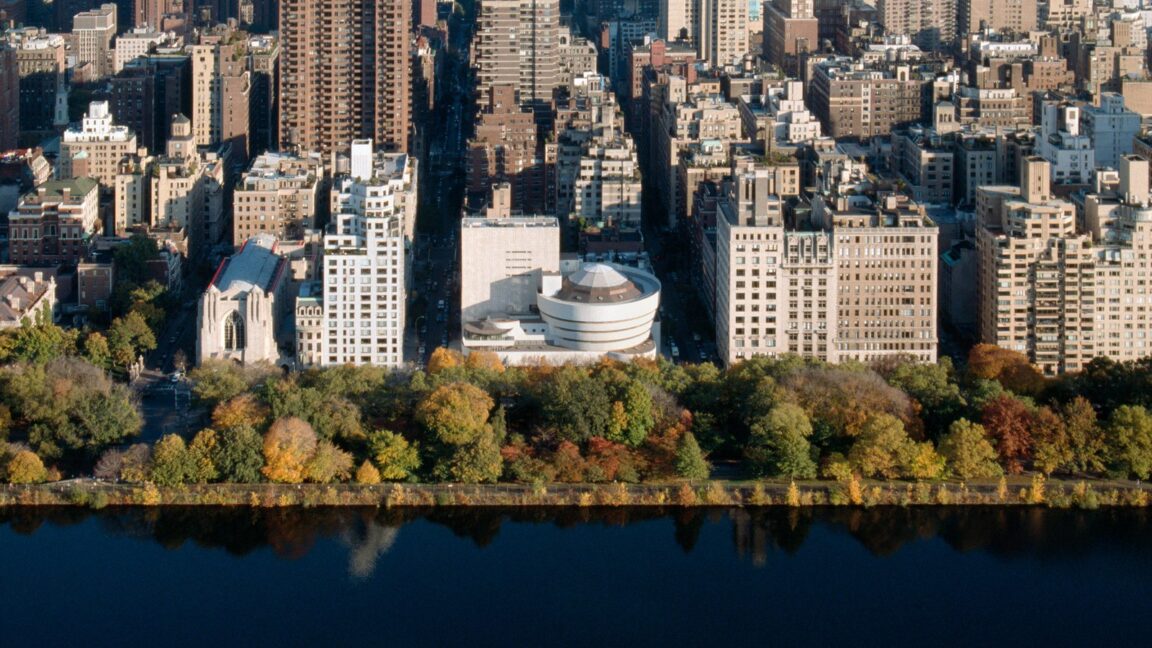
Photo: The Guggenheim’s white spiral seen from above Central Park, with the museum tower behind it. Image: Solomon R. Guggenheim Foundation, via guggenheim.org, the museum’s official website.