 James Wolfe
The Frick Collection is back in its own house, and the visit is now a two floor experience. The museum reopened at 1 East 70th Street on April 17, 2025, after its first comprehensive renovation in nearly ninety years, with the historic first floor galleries restored and the Frick family’s former private rooms on the second floor open to the public for the first time. Timed tickets are recommended rather than strictly required, general admission is $30 for adults, and the museum is closed on Tuesdays. Go on a weekday morning if you can, book the timed slot in advance, start upstairs in the new rooms while you are fresh, and save the Garden Court for the pause in the middle.
Quick Facts
Address: 1 East 70th Street at Fifth Avenue, New York, NY 10021. The Frick Art Research Library entrance is at 10 East 71st Street.
Hours: Monday and Wednesday to Sunday, 10:30 a.m. to 5:30 p.m. Closed on Tuesdays.
Admission: Adults $30, seniors 65 and over $22, visitors with disabilities $22, students with ID $17, youth ages 10 to 18 free, members free.
Age rule: Only children ages 10 and older are admitted, with no exceptions.
Booking: Timed tickets are recommended. Last tickets are sold an hour before closure, and admission includes all current special exhibitions.
Cheapest windows: Pay what you wish on Wednesdays from 1:30 to 5:30 p.m., and free Louis Vuitton First Fridays evenings, 5:30 to 9:00 p.m. on the first Friday of most months.
Photography: Permitted only in the Garden Court. The galleries have no wall labels, by design.
What actually changed in the reopening?
The Frick closed its Fifth Avenue home in 2021 and showed the collection for three years at Frick Madison, the Breuer building five blocks north, which closed in March 2024. The renovation that followed, designed by Selldorf Architects with Beyer Blinder Belle as executive architect, was the institution’s first comprehensive project in nearly ninety years. The point of it was not to make the Frick bigger in spirit. It was to restore the first floor rooms to their domestic character, improve the infrastructure invisibly, and add the space a modern museum needs, including new special exhibition galleries, education space and an auditorium, without breaking the house illusion that makes the place unlike any other museum in the city.
The headline change for a returning visitor is upstairs. Rooms that were the family’s private quarters, never before open as galleries, now hold smaller paintings, sculpture, decorative arts and displays including clocks and watches and an Impressionist room. Works that spent decades in storage or in tight corners finally have walls. The Boucher Room has returned to its original position, and the overall hang feels less like a greatest hits corridor and more like a house you are allowed to wander properly.
Which rooms should you do first?
Start on the second floor. Most visitors still enter and drift straight into the famous first floor rooms, so the new galleries are calmest in the first hour after opening, and they are the part of the museum that even Frick regulars have never seen. Give them a full half hour. Look for the smaller scale works that would be lost downstairs, and take in the odd, pleasurable fact that you are standing in bedrooms and private sitting rooms that were closed to the public for the museum’s first ninety years.
Then come down and do the first floor slowly. The Garden Court, with its fountain and plantings under glass, is the natural hinge of the visit. The permanent collection holds about 1,800 works of fine and decorative art, ranging from the Renaissance to the early twentieth century, and the first floor keeps the core of it in the rooms Henry Clay Frick shaped for it. The names on the walls, where you check them on the museum’s free mobile guide rather than on labels, run from Bellini and Titian through El Greco, Rembrandt, Vermeer, Goya, Turner, Monet, Ingres, Van Dyck and Fragonard. The Fragonard Room and the Garden Court are the two spaces first timers talk about on the way out, and both reward an unhurried ten minutes rather than a photograph and a move on. Photography, in any case, is only permitted in the Garden Court, which settles the question everywhere else.
If the Met is also on your New York list, the two museums pair well across a single Upper East Side day, and our guide to the Metropolitan Museum without the overwhelm plans that larger house in the same spirit, a route instead of a list.
How do timed tickets really work?
Plainly. The museum recommends booking a timed ticket in advance through its own site, and members simply present a membership card or confirmation email and walk in free, with no reservation needed. Tickets include every current special exhibition at no extra charge. The last tickets of the day are sold an hour before the 5:30 p.m. closure, so a spontaneous late afternoon visit is a gamble, not a plan. Ticket questions go to the admissions desk, and the museum is clear that tickets cannot be resold or transferred without authorisation.
Two discount windows are worth building a week around. On Wednesdays, admission is pay what you wish from 1:30 to 5:30 p.m. Reserve online with a minimum contribution of $5 per ticket to guarantee entry, or take your chances on site, where other contribution amounts, including less than $5, are offered when availability allows. On Louis Vuitton First Fridays, the museum opens free from 5:30 to 9:00 p.m. on the first Friday of each month except January and September. Youth ages 10 to 18 are always free, students pay $17 with ID, and the museum also participates in access programmes including Museums for All for SNAP and EBT cardholders.
Who is the reopened Frick best for, and who should skip it?
It is best for travellers who like small museums with a point of view. A full visit takes two to three hours, not a day, and the reward per hour is among the highest in New York. It suits couples, solo museum goers, and anyone who has done the big Fifth Avenue institutions and wants the quieter masterpiece. The age rule decides it for families: children under 10 are not admitted at all, so a family with younger children should put the Met, twelve blocks north, at the centre of the day instead and save the Frick for an adults only slot. Our New York in 3 days itinerary for first timers shows how the museum choice shapes day three of a first trip.
How do you get there, and what should you know on the door?
The museum stands at Fifth Avenue and East 70th Street, across from Central Park. By subway, take the 6 train to 68th Street and Lexington Avenue, or the Q train to 72nd Street and Second Avenue, then the crosstown M72 bus to Fifth Avenue if you want to shorten the walk. Northbound M1, M2, M3 and M4 buses stop at Madison Avenue and 69th Street, southbound at Fifth Avenue and 69th Street. Taxis and rideshares drop off at the main entrance at 1 East 70th Street, and there is a designated Access A Ride stop on the south corner of East 70th and Fifth. Inside, expect the domestic rules of a house museum: no wall labels, a free mobile guide and introductory video to carry the interpretation, and staff who guard the quiet. That quiet is the product. Treat the rooms like someone else’s beautiful home, because that is exactly what they were. Henry Clay Frick, the industrialist who built the house and left his collection to the public, died in 1919; the museum opened in 1935, and the 2025 reopening is the first time the whole house, upstairs included, has worked as he might have imagined a visitor experiencing it.
Frequently Asked Questions
When did the Frick Collection reopen?
The Frick reopened in its renovated Fifth Avenue home on April 17, 2025, after a renovation and enhancement project that ran from 2021 to 2025. During the closure the collection was shown at Frick Madison, which closed in March 2024.
How much does the Frick Collection cost?
General admission is $30 for adults, $22 for seniors 65 and over and for visitors with disabilities, and $17 for students with ID. Visitors ages 10 to 18 and members enter free. Admission includes all current special exhibitions.
Do you need to book Frick tickets in advance?
Timed tickets are recommended, and booking ahead is the safe choice at weekends. Members need no reservation. The last tickets each day are sold an hour before closing.
Can children visit the Frick Collection?
Only children ages 10 and older are admitted. There are no exceptions, which makes the museum an adults and older children visit rather than a family day out.
When is the Frick Collection free or cheapest?
Pay what you wish admission runs on Wednesdays from 1:30 to 5:30 p.m., with a $5 minimum per ticket for guaranteed online reservations. Louis Vuitton First Fridays are free from 5:30 to 9:00 p.m. on the first Friday of each month except January and September.
Can you take photographs inside the Frick?
Photography is permitted only in the Garden Court. It is not allowed in the galleries, which also have no wall labels, to preserve the atmosphere of the historic house.
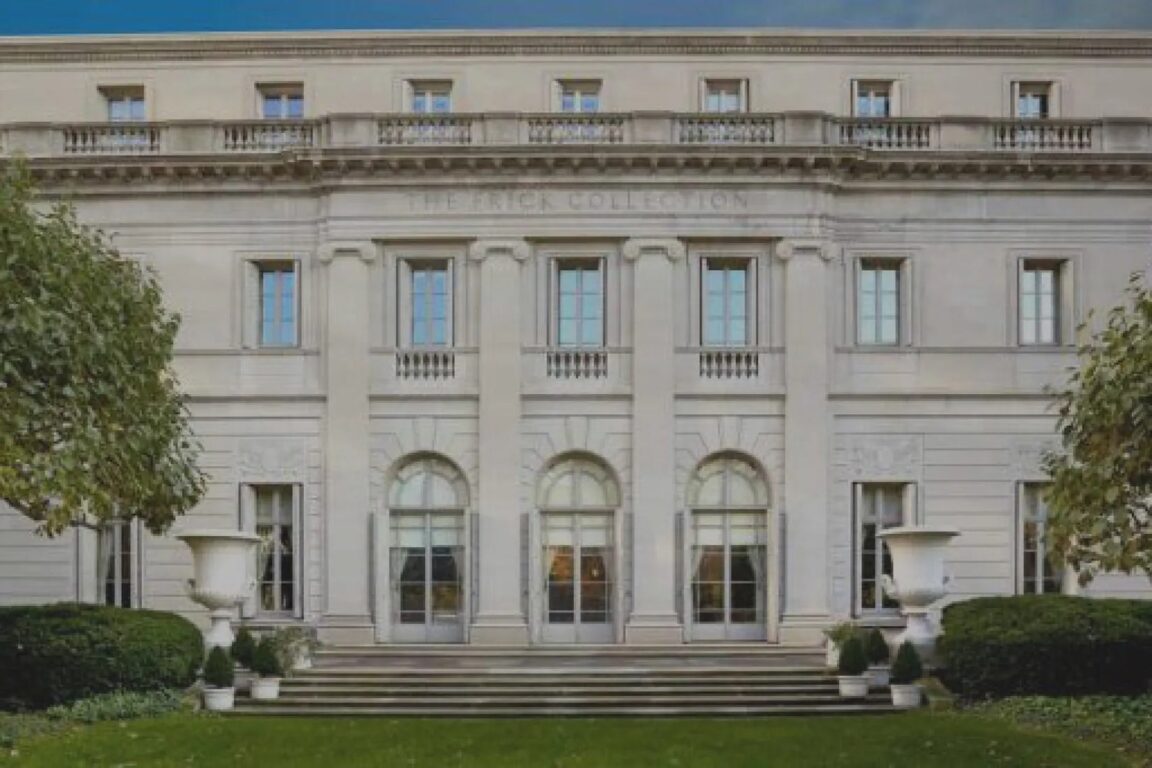
Featured image: The Fifth Avenue facade and garden front of The Frick Collection, New York, with the museum name carved above the windows. Photo by The Frick Collection, via frick.org, the museum’s official website, used with credit.