 Priya Nair
Tartu is Estonia’s second city and its oldest university town, and the way to read it is through three layers that sit within a short walk of each other: the neoclassical Town Hall Square with its leaning house and kissing students, the wooden streets of Supilinn, the Soup Town, where the streets are named after vegetables, and the student machinery of a university founded in 1632 that still sets the city’s rhythm. Most visitors day trip from Tallinn and see the square. Stay two days and the sequence below gives you the square’s rituals in the morning, the science centre and museums in the middle of the day, and the wooden districts where students actually live by evening.
Quick Facts
Where: Tartu, southern Estonia, on the Emajogi River. Estonia’s second city and its university capital.
University: The University of Tartu was founded in 1632, and the student population shapes everything from cafe hours to the queue culture of the soup kitchens.
Town Hall: The present Town Hall on Town Hall Square (Raekoja plats) is the third on the site, an early neoclassical building completed in 1789.
Carillon: The Town Hall carillon has 18 bells and plays daily at 9am, noon, 3pm, 6pm and 9pm. It is the oldest and largest of Estonia’s three carillons.
Kissing Students fountain: The fountain on the square, in place since 1998, is the city’s best known meeting point and its unofficial emblem.
Leaning House: Raekoja plats 18, built in 1793 on the edge of the medieval city wall. It now houses the Tartu Art Museum.
AHHAA Science Centre: Sadama 1, the Baltic region’s flagship hands on science centre, an easy walk from the square.
Estonian National Museum: Founded in 1909, in its current building since 2016, about 2 km from the centre, with 6,000 square metres of exhibition space.
Recent honour: Tartu was a European Capital of Culture in 2024.
What happens on Town Hall Square through the day?
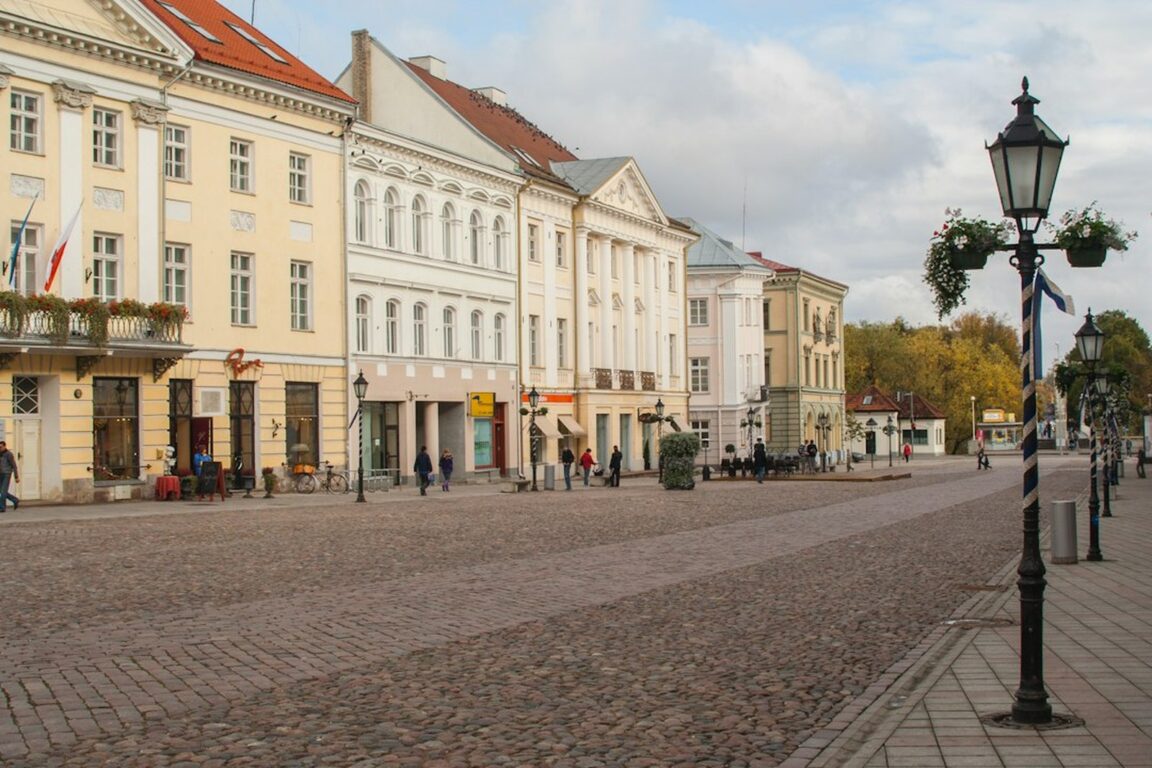
Town Hall Square, Raekoja plats, is a trapezoid rather than a true square, a sloping market space lined with neoclassical facades that grew out of the 18th century Great Market. The Town Hall that anchors it is the third town hall on the site, completed in 1789 in early neoclassical style, and it still works as the city’s metronome: its 18 bell carillon, the oldest and largest of the three carillons in Estonia, plays at 9am, noon, 3pm, 6pm and 9pm. Time a coffee to a carillon hour and the square performs its oldest ritual on schedule.
The newer ritual stands in the middle of the square. The Kissing Students fountain, installed in 1998, shows two students locked in an embrace under an umbrella, and it has become the meeting point everyone in Tartu actually uses: dates, tour groups and graduating students all arrange to find each other at the fountain. In graduation season the square fills with white capped students, and the fountain is where the photographs happen. The square is also the city’s stage set, hosting markets and festival events across the year, so a first morning spent simply watching it work, from a cafe table on the sloping side, is orientation rather than idleness.
Why does the Leaning House lean, and what is inside it?
At Raekoja plats 18, on the square itself, the Leaning House tilts visibly toward the street, and Tartu calls it its own Pisa tower. The explanation is in the foundations. The house was built in 1793 along the edge of the medieval city wall: the river side of the building rests on the wall’s solid stone foundation, while the other side sits on softer ground, and the uneven support has been pulling the house out of true ever since. The building is listed in Estonia’s national register of cultural monuments.
Its working life is as good as its lean. From 1879 the house held a pharmacy, and the young Oskar Luts, who became one of Estonia’s best loved writers, worked there as a pharmacist’s assistant, a piece of literary history the city points out with pride. Today the Leaning House is home to the Tartu Art Museum, so the tilt is not just a photo stop: you can go inside, climb floors that slope gently underfoot, and see Estonian art in one of the most characterful museum buildings in the country. It is the rare leaning building that earns its visit twice, once from the square and once from within.
What is Supilinn, and why is it called Soup Town?
Northwest of the centre, between the old town and the Emajogi River, Supilinn is Tartu’s soup kitchen of a neighbourhood, and the name is literal. The district formed in the mid 18th century as a poor suburb of small wooden houses and big gardens, where the cooking of the day was soup, and the street names record the ingredients: Herne is Pea Street, and its neighbours are named for potatoes, beans and berries. The little Herne Shop on Pea Street is a local legend in its own right, the kind of corner shop a neighbourhood organises its memory around.
Supilinn today is the part of Tartu students and young families actually inhabit, and it rewards slow walking more than any checklist. The wooden houses are painted in soft colours, the gardens run down toward the river and the frog pond, cats hold the pavements, and the walls carry the street art that has made Tartu known as the street art capital of Estonia. Murals appear and change with the seasons, and the district’s spring neighbourhood days open the gardens and yards to visitors. Set against the formal square, Supilinn is the counterweight that explains the city’s character: Tartu is a university town that still lives like a village in its oldest suburb.
For the wooden architecture in its grander form, walk the old town streets too. The oldest wooden houses in Tartu stand on Lutsu, Jaani and Lai streets, several of them built in the 18th century and survivors of the great fire of 1775 that destroyed most of the city. Between them sits St John’s Church, a medieval brick church decorated with terracotta figures, one of the most distinctive medieval churches in Northern Europe and a reminder that Tartu’s history runs far deeper than its university.
How should you spend the science and museum day?
Give the second day to the institutions, in this order. Start at the AHHAA Science Centre at Sadama 1, the largest science centre in the Baltic region, where the exhibitions are built to be touched: technology halls, a planetarium programme and rotating shows that absorb families for half a day without effort. It sits close to the river and the bus station end of town, so it pairs naturally with arrival or departure day logistics.
Then go out to the Estonian National Museum, about 2 km from the centre. Founded in 1909 and rehoused in 2016 in a vast building on a former airfield site, it holds 6,000 square metres of exhibitions telling the story of Estonian everyday life, with the Finno Ugric displays as its second great theme. It is the museum that explains the country the university town sits in, and it needs a full afternoon rather than a gap between coffees. Back in the centre, the Tartu Art Museum in the Leaning House and the university’s own historic buildings, including the main building on Ulikooli street, fill whatever time remains. If Tartu is one stop on a Baltic route, our three day Tallinn itinerary covers the capital in the same spirit, and our Riga itinerary completes the three capital triangle to the south.
Frequently Asked Questions
How many days do you need in Tartu?
Two days is the honest answer. One day covers Town Hall Square, the Leaning House and a walk through Supilinn. The second day is for the AHHAA Science Centre and the Estonian National Museum, which sits 2 km from the centre and deserves an afternoon of its own.
When does the Tartu Town Hall carillon play?
The carillon plays daily at 9am, noon, 3pm, 6pm and 9pm. Its 18 bells make it the oldest and largest of the three carillons in Estonia, and the square is the best place to hear it, ideally from a cafe table with the Kissing Students fountain in view.
Why is the Leaning House in Tartu tilted?
The house, built in 1793 at Raekoja plats 18, stands on the edge of the medieval city wall. One side rests on the wall’s stone foundation and the other on softer ground, and the uneven support causes the lean. It held a pharmacy from 1879 and now houses the Tartu Art Museum.
What does Supilinn mean and what is there to see?
Supilinn means Soup Town. It is Tartu’s oldest suburb, formed in the mid 18th century, with colourful wooden houses, garden streets named after soup ingredients such as Pea Street, a frog pond by the Emajogi River, and some of the best street art in Estonia.
Is Tartu worth visiting outside the university term?
Yes, but the city changes character. In term time the student population fills the cafes, bars and soup kitchen queues and the square stays lively into the evening. In summer the city is quieter and greener, the museums and Supilinn gardens are at their best, and the festival calendar fills some of the gap.
Image: Tartu Town Hall Square, its cobbles and neoclassical facades under the striped lamp posts. Photo: Julius Jansson, via Unsplash, used with credit.