 Jordan Ellis
Three days is the right amount of time for a first visit to Tallinn. Day one belongs to the walled Old Town, a UNESCO World Heritage Site since 1997 and one of the best preserved medieval town centres in northern Europe. Day two moves north west into Kalamaja, the wooden house district behind the railway station, with the Seaplane Harbour museum and the Telliskivi creative quarter. Day three is slower: the baroque palace and park at Kadriorg in the morning, and a seaside walk at Pirita if the weather holds. Tallinn is compact, the euro is the currency, and almost everything in this plan is walkable, with trams covering the Kadriorg leg.
Quick Facts
- Best base: Inside or just outside the Old Town walls, so days one and two start on foot
- Old Town status: UNESCO World Heritage Site, inscribed in 1997
- Kadriorg Art Museum hours: Tuesday and Thursday to Sunday 10.00 to 18.00, Wednesday 10.00 to 20.00, closed Monday (Art Museum of Estonia)
- Kumu hours: Tuesday, Wednesday and Friday to Sunday 10.00 to 18.00, Thursday 10.00 to 20.00, closed Monday
- Getting to Kadriorg: Tram 1 or tram 3 from the Old Town edge to the Kadriorg stop, then a short walk through the park
- Currency: Euro. Cards are accepted almost everywhere
- Airport: Tallinn Airport is about 4 kilometres from the Old Town, a short tram or taxi ride
- Helsinki day trip: Ferries cross the Gulf of Finland in about two hours, several times a day
Day 1: The Old Town, lower town first, then Toompea
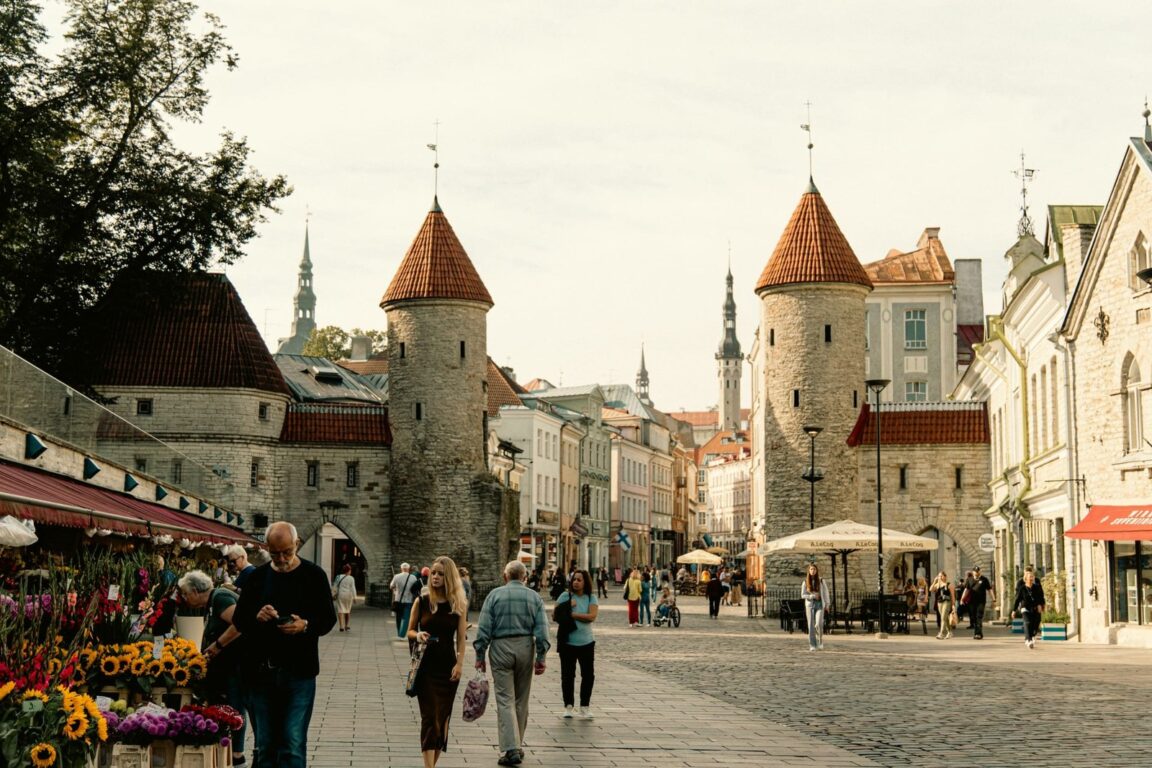
Start at Viru Gate, the twin towered entrance on the eastern side of the walls, and walk up Viru Street to Town Hall Square, Raekoja plats. The square has been the centre of the lower town for centuries, and the Town Hall itself, completed in 1404, is the oldest surviving Gothic town hall in northern Europe. If the tower is open, climb it early, before the day tour groups arrive, for the first rooftop view of the trip.
The lower town loop
From the square, take Pikk Street north past the guild houses and the former KGB headquarters building to St Olaf’s Church, whose spire once made it among the tallest buildings in the world. Double back through St Catherine’s Passage, a narrow lane of craft workshops set into the remains of a Dominican monastery, and along the city wall walkway where it is open. The wall, with its red roofed towers, is the image most visitors carry home, and walking a section of it explains the shape of the whole old town better than any map.
Up to Toompea
Climb either the Short Leg or the Long Leg lane to Toompea, the limestone hill that was always the seat of power while the lower town ran trade. Alexander Nevsky Cathedral, the onion domed Orthodox cathedral finished in 1900, faces the parliament building in Toompea Castle. Finish the circuit at the Kohtuotsa and Patkuli viewing platforms, which look over the lower town rooftops to the harbour. Patkuli at the end of the day, when the light drops, is the classic Tallinn photograph. Readers pairing the Baltic capitals often continue with our guide to 3 days in Riga, which uses the same lower town first pacing.
Day 2: Kalamaja’s wooden houses and the harbour
Kalamaja, directly north west of the Old Town behind Balti jaam, the main railway station, was a fishermen’s and workers’ district, and its streets of painted wooden houses from the late 19th and early 20th centuries are now the most desirable residential blocks in the city. There is no single sight here. The pleasure is the grid itself: Vana-Kalamaja, Valgevase, Niine and the side streets, walked slowly, with coffee stops.
Telliskivi and the Seaplane Harbour
On Kalamaja’s western edge, Telliskivi Creative City fills a former industrial complex with design shops, restaurants, galleries and the Fotografiska photography museum. It suits a long lunch. From there, walk or take a short bus ride to the Seaplane Harbour, Lennusadam, where a 1930s seaplane hangar holds the Estonian Maritime Museum, including the submarine Lembit, built in Britain in the 1930s, which visitors can walk through. The hangar is vast, the exhibits are hands on, and it is the best bad weather anchor in the city. Allow two to three hours.
Evening in the old town, second pass
Use the second evening to return to the Old Town after the cruise and day tour crowds have gone. The lanes around the Danish King’s Garden and the wall towers are quiet by early evening in shoulder season, and restaurants that feel rushed at lunch settle down. This is also the moment for the apteek, the Town Hall Pharmacy on the square, trading since at least 1422 and among the oldest continuously running pharmacies in Europe.
Day 3: A Kadriorg afternoon, then Pirita or the ferry
Kadriorg is Tallinn’s green eastern district, laid out around the palace Peter the Great began in 1718 as a summer residence, named for his wife Catherine. The palace now houses the Kadriorg Art Museum, the Art Museum of Estonia’s branch for older European and Russian art, and the park around it, with its swan pond and formal gardens, is free and open at all hours even when the museum is closed. Note the Monday closure shared by both Kadriorg and Kumu, and plan this day for any other day of the week.
Kumu and the park
At the park’s eastern edge stands Kumu, opened in 2006 as the main building of the Art Museum of Estonia and the country’s national gallery, covering Estonian art from the 18th century to the present. Palace plus Kumu plus the park fills an afternoon comfortably. Trams 1 and 3 run back to the centre in about fifteen minutes. The Baltic comparison continues naturally in our 2 day Vilnius plan, the third capital in the set.
Pirita, if the light is good
If the afternoon stays clear, continue east to Pirita, Tallinn’s beach district, where the promenade looks back across the bay to the Old Town skyline. It is a local, low key end to the trip: a walk, a coffee, and the view of the spires you spent day one climbing. In winter, swap Pirita for the Old Town Christmas market season on Town Hall Square or an extra museum, and dress for a Baltic wind that comes straight off the gulf.
Where to stay and eat
Stay inside the walls for atmosphere or on their edge for quieter rooms and easier tram access; Kalamaja suits travellers who prefer a residential base and do not mind a ten minute walk to the square. Eating follows the same split. The Old Town holds the celebratory restaurants, Telliskivi and Kalamaja hold the everyday ones locals use, and Kadriorg is a coffee and cake district rather than a dinner one. Book weekend dinners ahead in summer.
Getting around
The centre needs no transport plan beyond walking and the tram. Public transport in Tallinn is ticketed for visitors through the city transport app or contactless card, and residents travel free under the scheme the city introduced in 2013. The airport tram and the Kadriorg trams are the two journeys most first timers actually take. Taxis and ride hailing are plentiful and inexpensive by northern European standards.
Practical notes: the Tallinn Card, seasons and day trips
The Tallinn Card, sold for 24, 48 and 72 hour periods, bundles public transport with entry to most museums in this plan, including the Kadriorg and Kumu branches and the Seaplane Harbour, and it pays for itself on a museum heavy day two and three. Run the maths against your own list rather than buying it by default: a light itinerary of viewpoints, parks and lanes costs almost nothing, because the Old Town itself is free to walk. Seasonal timing changes the texture more than the route. In June the city barely darkens at night and the Old Town lanes stay lively late; in December the Christmas market fills Town Hall Square and daylight shrinks to a few blue hours, which compresses sightseeing into the middle of the day and pushes museums to the edges. Shoulder season, late April to May and September, is the local sweet spot: full opening hours, thinner crowds, and light good enough for the Toompea platforms. If a fourth day appears, the standard extensions are Lahemaa National Park to the east, with its bog boardwalks and manor houses, or the open air museum at Rocca al Mare to the west; both are day trips, not additions to squeeze into day three.
Frequently Asked Questions
How many days do you need in Tallinn?
Three days covers the Old Town, Kalamaja and Kadriorg without rushing. Two days works if Kadriorg is cut to the park and palace exterior, and one day, which many ferry passengers attempt, only really covers the Old Town.
When is the best time to visit Tallinn?
Late May to early September brings long light evenings and terrace weather. December brings the Christmas market and short, dark, atmospheric days. January and February are the coldest months and suit a museum heavy version of this plan.
Can you visit Tallinn as a day trip from Helsinki?
Yes. Ferries take about two hours each way and run several times daily, but a day trip leaves only the Old Town realistic. This three day plan assumes you sleep in Tallinn at least two nights.
Is Tallinn expensive?
By Nordic standards it is moderate, and noticeably cheaper than Helsinki or Stockholm, though Old Town restaurant prices approach western European levels in summer. Kalamaja and Kadriorg cafes are better value.
Do people speak English in Tallinn?
Yes, widely, especially among younger Estonians and across the hospitality sector. Estonian is the official language, and a basic greeting in Estonian is appreciated.