 Elena Vasquez
Two days in Vilnius divides cleanly into one day inside the city and one split day. Day 1 belongs to the Baroque Old Town: Cathedral Square, Gediminas Tower, the church spine running south to the Gate of Dawn, and the Church of Sts Peter and Paul. Day 2 starts across the river in Užupis, the self declared artists republic, and finishes with a half day trip to Trakai Island Castle on Lake Galvė, 28 kilometres west. Nothing in this plan needs a car, every sight named is walkable or one short train ride away, and the ticket prices and hours below were checked on 13 November 2026 against the National Museum of Lithuania, the Trakai History Museum and UNESCO.
Quick Facts
- Best base: The Old Town streets between Cathedral Square and Town Hall Square, so both days start on foot.
- Old Town status: The Vilnius Historic Centre, 352 hectares, has been a UNESCO World Heritage Site since 1994, listed for its Gothic, Renaissance, Baroque and Classical buildings and its medieval radial street plan.
- Gediminas Tower: Open daily 10:00 to 20:00; adults 8 euros, concessions 4 euros; the hill itself is free, and the funicular costs 2 euros one way or 3 euros return.
- Trakai Island Castle: 28 kilometres west of Vilnius, about 34 minutes by train; in November it opens Tuesday to Sunday, 10:00 to 18:00, closed Mondays, at 12 euros for adults and 6 euros for concessions in the October to March season.
- Užupis: The artists quarter across the Vilnia River, which declared itself a republic on 1 April 1997; its 41 article constitution is displayed on Paupio Street.
- Getting around: The Old Town is compact and walkable end to end; Trakai is reached by train or bus from the adjoining railway and bus stations.
Day 1 Morning: Where Do You Start in a City That Began on a Hill?
Start at Cathedral Square, the wide paved plaza where Vilnius explains its own origins. The neoclassical Cathedral stands here with its separate bell tower, on ground at the foot of Gediminas Hill where the city was first fortified. Grand Duke Gediminas gave Vilnius its first written mention in letters of 1323, the year the city still treats as its founding date, and the castle hill behind the Cathedral is where that story begins. The Cathedral interior and the square itself are free to enter and wander, so give them the first half hour of the day before the tour groups arrive.
Then climb the hill. Gediminas Tower, the surviving keep of the Upper Castle, is run by the National Museum of Lithuania and holds exhibitions on the castle complex and the city defences, topped by the rooftop viewing platform that gives the classic panorama: red roofs, church spires and the Neris River bending below. The tower opens daily from 10:00 to 20:00, with the ticket office closing 30 minutes before the tower does. Adults pay 8 euros and concessions 4 euros. The hill and its panorama terrace are free, so travellers on a tight budget can take the view without the exhibition. The funicular from the Old Arsenal courtyard covers the climb for 2 euros one way or 3 euros return, and walking up the cobbled path takes under ten minutes. At the foot of the hill, the Palace of the Grand Dukes is a separate museum with its own tickets; with only two days, treat it as an optional extra rather than a headline, unless your trip falls on the last Sunday of the month, when Gediminas Tower admission is free.
Day 1 Midday: How Does the Old Town Spine Actually Work?
Vilnius Old Town is easiest to read as one street with three names. Pilies Street leaves Cathedral Square heading south, becomes Didžioji Street at Town Hall Square, and finishes as Aušros Vartų Street at the Gate of Dawn. Walk it slowly and most of the city falls off it on either side. West of the spine sit the courtyards of Vilnius University, one of the oldest universities in Eastern Europe, and its Church of St Johns, whose bell tower is among the tallest in the Old Town. East of the spine, on Maironio Street, stands the building many visitors remember longest: St Anne’s Church, a late Gothic masterpiece in flaming red brick that has survived almost unchanged for five centuries, paired with the larger Bernardine Church beside it.
The southern end of the walk is the Gate of Dawn, the only one of the city wall gates to survive, built between 1503 and 1522. Its chapel holds the image of the Mother of Mercy, one of the most venerated paintings in the region, and the street below it still pauses for the pilgrims who stop in the roadway to face the chapel window. Treat the gate as a working place of worship rather than a photo stop: quiet voices, no flash, and a moment to one side if a service is under way.
Day 1 Afternoon: Which Church Justifies Leaving the Old Town?
One does. The Church of Sts Peter and Paul stands in Antakalnis, about a 20 minute walk northeast of the Cathedral along the river, and from a plain Baroque exterior it opens into the most astonishing church interior in the Baltic states: some 2,000 stucco figures covering the walls, vaults and chapels, biblical scenes, saints, demons and sea monsters all modelled in white. The church was designed by Jan Zaor, an architect from Kraków, and consecrated in 1701; travellers continuing south into Poland can compare it with the very different church architecture covered in our 3 days in Kraków itinerary. Allow 45 minutes inside, and go in the afternoon, when the light through the dome lantern is at its best and the morning groups have gone.
Walk back into the Old Town by the river path through Bernardine Garden, at the foot of the castle hill, and spend the early evening in the Pilies Street cafes. Vilnius rewards an unplanned hour at this point in the day: the Old Town has more than 40 churches, and the ones you pass without a plan, St Casimir with its pink Baroque facade on Didžioji Street among them, are often the ones that stay with you.
Day 2 Morning: What Is the Republic of Užupis, Really?
Cross the Vilnia River on any of the small bridges east of St Anne’s Church and you enter Užupis, whose name means the place beyond the river. On 1 April 1997 the neighbourhood artists declared it an independent republic, complete with a president, a foreign ministry of a sort, and a national day on April Fools Day. The joke has a serious core: Užupis was a neglected, semi ruined district in the 1990s, and the republic was the artists way of claiming it. The Užupis Art Incubator, in the old buildings along the river, still anchors that community.
Read the constitution first. Its 41 articles are fixed to a wall on Paupio Street in dozens of languages, and they set the tone of the whole district: everyone has the right to be happy, everyone has the right to be unhappy, a cat is not obliged to love its owner but must help in time of need. From the constitution wall, walk up to the Angel of Užupis, the trumpet blowing statue on the main square, then drift through the galleries, bookshops and riverside terraces of Užupio Street. Two hours is the right allowance. Užupis does not need a checklist; it needs a slow morning and a coffee, and it pairs well with the newer Paupys quarter just across the river, where a former industrial district now holds the city food market hall.
Day 2 Afternoon: Is the Trakai Castle Half Day Worth Half of Your Trip?
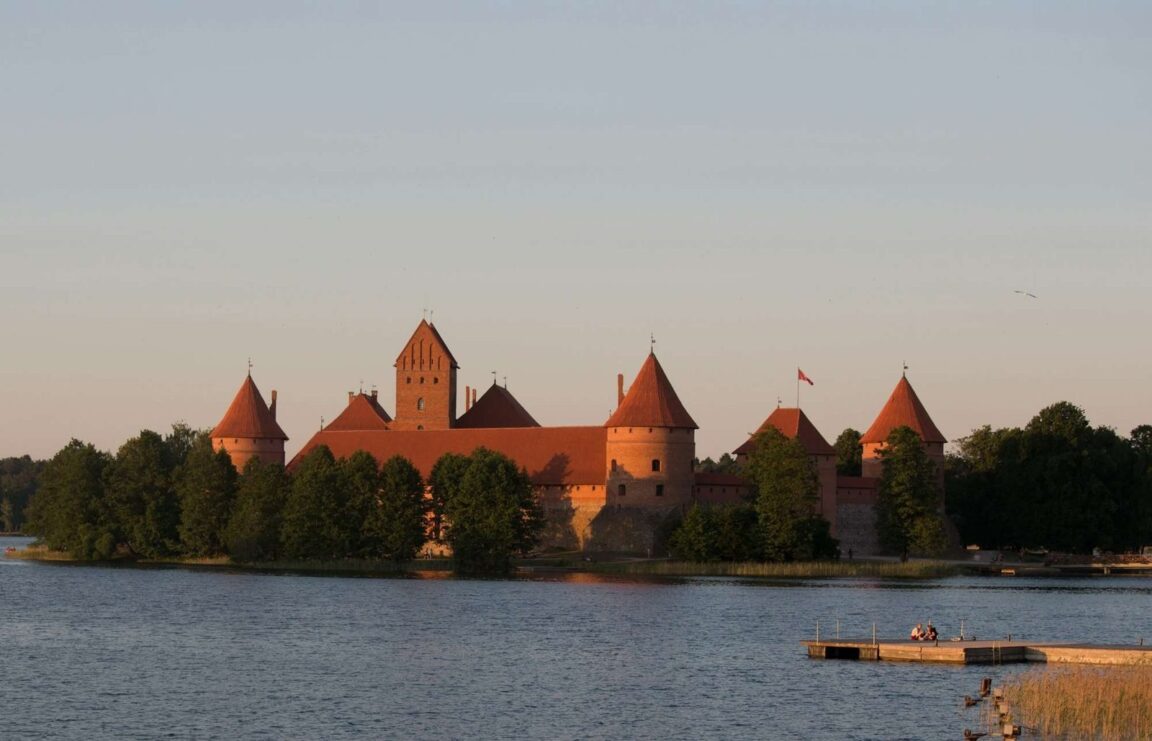
Yes, and it is the easiest decision in this itinerary. Trakai Island Castle stands on an island in Lake Galvė, 28 kilometres west of Vilnius, and it is unlike anything in the capital: a red brick Gothic fortress rising straight out of a lake. Construction began in the 14th century under Grand Duke Kęstutis, the major works were completed by his son Vytautas the Great around 1409, and the reconstructed castle has housed the Trakai History Museum since 1962. Give the half day this shape: a late morning train from Vilnius, the castle from late morning into early afternoon, a lakeside lunch in Trakai town, and a mid afternoon train back, which returns you to Vilnius with the evening free.
How do you get to Trakai and what does the castle cost?
Trains run from Vilnius railway station to Trakai in about 34 minutes, and buses from the adjoining bus station take about 40 minutes; the two stations in Trakai sit a couple of minutes apart, about 2.5 to 3 kilometres from the castle, a flat 30 to 40 minute lakeshore walk or a short ride on the town bus. Fares are a few euros each way and are priced by date, so check your own departure rather than budgeting on a fixed figure. Castle admission in the October to March season is 12 euros for adults and 6 euros for pupils, students and seniors, rising to 14 and 7 euros from April to September. In November the castle opens Tuesday to Sunday from 10:00 to 18:00 and is closed on Mondays, which is exactly why this plan puts Trakai on Day 2 rather than leaving the day of the week to chance; from December to February it opens Wednesday to Sunday only. Last admission is 30 minutes before closing. Confirm your date on the museum site, trakaimuziejus.lt, before you travel, because the seasonal pattern changes through the year.
What should you do in Trakai besides the castle?
Cross the wooden bridge, work through the gatehouse and courtyard into the ducal palace, and do not skip the museum exhibitions in the western casemates, where the applied art collections, furniture, pipes, porcelain and hunting trophies explain how the Grand Duchy actually lived. Back in the town, look for the Karaim story. Trakai is the historic home of the Karaim, a small Turkic speaking community brought from Crimea some 600 years ago, whose wooden houses with three windows facing the street line Karaimų Street, and whose kenesa, or prayer house, still stands in the town. Lunch should be kibinai, the Karaim pastries filled with chopped meat, sold by lakeside cafes along the shore; they are the one dish that belongs to this town alone. If the weather holds, the shore opposite the castle rents rowing boats in the warm months, and the castle view from the water is the photograph everyone wishes they had taken.
Where Should You Stay and How Does Vilnius Pair With the Rest of the Baltics?
Stay inside the Old Town, on or just off the Pilies to Didžioji spine, and both days of this plan run entirely on foot except for the Trakai train. The streets south toward the Gate of Dawn are quieter at night; the blocks near Cathedral Square put the castle hill on your doorstep. Vilnius also works as the southern anchor of a Baltic capitals trip, and the comparison is instructive: where Vilnius is Baroque and hilly, Latvia capital is the great Art Nouveau city. Readers building that longer route should see our 3 days in Riga itinerary for the northern half of the pairing.
Frequently Asked Questions
Can you see Vilnius properly in two days?
Yes, if the two days are structured as one city day and one split day. The Old Town, Užupis and Trakai cover the capital essential sights without rushing. What two days cannot hold is the museum depth, the Palace of the Grand Dukes, the Museum of Occupations and Freedom Fights and a full day in Trakai; those need a third day.
Is Trakai Castle open on Mondays?
Not in the low season. From October to March the castle closes on Mondays, opening Tuesday to Sunday 10:00 to 18:00 in October and November, and Wednesday to Sunday 10:00 to 18:00 from December to February. From April to September it opens daily 10:00 to 19:00. Plan the half day for any day but Monday.
How much does Gediminas Tower cost and is the hill free?
The tower exhibition costs 8 euros for adults and 4 euros for concessions, open daily 10:00 to 20:00. Gediminas Hill itself, and the panorama terrace below the tower, are free to visit during the day. The funicular is a separate 2 euros one way or 3 euros return, and admission is free on the last Sunday of each month.
What is Užupis and how long do you need there?
Užupis is the artists quarter across the Vilnia River that declared itself a republic on 1 April 1997, famous for its 41 article constitution on Paupio Street, the Angel of Užupis statue and its galleries and cafes. Two unhurried hours covers it well, including coffee.
How do you get from Vilnius to Trakai without a car?
By train from Vilnius railway station in about 34 minutes, or by bus from the bus station next door in about 40 minutes. In Trakai, walk the 2.5 to 3 kilometres along the lakeshore to the castle, or take the town bus to the stop beside the castle. Check times for your date, because engineering works have kept this line on temporary timetables through 2026.
Prices and hours checked 13 November 2026 against the National Museum of Lithuania (lnm.lt), the Trakai History Museum (trakaimuziejus.lt) and Go Vilnius listings. Seasonal hours change through the year; confirm your date before you travel.