 Camille Baptiste
This is Antigua Guatemala, the highland city in Guatemala Sacatepéquez department, and not Antigua the Caribbean island in Antigua and Barbuda; the two share a name and nothing else. This Antigua is a cobblestoned former colonial capital at about 1,500 metres in the Panchoy Valley, ringed by three volcanoes, where ruined convents stand on ordinary street corners and the whole centre has been a UNESCO World Heritage Site since 1979. Three days divides into one day for the city grid and its ruins, one decision about a volcano, and one day that the volcano decision shapes. This guide walks the city first, then makes the volcano call clearly: the Acatenango overnight is the great experience here for fit travellers in the dry season, and the viewpoint alternative is the right answer for everyone else.
Quick Facts
- Which Antigua: Antigua Guatemala, Guatemala, the former capital Santiago de los Caballeros, founded in this valley in 1543 and capital until the Santa Marta earthquakes of 1773 forced the move to present day Guatemala City.
- Heritage status: UNESCO World Heritage Site since 1979, listed for its Spanish Baroque influenced architecture, its colonial grid and its concentration of church and convent ruins.
- The volcanoes: Agua, 3,766 metres, the perfect cone due south; Fuego, 3,763 metres, one of the most active volcanoes in Central America; and Acatenango, 3,976 metres, Fuego neighbour and the overnight hike.
- The ruins pattern: The major convent ruins generally open daily 9:00 to 17:00 with a foreign visitor fee of 40 quetzales per site, cash in quetzales; confirm at the gate, because hours flex for events and restoration.
- Getting there: About an hour by road from Guatemala City and La Aurora International Airport in normal traffic, longer at peak hours; book a shuttle or car in advance rather than improvising at the airport.
- Best season: The dry season, November to April, for clear volcano views and reliable hiking; Semana Santa brings extraordinary processions and the year highest prices and crowds.
Day 1 Morning: How Do You Read a City Built on a Grid?
Antigua was laid out on a strict grid around its main square, and the grid is still the visitor best tool: numbered avenues run north to south, numbered streets east to west, and the volcanoes work as a compass. Agua fills the end of every southward street. Start at Parque Central, the main square, with the Cathedral on its east side. The Cathedral restored facade fronts a working parish church, while behind it the roofless naves of the original cathedral survive as a ruin, the single clearest illustration in the city of what 1773 did here. On the square south side stands the Palacio de los Capitanes Generales, the former seat of the Captaincy General that governed much of Central America from this valley for more than two centuries.
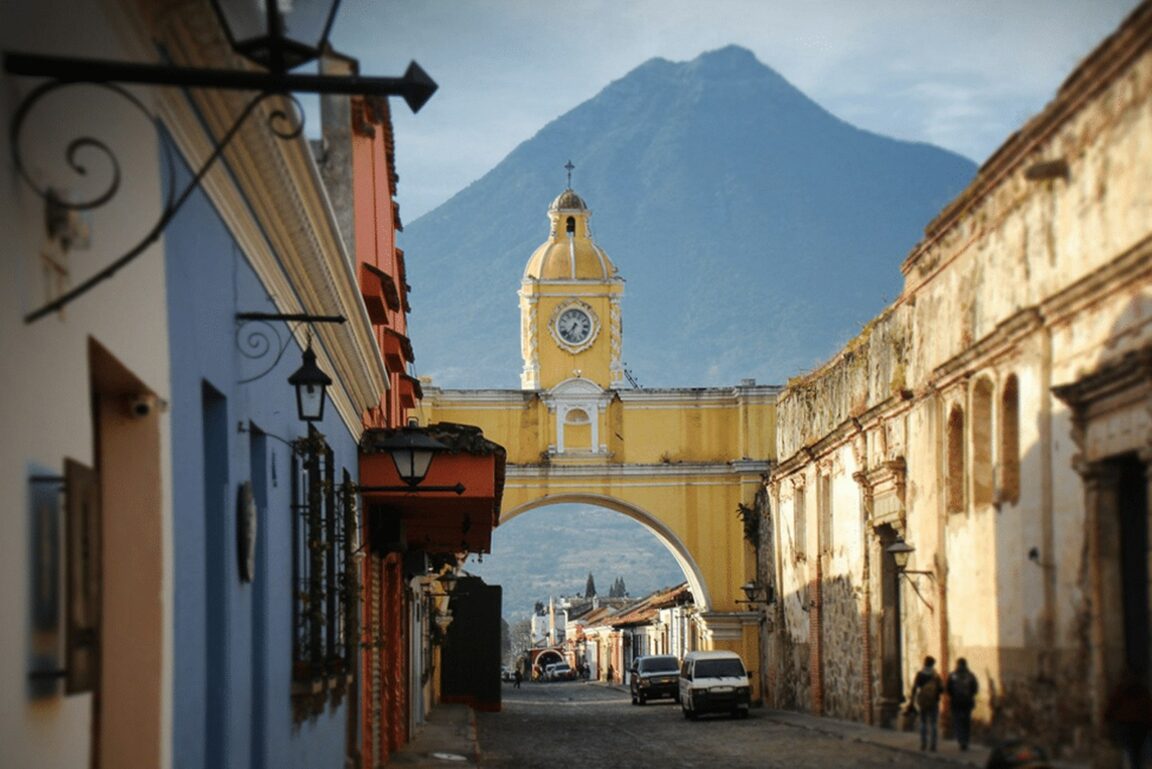
Walk four blocks north on 5a Avenida Norte to the image that defines the city. The Santa Catalina Arch, built in 1693, is a yellow arch with a clock tower, added later, spanning the street so that the cloistered nuns of the Santa Catalina convent could cross between buildings without being seen in the street. On a clear morning Agua cone lines up directly behind it. Go before 9:00, when the street is quiet and the light is on the arch; by midday the same view is a queue of cameras. Two blocks further, the Church of La Merced is the other yellow landmark, a low, massively built Baroque church whose squat proportions are earthquake engineering as much as style, with an ornate stucco facade and a fountain courtyard in the convent beside it.
Day 1 Afternoon: Which Convent Ruins Deserve Your 40 Quetzales?
Antigua has more ruins than any visitor can enter in three days, so choose by what each one teaches. The essential first stop is the Convento de las Capuchinas, consecrated in 1736 for Capuchin nuns and abandoned after 1773. It is the most complete convent complex in the city, and its strangest feature is a circular tower ringed with tiny individual cells around a central patio, a piece of religious architecture with no real equivalent elsewhere in the Americas. Allow a full hour; the gardens, the bathing pool below the tower and the rooftop views reward slowness.
Second, the Convento de Santa Clara, a few blocks southeast of the square, is the romantic ruin: a beautiful ruined church facade, cloisters around a garden and fountain, and grass where roofs used to be. Third, at the city western edge, La Recolección is the dramatic one, a vast roofless church and monastery field where fallen vaults and broken arches lie close to how the earthquake left them. Each of the three generally opens daily from 9:00 to 17:00 and charges foreign visitors 40 quetzales, payable in cash, so carry small quetzal notes and treat the three as a set: Capuchinas for convent life, Santa Clara for atmosphere, Recolección for scale. Finish the day at Casa Santo Domingo, the Dominican monastery complex converted into a hotel and museum site, where colonial art museums sit inside the restored and ruined fabric; even travellers not staying there can visit the museums and grounds.
Day 1 Evening and Day 2 Morning: What Does the City Do After the Ruins Close?
Antigua evenings belong to the streets around the arch and the square: low colonial buildings hold restaurants, wine bars and chocolate and coffee shops, and the city strong suit is a courtyard dinner within a few blocks of wherever you are staying. Use the evening of Day 1 to eat early and sleep early, because both volcano options start before dawn. On the morning of Day 2, before the decision takes over, climb to Cerro de la Cruz, the wooded hill topped by a stone cross on the city northern edge. The stepped walk takes about 20 to 30 minutes from the centre, it is free, and from the top the whole grid, the rooftops and Agua volcano compose the classic Antigua panorama. Go in daylight, ideally in the morning, and in a pair or a group, and treat it as the city viewpoint standard against which the bigger volcano day should be judged.
The Volcano Call: Should You Sleep on Acatenango or Take the Viewpoint?
Take the Acatenango overnight if you are fit, acclimatised and here in the dry season
Acatenango is a 3,976 metre volcano, and the overnight trek up it exists for one reason: its base camps face Fuego, 3 kilometres or so away, and Fuego erupts through the night with glowing lava visible against the dark. No viewpoint in or near the city shows you that. The standard pattern, run by Antigua operators including OX Expeditions and Wicho and Charlie’s, is a two day, one night guided trek: transfer to the trailhead village of La Soledad, a climb of roughly 1,500 metres of gain through farmland and cloud forest to a base camp at around 3,400 to 3,600 metres depending on the operator, an evening watching Fuego, then a summit push at about 4:00 in the morning for sunrise at 3,976 metres, and a descent that returns you to Antigua around midday on the second day. Booked this way, the trek occupies the second half of Day 2 and the first half of Day 3 of this itinerary, and it is the making of the trip for travellers who meet its conditions: real hiking fitness, at least a night or two already spent at Antigua altitude of about 1,500 metres, warm layers for a summit morning that can drop below freezing, and a dry season or settled weather window.
Take the viewpoint route if any of those conditions fail
The honest counter case is that Acatenango punishes the unprepared. The climb is steep, loose and high; altitude affects people unevenly, cloud can erase Fuego entirely, and the trek consumes the best part of two days of a three day trip. If you have knee trouble, no altitude time, a wet season forecast, or simply a city first trip, the viewpoint route is not a consolation prize. It is Cerro de la Cruz at dawn for the city panorama, plus a guided half day trip to Pacaya, the lower and easier active volcano south of the city, where guided walks cross lava fields formed by recent flows and the whole outing fits between breakfast and mid afternoon. That combination gives you a volcano under your boots and the full Antigua view, and returns your Day 3 intact for the city.
What are the safety rules that do not bend?
Three. First, Acatenango and Pacaya are guided hikes; go only with a licensed operator, and confirm the route status before you pay, because access changes with volcanic activity. Second, Fuego itself is not a hiking destination: Guatemala volcano monitoring and disaster authorities have repeatedly warned people not to approach or stay on Fuego upper areas, including the La Meseta and El Camellón zones, because of falling incandescent material. Watch Fuego from Acatenango, as the operators intend. Third, build the rest of the trip so a cancelled trek is a disappointment, not a collapse: operators cancel for weather and volcanic conditions, and the city day in this guide is deliberately strong enough to absorb the swap.
Day 3: How Does the Trip End Well in Either Version?
If you trekked, Day 3 is a descent, a long lunch and a gentle afternoon: the markets and craft shops around the Mercado de Artesanías, a coffee farm visit on the city edge, where tours walk the whole seed to cup process in the volcanic soil that makes this region coffee famous, and a final pass under the arch at dusk. If you took the viewpoint route, Day 3 can hold the ruins you skipped, a jade workshop visit, Antigua has a long jade carving tradition, and the climb back to Cerro de la Cruz for late light. Either way, protect the last evening. Antigua after dark, with the volcanoes reduced to silhouettes and the ruins lit, is the memory most visitors carry home.
Antigua also pairs naturally with Mexico great festival city for travellers building a longer Central America and Mexico route. The reverence with which this city handles its religious heritage has a Mexican counterpart in Oaxaca, covered in our Day of the Dead in Oaxaca guide, and the colonial grid comparison runs south to Colombia in our 2 days in Cartagena itinerary, where the walled city tells a very different colonial story by the sea.
Where Should You Stay in Antigua?
Stay inside the grid, within about six blocks of Parque Central, in the low colonial buildings the preservation rules protect; in Antigua the hotel stock is mostly small properties in converted colonial houses around courtyards, and the centre is walkable to every sight in this guide. Streets near the arch and La Merced are lively; streets south and east of the square run quieter. Avoid basing in Guatemala City for an Antigua trip, because the hour of road between the two turns every plan into a commute.
Frequently Asked Questions
Is Antigua Guatemala the same as the Caribbean island of Antigua?
No. Antigua Guatemala is a highland city in Guatemala, in Central America, a former Spanish colonial capital among volcanoes. The Caribbean Antigua is one half of the island nation of Antigua and Barbuda, a separate country with beaches and a different history. Flights, weather and packing for the two have nothing in common.
Is the Acatenango overnight hike worth it on a 3 day trip?
For fit, acclimatised travellers in the dry season, yes: the night view of Fuego erupting from base camp is the standout experience in this part of Guatemala, and the trek still leaves a full city day and a gentle final afternoon. For anyone short on fitness, altitude time or clear weather, no; the Cerro de la Cruz and Pacaya viewpoint route is the better trip.
How hard is Acatenango, honestly?
It is a strenuous guided trek: roughly 1,500 metres of climbing from the La Soledad trailhead to base camp, a night at around 3,400 to 3,600 metres, and a pre dawn summit push to 3,976 metres in temperatures that can fall below freezing. It is not a casual walk, and reputable operators lend or rent the warm gear the summit requires.
How much do the Antigua ruins cost and when are they open?
The major convent ruins, including Las Capuchinas, Santa Clara and La Recolección, generally charge foreign visitors 40 quetzales per site and open daily from 9:00 to 17:00. Carry cash in quetzales, and check at the gate on the day, because individual sites close occasionally for restoration work and private events.
When is the best time of year to visit Antigua Guatemala?
The dry season from November to April, when volcano views are clearest and hiking conditions most reliable. Semana Santa, Holy Week, is the city most famous week, with processions over sawdust carpets, but it must be booked far ahead at premium prices. The May to October rainy season usually rains in the afternoon and clouds the summit views.
Can you hike Fuego itself?
No, and you should not try. Fuego is highly active, and Guatemalan authorities have warned against approaching or staying on its upper slopes and ridge zones because of incandescent ballistic material. The Acatenango overnight exists precisely to give you the safe, spectacular vantage point across the valley.
Fees, hours and volcano details checked 13 November 2026 against UNESCO listing information for Antigua Guatemala, Guatemalan volcano monitoring advisories reported in October 2026, and published Antigua operator itineraries for Acatenango. Ruin hours and trek operations change with restoration and volcanic activity; confirm on the day.