 Camille Baptiste
One evening is enough to walk Dublin’s literary map if you walk it in the right order: start around Grafton Street with the Joyce pubs, Davy Byrne’s and The Bailey, drift through the snugs of McDaid’s and Kehoe’s where Behan and Kavanagh drank, and finish across the river end of the old town at the Palace Bar on Fleet Street, the Victorian room that served generations of Irish writers and journalists. The whole route fits inside a twenty-minute walking radius, the pubs are working bars rather than museums, and the literature is on the walls, in the snugs and, in one case, holding up a door. Go on a weekday, start early, and order at the bar like everyone else.
Quick Facts
The route: Davy Byrne’s and The Bailey on Duke Street, Kehoe’s on South Anne Street, McDaid’s on Harry Street, the Palace Bar on Fleet Street, with the Long Hall and Toner’s as extensions.
The Joyce anchor: Davy Byrne’s, where Leopold Bloom orders a gorgonzola sandwich and a glass of burgundy in Ulysses.
The Behan and Kavanagh anchor: McDaid’s on Harry Street, the genuine local of both writers in the 1950s.
The organised option: The Dublin Literary Pub Crawl, running since 1988, meets at The Duke on Duke Street and uses actors to perform the writers between stops.
Best night: A weekday, starting around 17:00, before the after-work crowd and the tour groups converge.
Etiquette in one line: Order at the bar, buy your round when it comes to you, and never rush a snug.
Stop One: Davy Byrne’s and the Joyce Plate
Davy Byrne’s on Duke Street is the most quoted pub in Irish literature. In the Lestrygonians episode of Ulysses, Leopold Bloom, hungry and avoiding his wife’s lover, comes in off Grafton Street and orders a gorgonzola sandwich and a glass of burgundy, a pairing so specific that the pub still serves versions of it to readers making the pilgrimage. The room today is a handsome, food-serious gastropub rather than a preserved 1904 set, which is precisely the point: this is a pub that kept working while its fame grew around it.
Order the Bloom combination if you are a Joyce reader; it is a small, edible piece of the novel. Then look at the room properly. Davy Byrne’s rewards the reader who notices that Dublin’s literary shrines are not roped off. They take bookings, serve lunch and pull pints for office workers who may never have opened Ulysses, and the literature has to share the room with all of it.
Stop Two: The Bailey and the Door of 7 Eccles Street
A few doors along Duke Street, The Bailey holds the strangest relic on the route: the front door of 7 Eccles Street, the fictional home of Leopold and Molly Bloom. When the real Eccles Street house was demolished, the door was rescued and eventually installed here, where generations of Bloomsday pilgrims have posed beside it. The Bailey itself is a larger, more modern room than its neighbours, which makes it the practical group stop of the evening: easier to seat everyone, easier to eat, and the natural pause point before the crawl turns toward the writers who drank rather than merely appeared in print.
Stop Three: Kehoe’s and McDaid’s, the Behan and Kavanagh Rooms
Kehoe’s on South Anne Street is one of the prettiest unaltered Victorian bars in the city centre, dark wood, mirrored partitions and a snug that still feels like a front room, because the upstairs once was one. It is the connective tissue of the walk, five minutes from Davy Byrne’s and five from McDaid’s, and the right place to learn the snug etiquette that governs the rest of the evening: a snug is a small enclosed booth, historically where women, clergy and anyone wanting privacy drank unseen, and today it is simply the best seat in the house. If a snug is free, take it, close the door, and let the bar come to you through the hatch if there is one.
McDaid’s, on Harry Street off Grafton Street, is the emotional centre of the route. Brendan Behan drank here through the 1950s and early 1960s, Patrick Kavanagh drank here, and the pub’s literary reputation rests on genuine residency rather than a single famous visit. It is a small room and it fills fast on weekend nights, which is the practical argument for the weekday start. Stand at the bar, keep the round system moving, and understand that you are drinking in a pub where two of Ireland’s greatest writers were not attractions but regulars, with all the argument and genius that implies.
Stop Four: The Palace Bar, Fleet Street
Cross toward Temple Bar and finish the core route at the Palace Bar on Fleet Street, a Victorian pub of 1823 vintage character, etched glass, a famous snug and a back bar that became a second office for generations of Irish Times journalists and the writers who drank with them. Kavanagh knew this room, and the Palace’s literary line runs unbroken from the newspaper trade to the present. It is also, usefully, one of the best whiskey rooms in the city centre, with its own bottlings and a staff culture that treats the whiskey list seriously.
The Palace makes the right final stop because it widens the story: Dublin’s literary pub culture was never only novelists and poets. It was journalists filing copy against a deadline, editors holding court, and the talk itself as the medium. If the evening still has legs, the Long Hall on South Great George’s Street, a jewel of a Victorian pub, is the beautiful extension; Toner’s on Lower Baggot Street, where Yeats is said to have made his only recorded pub visit and taken a single sherry before declaring he had seen enough, is the completist’s detour for another day.
Doing It Guided, and Doing It Right
The organised Dublin Literary Pub Crawl has run since 1988 and meets upstairs at The Duke on Duke Street; two actors perform Joyce, Behan, Wilde and others between the stops, and for a first night in the city it is a genuinely good piece of theatre as well as a walk. The self-guided version in this article follows the same geography at your own pace, with the advantage that you can linger in McDaid’s and skip what does not interest you. Either way, the rules of the rooms apply: order and pay at the bar, expect to stand at busy times, take your turn in the round, and keep phones and voices at pub volume in the snugs.
Pair the evening with the rest of literary Dublin by day: Trinity College and the Book of Kells, the Museum of Literature Ireland, and the Joyce statues and plaques threaded through the same streets. And if the trip extends beyond the capital, the harbour towns and coastal drives in our Wild Atlantic Way guide from Galway to Westport carry the same pub culture west, while our advice on the best time to visit Ireland for a road trip will steer you toward the long-light weeks when an evening walk like this one ends in daylight.
A Note on Pace and Rounds
Two practical disciplines make the evening work. The first is pace: these are small rooms and the night is long, so a half or a short measure where you are unsure of your appetite keeps the walk intact; nobody in a Dublin literary pub will judge the order, but the fifth full pint on Duke Street has ended more crawls than any closing time. The second is the round. Irish pub culture runs on reciprocal rounds, and a group that buys in turns will find the bar staff and the room itself noticeably warmer than one paying separately all night. Keep the round small, keep it moving, and let the person whose pub it is, the Joyce reader at Davy Byrne’s, the Behan admirer at McDaid’s, set the order.
Frequently Asked Questions
How many pubs can you realistically do in one evening?
Five or six with a proper drink at each. The core route here, Davy Byrne’s, The Bailey, Kehoe’s, McDaid’s and the Palace Bar, fits comfortably into one evening on foot; the Long Hall and Toner’s are extensions for a second night.
What is the Davy Byrne’s Joyce plate?
The gorgonzola sandwich and glass of burgundy that Leopold Bloom orders in Ulysses. Davy Byrne’s still serves its version, and ordering it is the standard reader’s ritual on this route.
What exactly is a snug?
A small enclosed booth inside a traditional pub, originally giving privacy to drinkers who did not want to be seen in a bar. Snugs survive at Kehoe’s, the Palace Bar and other older Dublin pubs, and they are the most sought-after seats in the house.
Is the organised literary pub crawl worth it?
Yes for a first visit. It has run since 1988 from The Duke on Duke Street, and the actors’ performances between stops add context the self-guided walk cannot. Do the self-guided route on a return visit, when you know which rooms you want to linger in.
When is the best time to start?
Around 17:00 on a weekday. You reach McDaid’s before the evening crush, the rooms are in working rather than party mode, and in late spring and summer the walk between pubs happens in full daylight.
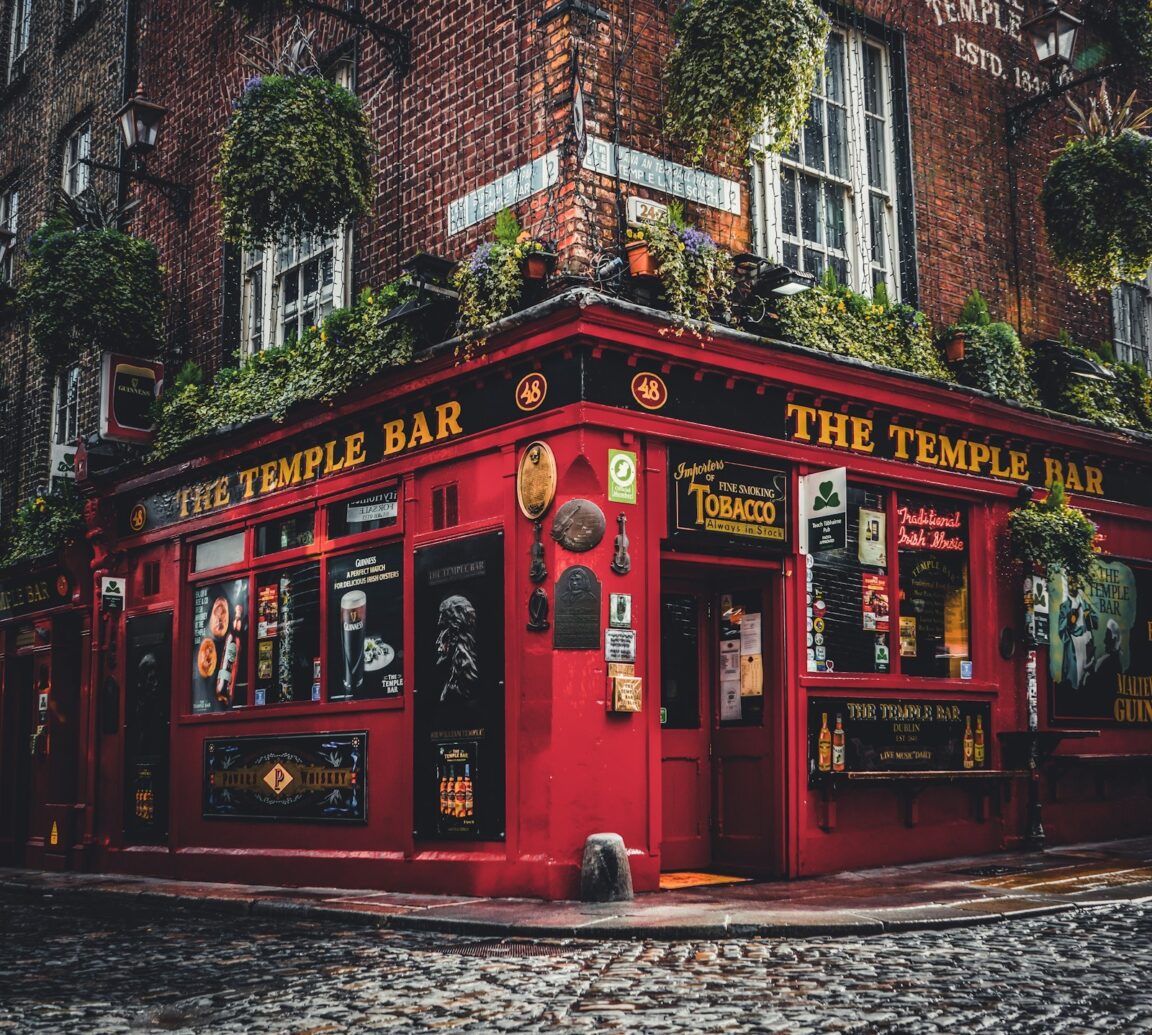
Featured image: The Temple Bar pub on its cobbled corner in Dublin’s Temple Bar district, the quarter the literary walk skirts on its way to Fleet Street. Photo by Leonhard Niederwimmer on Unsplash.