 Aiko Tanaka
Guernica hangs in Room 205.10 on the second floor of the Sabatini building at the Museo Reina Sofia, and the visit works best when you build up to it through the rooms that explain it rather than beelining to the famous canvas. Two pieces of preparation matter more than any others. First, the photography rule has changed: the decades-long ban on photographing Guernica was lifted in September 2023, and photographs without flash are now permitted, though tripods and selfie sticks remain banned across the museum. Second, the free hours are real but crowded: entry is free on Monday and Wednesday to Saturday from 19:00 to 21:00 and on Sunday from 12:30 to 14:30, for individual visitors who still need a ticket, and the Guernica room in those windows is the busiest room in Madrid. Pay the standard admission, currently listed at 12 euros, come at opening, and take the floor in order.
Quick Facts
The painting: Guernica, Pablo Picasso, 1937, oil on canvas, about 3.5 metres high and 7.8 metres wide
Where: Room 205.10, Floor 2, Sabatini building, Museo Nacional Centro de Arte Reina Sofia, Calle de Santa Isabel 52
Hours: Monday and Wednesday to Saturday 10:00 to 21:00, Sunday 10:00 to 14:30, closed Tuesdays
Standard ticket: 12 euros at the time of writing, bought online or at the museum
Free hours: Monday and Wednesday to Saturday 19:00 to 21:00, Sunday 12:30 to 14:30, individuals only, ticket still required
Photography: permitted without flash since September 2023; flash, tripods and selfie sticks banned museum-wide
The Floor Order That Builds to It
The Reina Sofia’s second floor tells the story of Spain from the start of the twentieth century to the Civil War, and Guernica sits near the end of that story, which is exactly where Picasso’s painting lands hardest. Resist the instinct to ride the glass lifts straight to Room 205.10. Instead, walk the floor’s sequence of rooms in their numbered order: the early modern movements in Spain, the arrival of Cubism and Surrealism, the Republic’s cultural explosion, and then the war. By the time you reach the Guernica rooms, the black, white and grey of the canvas reads as a conclusion the whole floor has been arguing toward.
The rooms around Guernica itself are part of the exhibit. Picasso’s preparatory studies, drawings and the sequence of states through which the composition evolved are shown nearby, along with Dora Maar’s photographs of the canvas in progress in the Paris studio in May and June 1937. Give those rooms ten minutes before the painting rather than after: knowing that the bull, the horse and the screaming figures were moved, redrawn and argued over for five weeks makes the finished wall of paint feel made rather than merely famous. Then take the painting in two passes, once from the far wall for the whole composition, and once slowly along its length, close enough to see the brushwork and the newsprint tones.
Guernica was painted for the Spanish Republic’s pavilion at the 1937 Paris International Exhibition, months after German and Italian aircraft bombed the Basque town of Gernika on a market day. It toured, then spent decades at the Museum of Modern Art in New York, because Picasso refused to let it enter Spain while Franco ruled. It finally arrived in Madrid in 1981, six years after Franco’s death, hung first at the Cason del Buen Retiro, and moved to the Reina Sofia in 1992. That journey is the room’s invisible label: the painting is not merely displayed in Spain, it was repatriated, and Spanish visitors treat the room accordingly.
The Photography Rule, As It Actually Stands
Older guides, and a great deal of repeated travel advice, still state that photography of Guernica is forbidden. That was true for decades, when guards in Room 205 spent their days stopping raised phones, and it stopped being true in September 2023, when the museum under its then director Manuel Segade lifted the ban and brought Guernica into line with the museum’s general policy. Photographs without flash are now allowed in front of the painting, as they are across the collection.
The limits that remain are museum-wide and still enforced: no flash, no tripods, no selfie sticks, no camera stands. The practical etiquette is unchanged too. The room is a place where people stand quietly for a long time; take a photograph if you want one, from the side rather than by planting yourself at the centre rail, and then put the phone away and actually look. The painting rewards scale and patience in a way no phone screen survives, and the studies in the adjoining rooms explain more with your eyes up than any photograph taken home will.
Free Hours and the Real Queue
The free windows are generous: the last two hours of the day, 19:00 to 21:00, on Monday and Wednesday to Saturday, plus Sunday 12:30 to 14:30, with additional free days on set dates in the museum’s calendar. Three conditions catch visitors out. Free access is for individual visitors, not groups. You still need a ticket, collected or booked for those hours, so the saving is money, not queueing. And the Guernica room during free hours fills to a density that changes the experience entirely: expect a slow shuffle at the rail rather than a clear view, and no realistic chance of the quiet two-pass viewing described above.
The honest arithmetic is this. If Guernica is the point of the trip, the 12 euro ticket at the 10:00 opening is the best-value purchase in Madrid: the room in its first half hour is as calm as it ever gets, and the whole floor can be walked in sequence before the school groups and day tours arrive. If the museum is a general interest stop on a long Madrid stay, take a free evening, see the greatest hits, and accept the crowd as the price of free. What not to do is arrive at 19:00 expecting a contemplative encounter with the most famous anti-war painting in the world, in the company of everyone else in Madrid who read the same tip. Pair the visit with the Prado across the art triangle using our route for the Prado in two hours, and keep the paperwork of a Spain trip straight with our explainer on Spain’s traveller registration at hotel check-in.
Practical Shape of a Visit
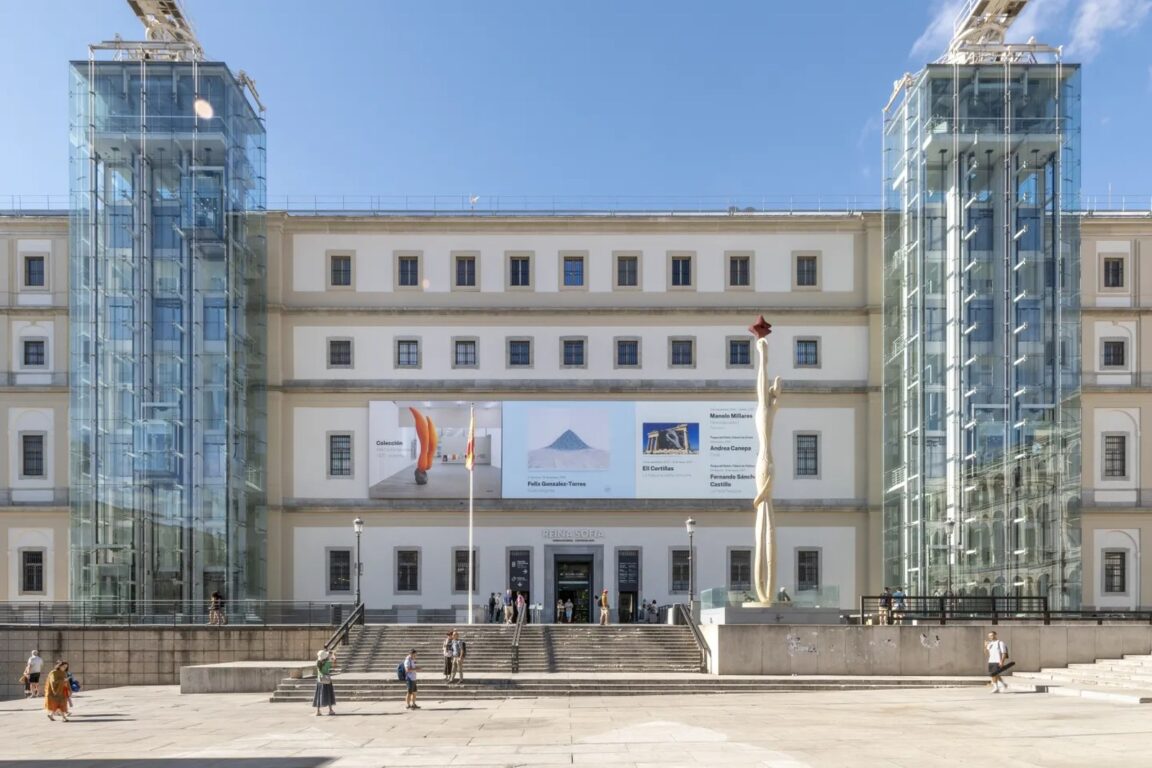
The museum has two entrances: the Sabatini building on Calle Santa Isabel, the eighteenth century former hospital where Guernica hangs, and the Nouvel building on Ronda de Atocha, the modern extension. Visitors with online tickets are generally directed to the Nouvel entrance, which moves faster; both lead to the same floors. The museum closes on Tuesdays, the reverse of the Prado pattern many visitors assume, so build the art triangle accordingly: Reina Sofia on a Monday, Prado on a Tuesday if your days allow. Allow two to three hours for the Sabatini floors with Guernica given its proper time, longer if the temporary exhibitions in the Nouvel building catch you. Cloakroom, lockers and the usual bag rules apply; large bags do not enter the galleries, and the glass lifts on the Sabatini facade are worth one ride purely as architecture.
Frequently Asked Questions
Can you photograph Guernica now?
Yes. The long-standing ban was lifted in September 2023. Photographs without flash are permitted; flash, tripods and selfie sticks remain banned throughout the museum.
Where exactly is Guernica in the museum?
Room 205.10 on Floor 2 of the Sabatini building, the older of the museum’s two buildings, reached from the Calle Santa Isabel side or through the connected floors from the Nouvel entrance.
When is the Reina Sofia free?
Monday and Wednesday to Saturday from 19:00 to 21:00, and Sunday from 12:30 to 14:30, for individual visitors. A ticket is still required for those hours, and the Guernica room is at its busiest then.
What day is the museum closed?
Tuesday, every week, plus a short list of public holidays. Do not assume the Monday closure pattern of many other museums.
How much is standard entry?
General admission is listed at 12 euros at the time of writing, with the usual reductions and free categories for under-18s and others set out on the museum’s own site. Confirm the current price there before you go.
How long should I allow?
Two to three hours for the main floors with Guernica properly seen, including its surrounding study rooms. A free-evening visit can cover the highlights in the two hour window if you go straight to Floor 2.
Image: The Sabatini building facade of the Museo Reina Sofia, Madrid. Photo: Roberto Ruiz, via the Museo Reina Sofia official website (museoreinasofia.es).