 Camille Baptiste
You can walk into a Buenos Aires milonga, pay at the door, take a table and watch some of the finest social dancing on earth without dancing a single step, and nobody will think less of you for it. What you cannot do is treat it like a bar with dancing. A milonga runs on codes: invitations by eye contact and a nod, the cabeceo, music in sets called tandas that you dance whole or not at all, and a floor that moves counter-clockwise in lanes. Learn those three things before you go and a visitor who does not tango becomes the milonga’s favourite kind of guest: an appreciative one.
Quick Facts
What it is: A milonga is a social tango dance night, not a show. The dancing is improvised, by regulars and visitors together, on one shared floor.
The invitation: The cabeceo. Eye contact, the mirada, then a small nod, the cabeceo. A nod back accepts. Looking away declines, without a word or embarrassment.
The music: Tandas, sets of three or four songs by one orchestra, separated by cortinas, short bursts of non-tango music when the floor clears completely.
The floor: The ronda moves counter-clockwise in lanes. Couples progress around the room and never cut across the middle.
The thank you rule: Saying gracias to your partner signals the dance is over. Say it only at the end of a tanda, never after one song.
The clock: Classes often run before the milonga from about 8pm to 10pm. Dancing builds after 11pm and traditional rooms peak after midnight.
Money: Entry is paid at the door, modest by show standards, and cash in pesos is the safe plan.
What is the cabeceo, and how does a watcher use it?
The cabeceo exists to protect everyone’s dignity. In a traditional milonga nobody crosses the room to ask for a dance, because a public refusal would poison the night for both parties. Instead, a dancer catches another’s eye across the tables, the mirada, and tilts the head in a small nod toward the floor, the cabeceo. If the look is held and the nod returned, they meet at the edge of the floor. If the other person looks away, nothing happened, and the evening continues undamaged.
For a non-dancing visitor the rule has one practical consequence: be careful where your eyes rest. Sustained eye contact across a milonga is a language, and a watcher who gazes at dancers between tandas may accidentally accept an invitation, or issue one. Watch the floor while the music plays, which is what the room is for, and look at the dancing rather than into dancers’ eyes during the cortinas. If you do want to dance, position and patience do the work: sit where you can be seen, look toward the dancers you would accept, and let the system come to you. The full code system is laid out in the milonga cabeceo and tanda guide, written for visiting dancers, and this piece is its companion for watchers.
How do tandas, cortinas and the ronda shape the night?
The DJ builds the night in tandas: three or four songs, usually by a single orchestra from a single era, tango, then later perhaps vals or the faster dance also called milonga. A couple who accept each other dance the whole tanda together. Leaving after one song is the room’s clearest insult, which is why the cabeceo decision matters: you are agreeing to a set, not a song. Between tandas the cortina plays, thirty seconds or so of rock, cumbia or jazz, and the floor empties completely. Couples thank each other, return to their tables, and the room reshuffles.
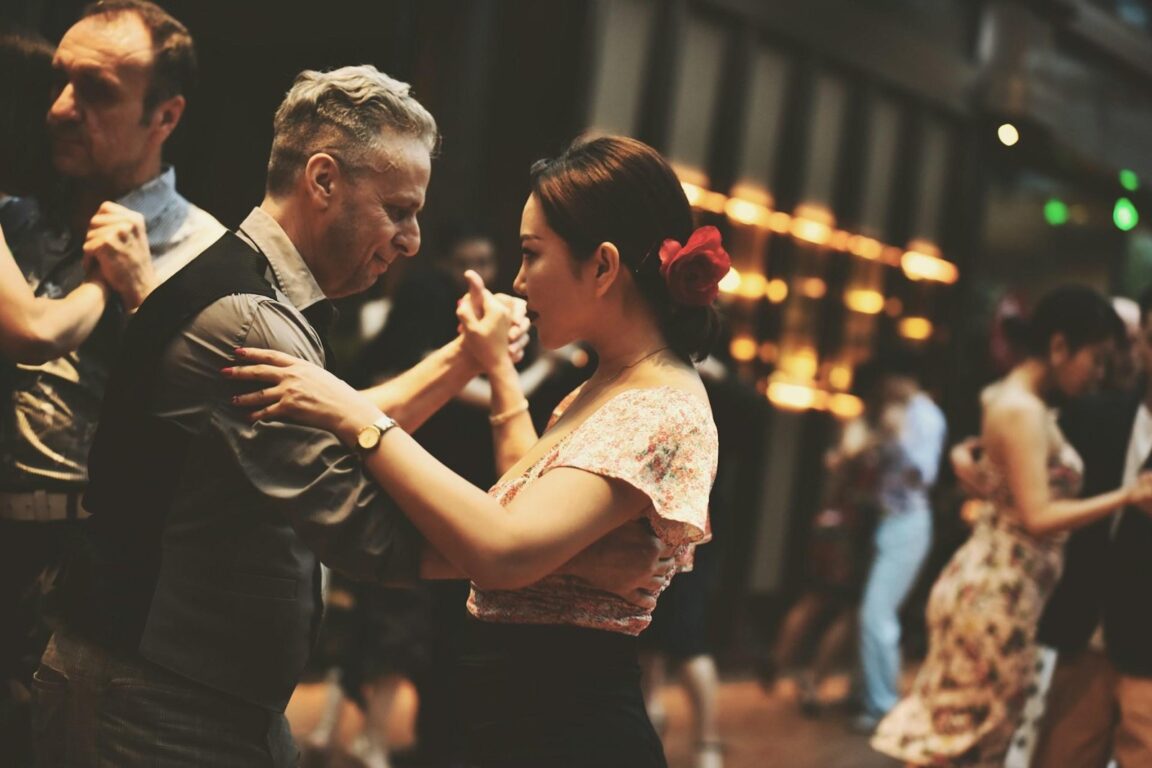
On the floor, the ronda rules. Couples travel counter-clockwise in lanes, the outside lane fastest, each couple keeping the space behind the couple ahead and never overtaking recklessly or stopping to practise figures while the room moves behind them. As a watcher, this is the beauty of it: a whole room of couples, many of them strangers an hour ago, circulating like a slow river without collision. Choose a table with a view of the long axis of the floor, order a drink, and give it an hour. The pattern teaches itself.
Which nights welcome beginners and watchers?
The welcoming end of the spectrum is the milonga with a class attached. Houses such as La Viruta in Palermo and La Catedral in Almagro run group classes for absolute beginners in the early evening, then open the floor, so a visitor can learn the basic walk, take the class’s social hour as a bridge, and then watch the real room assemble later with a drink in hand. These rooms are younger, more mixed and forgiving of spectators, phones and questions.
The traditional end, rooms such as Salón Canning and El Beso, is for watching first and understanding what you are seeing: stricter codes, seated tables arranged for the cabeceo, dancers who have shared floors for decades. A watcher is welcome in both kinds of room provided the etiquette holds: ask for a table rather than drifting, dress smart casual at minimum and smarter in traditional rooms, keep conversation low while the music plays, never walk across the floor, and never photograph dancers without asking. Arrive at a traditional milonga before the peak, take the table you are given, and stay for at least two full tanda cycles. Leaving after twenty minutes reads as judgement. Staying reads as respect, and the room can tell the difference.
What should a first milonga night look like, hour by hour?
Start with the class if the house offers one, because an hour of basic walking gives a watcher the single most valuable insight: how hard the easy-looking thing is. Eat before you go, as Buenos Aires dines late and milonga kitchens are an afterthought, a pattern the wider city guide in 3 days in Buenos Aires helps you plan around. Take the milonga itself from about 11pm. The first hour is warm-up, the room filling, the DJ building. After midnight the floor reaches its density and its standard, and the best dancers, who pace a night like musicians, come into their own.
Plan the exit as carefully as the entrance. Milongas run to 3am or later, taxis and ride apps are the way home, and cash covers the door and the drinks. A watcher who stays to the last tanda, thanks the organiser at the door and leaves quietly has done the milonga exactly right, without dancing a step.
Frequently Asked Questions
Can I go to a milonga if I do not dance tango?
Yes. Watchers are a normal part of a milonga. Take a table, order drinks, watch the floor while the music plays and follow the room’s etiquette. Nobody expects every guest to dance, and a respectful audience is valued.
What is the cabeceo?
The invitation system of the milonga: eye contact across the room, the mirada, answered by a small nod, the cabeceo. A returned nod accepts the dance. Looking away declines it silently, which is the point of the system.
What is a tanda, and why does it matter?
A tanda is a set of three or four songs by one orchestra, danced with the same partner. Accepting a cabeceo means dancing the whole tanda. Between tandas a short cortina clears the floor and the room reshuffles.
What should I wear to a milonga as a spectator?
Smart casual at minimum, and smarter for traditional rooms. Dancers wear smooth-soled shoes that can pivot. Watchers should dress as guests at a dance, not as tourists passing through, because the room reads effort as respect.
When does a milonga actually get going?
Classes run in the early evening, doors for the dance open around 10pm to 11pm in many houses, and traditional rooms peak after midnight and run to 3am or later. Arriving at 9pm to an empty floor is the classic first-timer error.
Image: Couples dancing tango in close embrace on a crowded milonga floor. Photo: Preillumination Seth, via Unsplash (hosted copy via Superprof), Unsplash License, used with credit.