 Rafael Santos
A Buenos Aires milonga runs on a silent code that a visitor can learn in one evening: you invite a partner with eye contact and a small nod, the cabeceo, never by walking over and asking out loud; you dance a full set of three or four songs, a tanda, with that partner; you clear the floor completely during the short non tango break, the cortina; and you move counter clockwise in lanes, never against the flow. Master those four rules and a visiting dancer fits. Break them, politely and unknowingly, and the room will notice long before anyone says a word.
Quick Facts
- What: A milonga is a social tango dance event, and also the room where it happens; the word also names a faster tango rhythm played in its own tandas
- The invitation: The cabeceo, eye contact (the mirada) plus a nod toward the floor, accepted by holding the look and nodding back, declined by looking away
- The music unit: The tanda, three or four songs by the same orchestra and era, danced in full with one partner
- The break: The cortina, 20 to 60 seconds of deliberately non tango music signalling everyone to clear the floor and reset
- The floor: The ronda, counter clockwise lanes of travel; no stopping for long figures, no cutting across, no overtaking recklessly
- The exit line: Saying gracias at the end of a tanda closes the dance cleanly; saying it mid tanda ends things early and reads as a rejection
What is a milonga, and how is it different from a tango show?
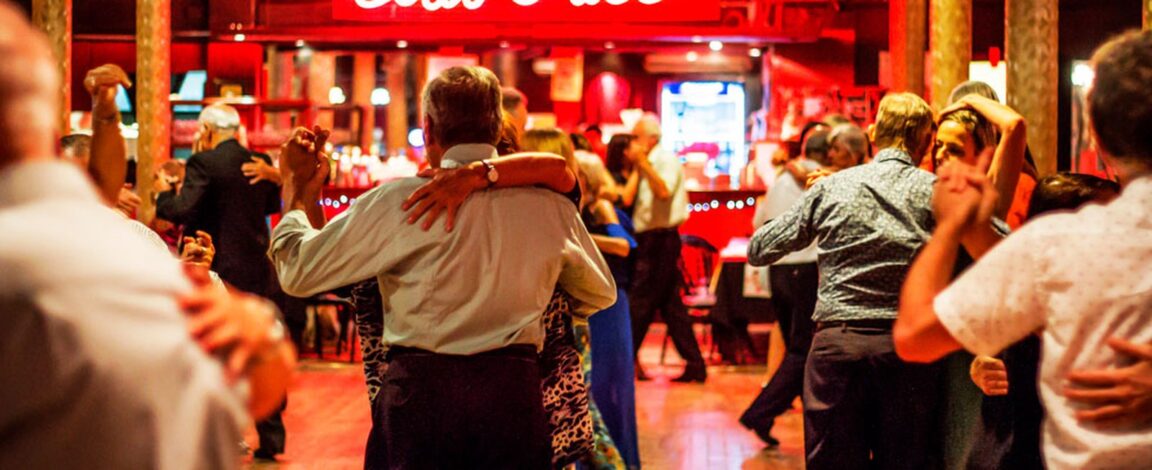
A milonga is not a performance. It is a social dance night with its own etiquette, closer in spirit to a members’ ritual than to a theatre, even though tourists are welcome in most rooms. Couples dance for each other and for the floor, in a close embrace, improvising to recorded orchestras from tango’s golden age. There is no stage set piece in a traditional milonga, no costume change and no applause break built into the evening. Some venues add a short exhibition by teachers around midnight, and then the social dancing resumes as if nothing had interrupted it.
That distinction decides what a visitor should expect. At a dinner show in San Telmo you watch professionals. At a milonga you are, potentially, a participant, and the room judges participation by conduct rather than by steps. A modest dancer who respects the codes will be invited back onto the floor all night. A brilliant dancer who invites verbally, hogs space and abandons partners mid tanda will dance far less than they expect. The codes, los codigos, exist to make a crowded floor safe and to make refusal painless, and every other rule in this guide flows from those two purposes.
How does the cabeceo actually work?
The cabeceo is a two part gesture. The mirada is the look: from your seat, you catch and hold the eye of someone across the room as a tanda is about to begin. The cabeceo is the nod, a small tilt of the head toward the dance floor. If the look is held and the nod returned, the invitation is accepted. The inviter then walks over, and the couple meet at the edge of the floor nearest the invited person’s table and enter the ronda together. If the look is not returned, or the eyes slide away, that is a complete and honourable no. Nobody else in the room has witnessed a rejection, which is exactly why the system survived.
Walking to a table and asking verbally reverses every protection the cabeceo offers. It corners the person asked, makes a refusal public and marks the asker as someone who does not know, or does not care, how the room works. Traditional milongas treat it as a serious breach. The modern picture is softening at the edges: in younger and more informal milongas, and among dancers who already know each other, women invite men by cabeceo as a matter of course and friends may arrange a dance in conversation. What has not changed is the principle. The invitation should always leave the other person a graceful way to decline.
Practical details matter. Sit where you can actually see and be seen, since cabeceo is impossible from a dark corner behind a pillar. Look up and around as the cortina ends and the next tanda forms, because that is the room’s marketplace moment; a dancer deep in conversation or studying a phone through that window will simply miss the tanda. Glasses, if you need them to read a face across a room, are milonga equipment, not vanity. And be precise about who you are looking at. In a row of seated dancers, an ambiguous nod can produce two people rising at once, a small social accident the whole table will remember.
What are tandas and cortinas, and why must you dance the whole tanda?
Milonga music is organised, never shuffled. A tanda is a set of three or four songs by the same orchestra from the same period, so a couple can settle into one style and one embrace for ten minutes or so. Tango tandas usually hold four songs; vals and the faster milonga rhythm usually hold three. DJs build the night in a repeating pattern, classically two tandas of tango, one of vals, two of tango, one of milonga, which regulars can read like a clock.
Between tandas comes the cortina, literally a curtain: a short burst of music that is obviously not tango, perhaps salsa, rock or folk, played for well under a minute. Its job is demolition. Everyone leaves the floor, partners thank each other and return to their seats, and the room resets for a new round of cabeceos. Dancing through a cortina, or lingering on the floor chatting while it plays, is the fastest visible way to announce that you are new.
The tanda is also the social contract. Accepting a cabeceo means accepting the full set, and leaving after one song, short of injury or a genuinely bad experience, is read as a pointed verdict on your partner. At the end of the tanda, a simple gracias and escorting your partner back toward their table closes the exchange with no obligation on either side. That same word is the emergency exit: saying gracias mid tanda ends the dance, which is why experienced dancers use it deliberately and sparingly, and why no one chats it casually between songs unless they mean it.
How does floorcraft work in the ronda?
From above, a good milonga floor looks like slow traffic on a roundabout. Couples travel counter clockwise around the room in two or three concentric lanes, the ronda, keeping a steady flow with the couple ahead. Leaders are responsible for navigation: entering the floor with a nod to the leader they will dance behind, keeping steps compact when the floor is full, and never stopping to work through a long figure while the lane stacks up behind them. Big steps, high leg movements and showy lifts belong to the stage. On a social floor they endanger the couples around you, and protecting your partner from collisions is considered the leader’s first technical skill.
Followers carry floorcraft duties too, chiefly keeping feet close to the floor in crowds and signalling discomfort early rather than enduring a dangerous dance in silence. Nobody crosses the floor while others are dancing; you walk around the edge. Nobody teaches on the floor, corrects a partner mid song, or talks through the music at length. Conversation belongs between songs, and even then it stays brief, because many dancers treat the pauses inside a tanda as part of the dance rather than as intermissions.
Our three days in Buenos Aires itinerary places the milonga night inside a wider city plan, and travellers crossing the river afterwards will find the same dance culture viewed from the far bank in our guide to Colonia del Sacramento, the Portuguese old town a ferry ride from the capital.
Where does a visiting dancer actually fit?
Realistically, in the middle. Traditional rooms seat men and women in separate sections with couples and groups at shared tables between them, an arrangement built entirely around sightlines for the cabeceo. A visitor’s best first move is unglamorous: arrive before the room fills, take the pre milonga class many venues run in the early evening, watch two full tandas before trying to dance, and let the first invitations come at a level the floor can absorb. Dress codes in traditional rooms still lean formal, neat shoes and no sportswear, and dance shoes with smooth soles are more than a fashion choice on crowded wooden floors.
Temperament counts for as much as technique. Thank partners warmly, accept a declined cabeceo without a flicker, sit out a tanda without sulking and never explain to a stranger why they were not chosen. Milongueros, the lifelong regulars, have long memories for conduct. A visitor who behaves well on a first night is visibly welcomed on a second, and in Buenos Aires the second night is where the real dancing starts.
Frequently Asked Questions
Can a woman invite a man to dance at a milonga?
Yes, by cabeceo. The mirada, a held look inviting a nod, has always been the woman’s side of the exchange, and in many modern milongas women cabeceo openly and equally. What the codes discourage for everyone is the verbal, at the table invitation that leaves no graceful refusal.
What happens if I want to stop dancing before the tanda ends?
Say gracias. In milonga code, thanking your partner mid tanda ends the dance, and both dancers leave the floor. Because it reads as a rejection, it is reserved for genuine problems such as pain, discomfort or unsafe dancing, not for a song you like less.
Do I have to change partners after every tanda?
That is the norm the cortina exists to enforce. Everyone clears the floor, returns to their seats and forms new couples by cabeceo for the next tanda. Dancing consecutive tandas with the same partner happens, especially with a spouse or regular partner, but it is a deliberate exception, not the default.
What should a first time visitor wear to a milonga?
Smart, neat clothing and smooth soled dance shoes. Traditional Buenos Aires milongas still expect a level of formality, no sportswear, no trainers, and followers commonly wear heels they can genuinely dance in for hours. When in doubt, dress up rather than down.
Is it rude to watch without dancing?
No. Watching from your seat is a normal part of the night, and a sensible first hour for any visitor. What the room dislikes is standing at the edge of the floor blocking the ronda, filming dancers without permission, or treating the floor as a show with applause.
Image credit: Couples dancing in close embrace on a crowded milonga floor in Buenos Aires. Photo by the Buenos Aires City Tourist Board, via turismo.buenosaires.gob.ar, the city’s official tourism authority, used with credit.