 Camille Baptiste
Kinsale earns its gourmet reputation honestly: a working harbour town in County Cork where the catch lands a short walk from the restaurants that serve it, two star forts guard the harbour mouth, and the headland beyond town carries one of the most sobering memorials on the Irish coast. Come for a long weekend of seafood, fort walks and harbour air, and time the trip for shoulder season, when the summer crowds thin and the restaurants still run full menus.
Quick Facts
Where: Kinsale, County Cork, about 25 km south of Cork city, at the mouth of the Bandon River.
Known for: Seafood restaurants and pubs, Charles Fort and James Fort, sailing, and the Old Head of Kinsale.
Charles Fort hours: Mid March to end of October, 10:00 to 18:00 (last admission 17:00); November to mid March, 10:00 to 17:00 (last admission 16:00), per Heritage Ireland.
Charles Fort admission: Adult 5 euro, senior and group 4 euro, child and student 3 euro, family 13 euro.
Best months: May, June and September for harbour weather without peak crowds.
Do not miss: The walk out to Charles Fort at Summer Cove, lunch on the harbour, and the Lusitania memorial at the Old Head.
Why Kinsale Works as a Food Town
Many Irish coastal towns claim a food scene; Kinsale’s claim rests on geography. The harbour is a genuine working port, the surrounding farms of West Cork supply the kitchens, and the town’s restaurant strip along the quays is compact enough that a visitor can compare menus on foot in ten minutes. The result is a density of serious cooking that towns twice its size struggle to match, from white-tablecloth seafood rooms to pubs serving chowder and crab sandwiches at lunch.
The town styles itself the gourmet capital of Ireland, a title it has promoted for decades, and the annual calendar backs it up with food festivals and a restaurant association that coordinates the town’s kitchens. None of that matters if the fish is not fresh, and in Kinsale the supply chain is measured in metres rather than miles. Order whatever came in that morning, ask what the boat landed, and build the meal around the answer.
The Two Forts at the Harbour Mouth
Charles Fort, at Summer Cove on the eastern shore, is one of the largest star forts in Ireland, built in the late 17th century to a design attributed to William Robinson. Its walls, barracks and parade ground survive in remarkable condition, and the scale only lands when you walk the full circuit of the ramparts. Heritage Ireland opens it all year: 10:00 to 18:00 from mid March to the end of October with last admission at 17:00, and 10:00 to 17:00 from November to mid March with last admission at 16:00. Admission is 5 euro for adults, 4 euro for seniors and groups, 3 euro for children and students, and 13 euro for a family ticket.
Across the water sits James Fort, the older and smaller of the pair, reachable from the town side. The two forts were positioned to command the harbour entrance between them, and reading the estuary from either rampart explains Kinsale’s whole history: a deep, sheltered anchorage that every passing power wanted to hold. Walk out to Charles Fort along the harbour path from town rather than driving; the approach along the water is half the pleasure, and the Scilly Walk route makes an easy leg stretch before lunch.
The Old Head and the Lusitania Memorial
South of town, the Old Head of Kinsale pushes a narrow finger of land into the Atlantic. It is the closest point of land to where the Lusitania was torpedoed in 1915, and the memorial on the headland commemorates the sinking that cost more than a thousand lives. The headland itself is now largely occupied by a private golf course, so public access concentrates on the memorial area and the signal tower; plan it as a short, reflective stop rather than a long walk, and combine it with the drive along the coast road.
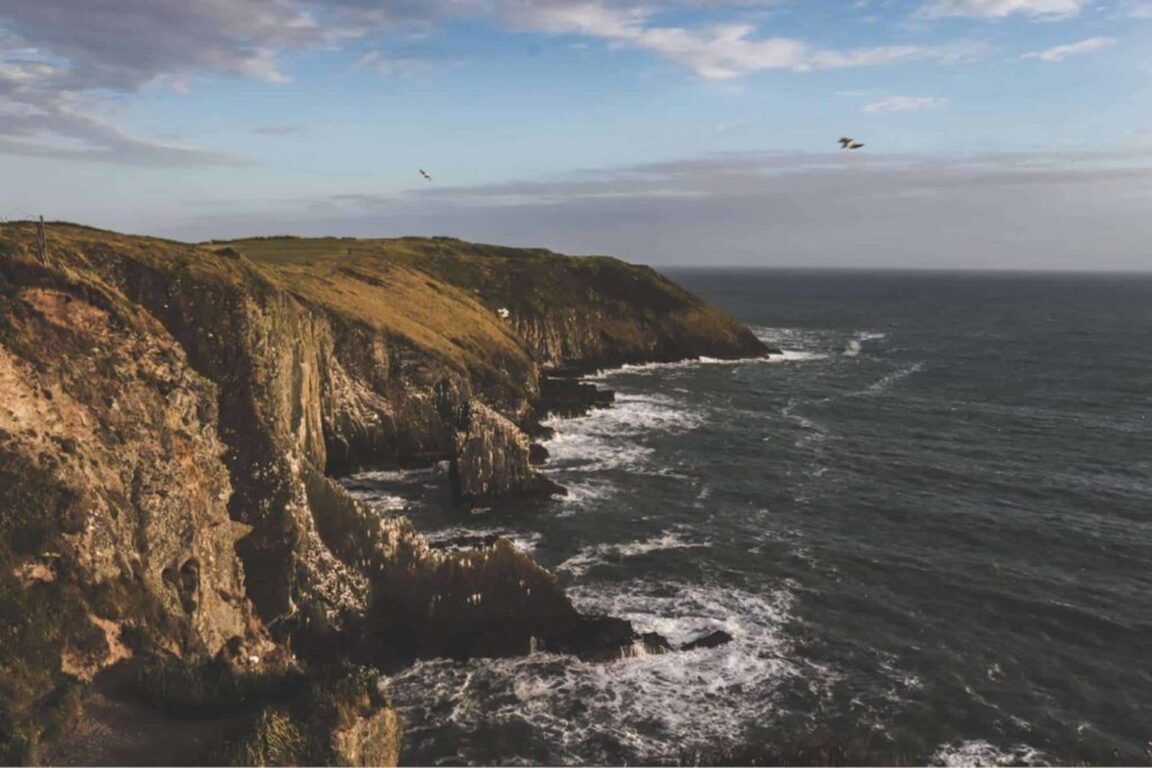
The cliffs below the Old Head are the same coastline shown in this article’s featured image: layered rock, Atlantic swell and not a building in sight. It is a useful corrective to the harbour’s cosiness. Kinsale’s sheltered quays sit minutes from open ocean, and the town’s seafaring character comes from exactly that contrast.
Eating and Drinking, Street by Street
Start on the quays, where the harbour-facing restaurants do the town’s flagship seafood cooking. Move one street back for the pubs, where lunch is chowder, open crab sandwiches and whatever white fish the kitchen bought that morning. Kinsale rewards the unplanned meal as much as the booked one, but in summer the best rooms fill: book dinner ahead for Friday and Saturday nights from June to August, and treat a walk-in lunch as the flexible meal of the day.
Seafood shacks and cafes around the harbour serve the simpler end of the same catch, fish and chips, prawn sandwiches and mussels, at prices that keep a Kinsale day trip affordable. The pattern to copy is local: a fort walk in the morning, a long harbour lunch, a slow afternoon in the town’s galleries and delis, and dinner booked at the place whose menu board mentioned the morning’s landing.
Getting There and Fitting Kinsale Into an Ireland Trip
Kinsale is an easy drive south from Cork city and Cork Airport, and it pairs naturally with a wider West Cork or Wild Atlantic Way route. If you are stringing the coast together, our guide to the Wild Atlantic Way from Galway to Westport covers the northern stretches of the same touring logic, while our notes on packing for Ireland in winter apply directly to a Kinsale trip between November and February, when the harbour is quiet, the forts keep their winter hours and the restaurants feel like locals’ rooms again.
Two nights is the honest minimum: one full day for the forts, the Old Head and the harbour, and a second for the town itself and a slow food crawl. Three nights lets you add a sailing trip or a day along the West Cork coast without rushing the meals, which in Kinsale would be missing the point.
On the Water: Sailing and Harbour Trips
Kinsale’s harbour is not only a view. The town is one of Ireland’s sailing capitals, with a marina full of masts and a summer rhythm set by regattas and evening races, and visitors can get onto the water without owning a boat: harbour cruises and sailing trips run from the quays in season, and the estuary reads completely differently from deck level, with the two forts passing one to each side as they were built to be seen. Kayaking and stand-up paddleboarding work the sheltered upper harbour, and the fishing boats that supply the restaurants also take anglers out for mackerel and deep-sea trips when the weather allows.
Even if you never leave the quay, spend an hour watching the harbour work. The comings and goings of the fishing fleet set the town’s clock, the yacht fleet sets its summer social calendar, and the ferries of gulls arbitrate everything. It is the context that makes the dinner menu legible: when the chef says the hake came in this morning, the harbour in front of the restaurant is where it came in to, and you may well have watched the boat dock.
Frequently Asked Questions
When is Charles Fort open, and what does it cost?
Heritage Ireland lists Charles Fort as open all year: 10:00 to 18:00 from mid March to the end of October (last admission 17:00) and 10:00 to 17:00 from November to mid March (last admission 16:00). Admission is 5 euro for adults, 4 euro for seniors and groups, 3 euro for children and students and 13 euro for a family.
How many days do you need in Kinsale?
Two nights covers the essentials: Charles Fort and the harbour walk, the Old Head memorial, and a proper run at the restaurants. Add a third night for sailing, a West Cork day trip or a slower food-focused stay.
Is Kinsale worth it in winter?
Yes, with the right expectations. The forts keep winter hours, the harbour is atmospheric rather than busy, and the restaurant scene runs year-round. Pack for wind and rain off the Atlantic and book the rooms that locals rate, not the summer terraces.
What is the Lusitania connection?
The Lusitania was torpedoed off the Old Head of Kinsale in 1915. The memorial at the Old Head, the closest point of land to the sinking, commemorates the disaster; many of the dead were brought ashore in this area, and the event is woven into the town’s maritime history.
Can you walk from Kinsale town to Charles Fort?
Yes. The harbour path from town to Summer Cove is an easy, scenic walk and the best way to arrive, with the estuary on one side the whole way. Allow time to walk the full rampart circuit once you are inside.
Featured image: The layered coastal cliffs near Kinsale, County Cork. Photo by Omkar Kulkarni on Unsplash.