 Elena Vasquez
Two days in Cordoba are enough if the Mezquita is taken first, at its calmest hour, and everything else is walked in the order the old town naturally arranges itself. The plan is this: enter the Mosque-Cathedral in the free early hour, Monday to Saturday from 8:30 to 9:30, when individual visitors walk the great columned hall in near silence, then spend the rest of day one in the Jewish Quarter that wraps around it, and give day two to the patios, the Alcazar gardens and the far bank of the Guadalquivir, ending both evenings on the Roman Bridge at dusk, when the stone turns gold and the Mezquita’s bell tower rises behind it. Timed this way, Cordoba’s one world class building gets your freshest hour, and the rest of the city unfolds at walking pace around it.
Quick Facts
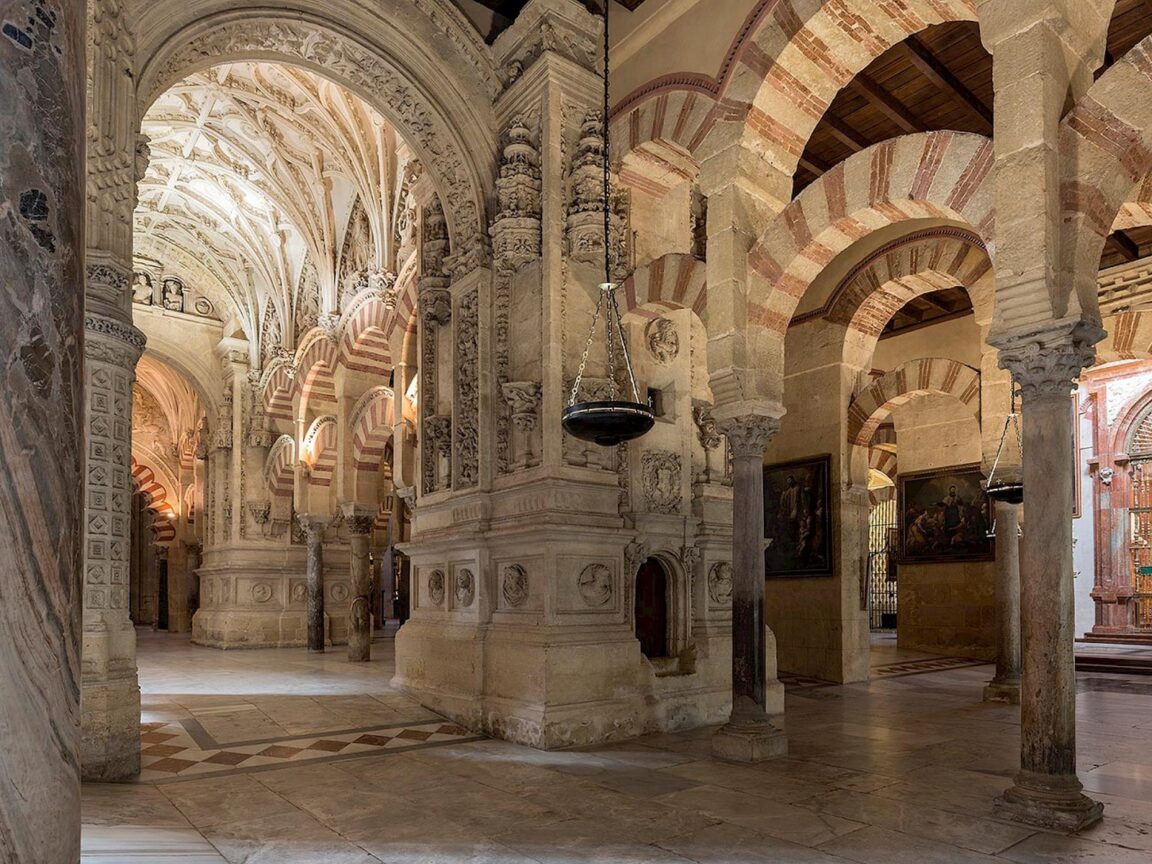
- The Mezquita: Mosque-Cathedral of Cordoba, begun in the 8th century, a forest of red and white arches with a Renaissance cathedral at its centre, and a working Catholic cathedral today
- Free hour: Monday to Saturday, 8:30 to 9:30, free entry for individual visitors, no groups; access closes at 9:20 and the building is cleared at 9:30, except on days of special celebration
- General ticket: 15 euros; 12 euros for over 65s and students aged 15 to 26; 8 euros for children aged 10 to 14; under 10s free; bell tower a separate 4 euro timed ticket (official site, checked 25 November 2026)
- Hours: Paid visits Monday to Saturday from 10:00, closing at 19:00 from March to October and 18:00 from November to February; Sundays and feast days split around Mass, 8:30 to 11:30 and from 15:00
- The patios: The Fiesta de los Patios runs in May, when the courtyards of San Basilio and the old town open to visitors; the Palacio de Viana shows patios year round
- The order: Mezquita, Jewish Quarter, Alcazar, Roman Bridge and Calahorra Tower, then patios and Viana on day two
- Dress: It is a working cathedral; covered shoulders and knees, and silence during services
Why should the Mezquita come first, and at opening?
Because the Mezquita is two experiences depending on the hour, and only one of them is unforgettable. From mid morning, the prayer hall fills with tour groups following flags through the arches, and the building becomes a queue with a masterpiece attached. In the free hour, it is something else entirely: a hushed, dim forest of columns, entered individually, with no guiding allowed, where the double arches of red brick and pale stone repeat into darkness in every direction and the scale of the place, nearly 800 columns still standing from the mosque’s expansions, can actually be felt. The rules of that hour are strict and are the reason it works: individual visitors only, entry stops at 9:20, and staff begin clearing the building at 9:30. Arrive at the Patio de los Naranjos, the orange tree courtyard, by 8:20, walk straight to the far side of the hall when you enter, and let the crowds of your own hour gather behind you at the entrance.
Use the paid visit as the second pass, not the first. With a general ticket, 15 euros at the official rate, you can return later in the day for the parts the free hour rushes: the cathedral choir and chapels at the centre, the gilded mihrab and the caliphal maqsura at the far wall, and the treasury. The bell tower, a separate 4 euro ticket in timed slots of about half an hour, is best climbed in the clear light of morning on day two, when the view takes in the courtyard grid, the old town roofs and the river in one turn. Buy tickets on the monument’s official site or at the Patio de San Eulogio visitor centre, and check the day’s hours there before either day, because a working cathedral’s calendar bends around feast days in ways no guidebook can predict.
How should the Jewish Quarter be walked in order?
Step out of the Mezquita and the Jewish Quarter, the Juderia, begins at its walls. Walk it as a loop, west and north from the monument, in this order. First, the Calleja de las Flores, the little flower filled lane that frames the postcard view back to the bell tower. Then the Synagogue on Calle de los Judios, one of only three medieval synagogues surviving in Spain, small, carved with Hebrew inscriptions and mudéjar plasterwork, and quick to visit; like the municipal museums, it closes on Mondays, which is worth knowing before you fix which day is which. Continue to the Casa de Sefarad museum opposite for the story of Jewish Cordoba, and the statue of Maimonides, the great philosopher born in this quarter, in the Plaza de Tiberiades. Then let the loop widen: the Puerta de Almodovar gate in the old wall, the Zoco municipal craft market in a courtyard off Deanes, and the little Calleja del Arco. The quarter rewards slowness, and it empties in the early afternoon, when much of Cordoba closes and the lanes belong to whoever stayed.
Day one’s afternoon belongs to the Alcazar de los Reyes Cristianos, five minutes southwest of the Mezquita: a fortress palace of towers and, above all, gardens, terraced pools, clipped hedges and orange trees laid out below the walls, with views back to the river. It also closes on Mondays, and its gardens are the part to prioritise if restoration work has parts of the palace closed, as has been the case recently; check the city museums page on the day. End the day where the plan promised: walk out onto the Roman Bridge at dusk, the long, low, many arched bridge over the Guadalquivir, rebuilt across the centuries on Roman foundations, and watch the light go off the water and the Mezquita together. The far end is guarded by the Calahorra Tower, now a museum of al-Andalus, worth its small ticket on day two for the rooftop view back.
What changes when the patios are in season?
If your two days fall in May, Cordoba rearranges itself around flowers. The Fiesta de los Patios, held across roughly the first half of May and recognised by UNESCO as Intangible Cultural Heritage, opens the private courtyards of the old town to visitors: whitewashed patios in the San Basilio quarter, around the Alcazar Viejo, and in Santa Marina, San Lorenzo and the streets near the Mezquita, each one a small garden theatre of geraniums, bougainvillea and jasmine tended all year for these days. Entry to most patios is free during the festival, with a donation culture and queues at the famous ones by midday; the tactic is to walk the San Basilio cluster early, take the siesta hours off, and return for the evening session, when the courtyards are lit and the owners are present and talking. Book May accommodation months ahead, because the festival fills the city as completely as Semana Santa fills Seville.
Outside May, the patios do not vanish; they concentrate. The Palacio de Viana, in the Santa Marina quarter, is a palace built around twelve patios, each in a different style and century, and it is the reliable year round patio visit, closed on Mondays like the rest of the municipal circuit. Pair Viana with the walk north through Plaza de la Corredera, Cordoba’s great rectangular plaza mayor, and the Roman Temple columns beside the town hall, and day two gains a second, lived in Cordoba beyond the monument quarter: markets, neighbourhood churches of the Fernandine route, founded by Ferdinand III across the old town, and tapas bars where salmorejo, the thick Cordoban tomato and bread soup crowned with ham and egg, is a civic obligation rather than a menu item. That balance, one day for the caliphal and Jewish city, one for the courtyard city, is what two days are for.
What should you know before you go?
Three practicalities decide whether this itinerary feels easy. First, the Monday problem: the Synagogue, the Alcazar and most municipal museums close on Mondays, while the Mezquita’s free hour runs Monday to Saturday; if your two days include a Monday, put the Mezquita free hour, the bridge, Viana’s exterior quarter and the river walks on Monday, and keep the ticketed quarter sights for the other day. Second, the heat: Cordoba is one of Europe’s hottest cities in summer, regularly passing 40 degrees, and the two day plan in July or August should invert itself, sights at opening and in the evening, a long indoor middle, and the bridge at a dusk that comes after nine. Spring, especially the patio weeks, and autumn are the city’s great seasons. Third, arrivals: Cordoba sits on the high speed line between Madrid and Seville and Malaga, under two hours from Madrid, which makes the two day stay an easy add on to an Andalusian loop rather than a trip of its own. For the Seville end of that loop, see our Seville tapas bars guide, and for the Madrid end, our Prado Museum first visit guide.
Frequently Asked Questions
Is the Mezquita really free in the early morning?
Yes. From Monday to Saturday, individual visitors enter free between 8:30 and 9:30, except on days of extraordinary celebration. Groups are not admitted in that hour, access closes at 9:20, and the visit is silent and unguided, which is precisely why it is the calmest way to see the building.
How much does the Mezquita cost at other times?
General admission is 15 euros, with reduced rates of 12 euros for over 65s and students aged 15 to 26, and 8 euros for children aged 10 to 14; children under 10 enter free. The bell tower is a separate timed ticket at 4 euros. Prices are those published on the official site, checked in November 2026.
When is the Patios Festival?
In May, across roughly the first half of the month, when dozens of private courtyards, concentrated in San Basilio and the old town quarters, open to the public. Exact dates are set by the city each year. Outside the festival, the Palacio de Viana’s twelve patios give the year round version.
Are two days enough for Cordoba?
For the city itself, yes, comfortably, because the historic centre is compact and walkable: Mezquita, Juderia, Alcazar, bridge and patios all sit within about twenty minutes of each other. The one worthwhile extra, the ruined caliphal palace city of Medina Azahara outside town, is the sight to add if a third day appears.
What should I wear for the Mezquita?
Dress as for a working cathedral, because it is one: shoulders and knees covered, hats removed inside, and silence during services. Tourist visits pause around Mass on Sundays and feast days, when the morning visiting hours end at 11:30 and resume in the afternoon.
Image: Inside the Mosque-Cathedral of Cordoba, where the mosque red and white arches meet the Renaissance cathedral. Photo from the Mosque-Cathedral official website (mezquita-catedraldecordoba.es), used with credit.