 Lucas Meyer
The honest answer for a long JFK layover is that the airport sits next to one of the best bird reserves in the eastern United States, and most travellers never learn it is there. The Jamaica Bay Wildlife Refuge, part of Gateway National Recreation Area, protects more than 12,600 acres of salt marsh, ponds and bay a short hop from the terminals, and its trails are open daily from 6 a.m. to 9 p.m. Pair it with the TWA Hotel at Terminal 5, where the restored 1962 flight centre and its rooftop pool sit inside the airport itself, and a long layover splits cleanly in two: wild marsh first, while your energy is fresh, then an hour of mid-century glamour and a swim back inside the airport fence, with security re-entry as the final, non-negotiable appointment.
Quick Facts
- The refuge: Jamaica Bay Wildlife Refuge, Gateway National Recreation Area, over 12,600 acres of water, salt marsh, freshwater and brackish ponds, upland fields and woods
- Refuge hours: Trails and parking lot open daily 6 a.m. to 9 p.m.; the Visitor Center is open Saturday and Sunday, 10 a.m. to 4 p.m. (National Park Service)
- The birding: On the Atlantic Flyway; spring and autumn migration are the peak seasons, with the West Pond trail the classic short walk
- The hotel: TWA Hotel, in the restored 1962 TWA Flight Center at Terminal 5, reached by the free AirTrain between terminals; its rooftop pool is open to guests and day visitors by reservation in season, so check the hotel site for the current pool arrangement before you count on it
- The transport reality: The refuge is not on the AirTrain line; reaching it means a taxi or rideshare from the terminals, or the AirTrain to Howard Beach plus a bus or a walk that eats too much of a layover
- The buffer: Be back inside your departure terminal 90 minutes before a domestic departure and 2 hours before an international one, and treat those as floors, not targets
- Checked: Refuge hours and facilities checked against nps.gov on 25 November 2026
Should you leave the airport at all?
Start with the decision most layover guides skip. Leave JFK only if three things are true at once: you have at least seven hours between flights, your bags are checked through or stored, and you are legally able to enter the United States or are already landside on a domestic connection. Under seven hours, the refuge trip becomes a taxi ride with a walk attached, and the better layover is the TWA Hotel alone, which never takes you outside the airport’s own transport loop. Between seven and nine hours, the refuge works as the single outside trip, with the TWA hour as the reward at the end. Beyond nine hours, both fit comfortably and the order in this guide, marsh first, pool second, still holds, because the refuge’s 9 p.m. trail closing and the daylight needs of birding both argue for doing the wild part early.
There is one more condition, and it is about you rather than the clock. Jamaica Bay is a real refuge, not an airport garden: exposed marsh, weather off the water, and trails where the interest is in what flies, feeds and nests there. In migration season it is genuinely thrilling, with shorebirds working the mudflats and raptors over the marsh. Outside migration, it is a big, quiet, beautiful edge-of-the-city landscape that rewards walkers and frustrates anyone who wanted an attraction. Go for the place it is, and the layover becomes the rare one that feels like a trip inside the trip.
How do you get to Jamaica Bay from the terminals?
The National Park Service gives the transit route plainly: the A train to Broad Channel station, then a walk along Noel Road to Cross Bay Boulevard and three quarters of a mile up the boulevard to the Visitor Center. From JFK that means the AirTrain to Howard Beach, a change to the A train, and the walk, a chain that can consume an hour in each direction if the connections fall badly. On a layover, that arithmetic fails. The working option is a taxi or rideshare from your terminal to the refuge entrance on Cross Bay Boulevard, roughly eight miles, with the same ride booked or flagged for the return. Agree the pickup point before you get out: the Visitor Center car park is the landmark both you and the driver can find.
Once there, keep the walk simple. The West Pond trail is the refuge in miniature, a loop of about a mile and a half past the pond, the marsh and the bay shore, with the Manhattan skyline in the distance as the reminder of where you actually are. The East Pond is the birders’ serious ground in late summer and autumn, when shorebirding there is famous, but it demands more time, more local knowledge and, in season, boots for muddy edges. On layover time, walk the West Pond loop slowly, scan the pond edges and the marsh, and let one good hour of paying attention do the work. Restrooms exist only when the Visitor Center is open, which the Park Service lists as weekends, 10 a.m. to 4 p.m., so plan a weekday visit accordingly. Dogs are not allowed at the refuge at any time.
What is the TWA pool hour, and how does it fit?
Back at the airport, the second half of the layover needs no taxi at all. The TWA Hotel occupies Eero Saarinen’s 1962 TWA Flight Center, the swooping white terminal at Terminal 5, and it is connected to the terminal system by the free AirTrain that loops the airport. The building itself is the first exhibit: the Sunken Lounge, the flight tubes, the split flap departure board, and a vintage Lockheed Constellation parked outside as a cocktail lounge. None of that requires a room booking, which is why the hotel works so well as layover infrastructure: you can walk in off the AirTrain, look at everything, and leave.
The rooftop pool is the piece to organise. It overlooks the runways, it is heated, and access for non-guests runs by reservation, with the arrangement and price set by the hotel and varying by season. Check the hotel’s own site on the day, book the slot that lands you back with your buffer intact, and treat the swim as a fixed appointment in the middle of the landside time, not as something to drift into. One hour is the right dose: swim, watch aircraft move below you, shower, change, and be walking back to your terminal with time in hand. If the pool is fully booked or closed for weather, the hour converts painlessly into the Connie cocktail lounge and the exhibits, and nothing else in the plan changes.
How much security buffer does each terminal really need?
The buffer question has a boring answer and a true one. The boring answer is the standard guidance: 90 minutes for domestic, two hours for international. The true answer is that JFK’s terminals are separate buildings joined by the AirTrain, and your real risk is not the security queue alone, it is the sum of the taxi back from the refuge, the AirTrain ride if your departure terminal differs from Terminal 5, the queue, and the walk to a far gate. Build the day backwards from the earlier of two deadlines: be through security by the time boarding begins minus your walk, and be back at the airport complex a full hour before that. In practice, for an eight hour layover, that means the refuge gets the first three hours, the TWA hour sits in the middle, and the last ninety minutes belong to the airport. Any version of the day that borrows from that final block to extend the marsh walk is borrowing against the flight itself.
Two practical notes complete the picture. First, the AirTrain is free for movement between terminals and to the hotel, and charges a fare only at the Jamaica and Howard Beach exits to the subway and rail system, which is one more reason the taxi beats transit for the refuge run. Second, if your layover is long because of an overnight gap, the TWA Hotel sells day stays as well as overnight rooms, and a few hours of sleep in a quiet room beats every other use of the time. Layovers are a logistics problem before they are a sightseeing opportunity, and this airport rewards travellers who solve them in that order. For another airport that has formalised the long connection, see our guide to Incheon Airport layover transit tours, and for an onward trip upstate after a New York arrival, our Hudson Valley three day rail itinerary picks up where the AirTrain leaves off.
Frequently Asked Questions
How long do I need at JFK to visit Jamaica Bay?
Seven hours between flights is the practical minimum, and eight is comfortable. The refuge trails are open daily from 6 a.m. to 9 p.m., so an early arrival and an evening departure frame the visit best. Shorter layovers should stay with the TWA Hotel inside the airport.
Can I walk from the AirTrain to the refuge?
Not sensibly on layover time. The Park Service transit route runs through Broad Channel station and a three quarter mile walk up Cross Bay Boulevard, and reaching that station from JFK involves the AirTrain and the A train. A taxi from the terminal is the layover-grade option in both directions.
Do I need to be a hotel guest to use the TWA pool?
No, but non-guest pool access runs by reservation and the terms vary by season, so confirm the current arrangement on the TWA Hotel site before you build the layover around it. The lobby, exhibits and the Constellation lounge are open to visitors without a booking.
When is the best season for birds at Jamaica Bay?
Migration seasons, spring and especially the long autumn passage, when the refuge sits directly on the Atlantic Flyway and the ponds and mudflats fill with shorebirds, waders and waterfowl. Summer brings breeding birds and biting insects in equal measure; carry repellent for any warm weather visit.
What if my onward flight is from a different terminal?
Add the AirTrain ride to your buffer and check the terminal before you leave for the refuge, not after. The free terminal loop is quick, but a wrong assumption about which terminal you need is the classic way a comfortable JFK layover becomes a run.
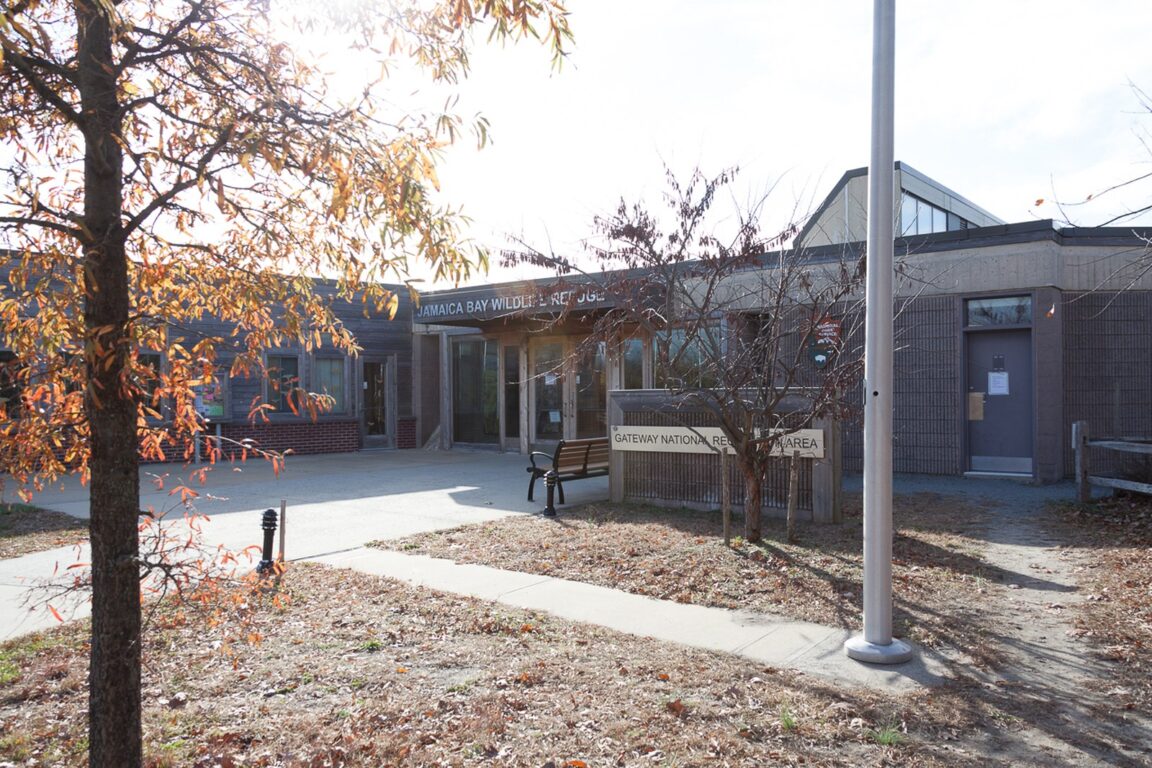
Image: The Jamaica Bay Wildlife Refuge Visitor Center in autumn sun. Photo by the National Park Service, from nps.gov, the refuge official site, used with credit.