 Hana Kim
Museum SAN justifies the detour from Seoul on architecture alone, before a single artwork is considered. Set along a ridge in the hills of Oak Valley near Wonju, the museum, designed by Tadao Ando and opened in May 2013, is arranged as a slow sequence of gardens, water, stone and concrete that takes most visitors half a day to walk properly. Add the James Turrell Hall, where light itself is the exhibit, and the newer GROUND installation by Antony Gormley, both entered on separate timed tickets, and the detour becomes the point of the day. This guide explains the route room by room, the ticket tiers that decide what you can enter, and the bus timing from Wonju station that shapes the trip.
Quick Facts
- Name: Museum SAN, for Space, Art, Nature; SAN also means mountain in Korean
- Location: 260 Oak Valley 2-gil, Jijeong-myeon, Wonju-si, Gangwon-do, South Korea
- Architect: Tadao Ando; operated by the Hansol Cultural Foundation; opened 16 May 2013
- Hours: 10:00am to 6:00pm, last admission 5:00pm; closed Mondays, with the monthly closing pattern published by the museum, checked on 25 November 2026
- Tickets: Basic pass adult KRW 23,000; passes including the James Turrell Hall adult KRW 39,000; higher combination and Signature passes up to KRW 59,000, as listed for 2026 and checked on 25 November 2026
- Site length: About 700 metres from the Welcome Center to the James Turrell Hall
- Time needed: Two hours for the basic route; three to four hours with the special halls
- Phone: +82 33 730 9000
What is the idea behind Museum SAN?
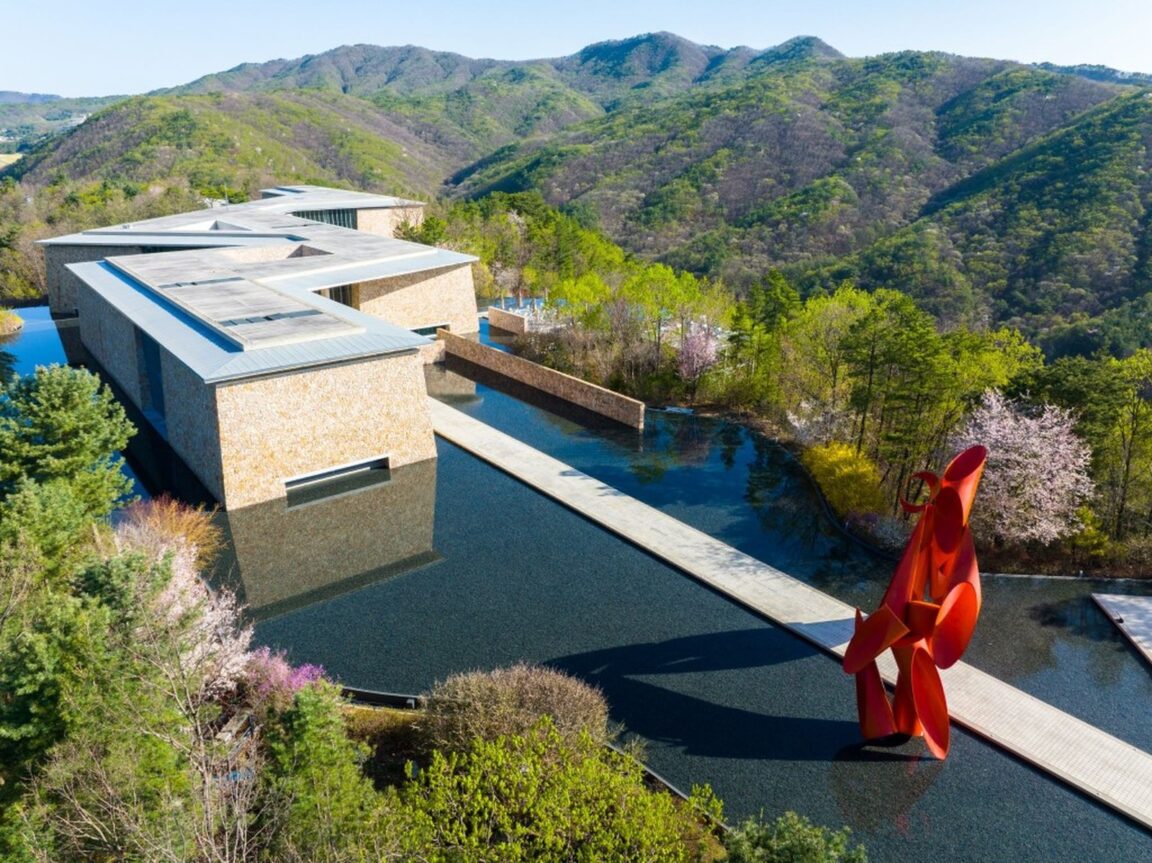
The museum’s own slogan is Disconnect to Connect, and the site is engineered to enforce it. There is no single front door and atrium. Instead, the visit begins at a Welcome Center and unfolds as a walk of about 700 metres along the mountain top: a Flower Garden, a Sculpture Garden, then the Water Garden, where the main building appears to float on a sheet of water, the main galleries themselves, a Stone Garden built around ancient style stone mounds, a Meditation Hall added for the museum’s tenth anniversary period, and finally, at the far end of the ridge, the James Turrell Hall. Ando’s materials are his signatures: exposed concrete, local honey coloured stone cladding on the main building’s four linked boxes, and carefully cut openings that frame sky, water and hillside. The building opened in 2013 as the Hansol Museum and was renamed Museum SAN in 2014; SAN stands for Space, Art, Nature.
The slowness is deliberate, and it is the first thing to plan around. Travellers who arrive expecting a city museum rhythm, in at ten, out by eleven thirty, will either rush the gardens that carry half the meaning or miss a timed entry they have already paid for. Treat the museum as a half day landscape walk with galleries inside it, and the whole visit relaxes.
What do the different tickets actually include?
Every ticket includes the basic route: the outdoor gardens, the Paper Gallery, which draws on the founding Hansol paper collection and explains the material Korea has made for centuries, and the Cheongjo Gallery’s art exhibitions in the main building. The special halls are then added in tiers, and this is where visitors most often make mistakes at the ticket desk.
The James Turrell Hall is a separate timed entry. Inside are works including a Skyspace, a Horizon Room, a Ganzfeld and a Wedgework, in which coloured light fills rooms and dissolves edges until depth becomes guesswork. Photography is not allowed inside, groups enter at set times roughly every thirty minutes, and young children are admitted only at a designated afternoon session with a guardian. The Meditation Hall and the GROUND installation, an underground concrete dome by Ando and Antony Gormley opened in 2025, with cast iron figures beneath a central oculus, are likewise separate timed entries. Combination passes bundle two special halls, and the Signature pass bundles everything. Adult prices listed for 2026 run from KRW 23,000 for the basic pass to KRW 39,000 for a pass including the James Turrell Hall and KRW 59,000 for the Signature pass, checked on 25 November 2026; youth and child rates are lower, and preschool children are not admitted to some combination passes at all, which families should check before choosing a tier.
The practical rule is simple: decide on the Turrell Hall before you arrive, because its slots sell out first, especially on weekends, then build the rest of the route around your entry time. Online booking can require Korean mobile verification, which leaves many overseas visitors buying timed slots at the Welcome Center on arrival; on a busy day that means arriving at the 10:00am opening and securing the Turrell slot before walking the gardens.
How should you sequence the route?
Walk it in the order Ando built it, but manage your clock. Start through the Flower Garden and Sculpture Garden without lingering too long, cross the Water Garden slowly, because the reflection of the main building is the museum’s signature view and the light is best before midday crowds arrive, then take the Paper Gallery and the main building galleries in order. The Stone Garden, with its rows of stone mounds under the sky, works as a pause before the special halls at the far end of the site. If your Turrell entry is late in the visit, the Meditation Hall’s quiet dome is a good near neighbour while you wait; if your entry is early, reverse the temptation and do not sprint: the walk from the Welcome Center to the Turrell Hall alone takes about twenty minutes at an easy pace, and the staff will not hold a missed slot on a sold out day.
Exhibitions in the main galleries change through the year, so the permanent architecture and the Turrell works remain the reliable core of any visit, with the current special exhibition as a bonus rather than the reason for the trip. Readers planning a wider Korean culture day can pair this guide with our Leeum and National Museum day in Seoul, which takes the opposite approach, two dense city collections in one day, and with our guide to mistakes to avoid in Seoul’s palace circuit for the capital’s other great timed entry system.
How do you get there from Seoul and Wonju station?
Wonju is the gateway. KTX trains from Seoul and Cheongnyangni reach Wonju in roughly an hour, and express buses serve the city as well. From Wonju station and the Wonju bus terminal, local buses and taxis climb to Oak Valley, where the museum sits; the final leg is the part to plan carefully, because buses are infrequent compared with city routes and the museum is a resort area site, not a downtown one. Allow a clear margin between your train’s arrival in Wonju and any timed museum entry, and keep the taxi option in reserve for the return if a bus gap threatens your train home. By car, the museum is roughly ninety minutes to two hours from Seoul depending on traffic, and parking is at the Welcome Center end of the site. The museum is closed on Mondays as its regular closing day, though the museum publishes a monthly schedule in which some Mondays open and other weekdays close, so confirm the exact date on the official site before fixing a day trip around it.
What should you know before you go?
Three practical points decide whether the day works. First, weather: much of the route is outdoors, the gardens and the walks between buildings are exposed, and the Water Garden and Stone Garden lose their effect in heavy rain, so a clear day is worth waiting for if your itinerary flexes. Second, pace and footwear: 700 metres each way, plus gallery time, on stone and gravel paths, calls for comfortable shoes rather than formal ones. Third, expectations inside the Turrell Hall: the works ask for stillness, sessions are guided and timed, phones and photography are excluded, and visitors who find enclosed coloured light spaces uncomfortable can step out with staff help. None of this is a warning against going. It is the reason the museum’s name fits: the space, the art and the nature are one continuous exhibit, and the travellers who slow down for it consistently rate it among the best museum days in Korea.
Frequently asked questions
Is Museum SAN worth a day trip from Seoul?
Yes, provided you give it half a day rather than squeezing it into a morning. The Ando architecture, the garden sequence and the James Turrell Hall together make a visit unlike any museum in the capital, and the Wonju train leg is only about an hour.
How much are Museum SAN tickets?
Adult prices listed for 2026, checked on 25 November 2026, start at KRW 23,000 for the basic pass covering the gardens and galleries, KRW 39,000 for a pass including the James Turrell Hall, and up to KRW 59,000 for the Signature pass including all special halls. Youth and child prices are lower.
Do I need to book the James Turrell Hall separately?
Yes. The Turrell Hall, the Meditation Hall and GROUND are timed separate entries added on top of the basic pass, bought as tiered passes. Turrell slots sell out first; overseas visitors who cannot book online should arrive at opening and buy the slot at the Welcome Center.
What are the opening hours and closing days?
The museum opens 10:00am to 6:00pm with last admission at 5:00pm. Monday is the regular closing day, but the museum publishes a monthly schedule with variations, so check the official site for your exact date.
How long does a visit take?
About two hours for the basic route and three to four hours with one or more special halls, including the 700 metre walk along the ridge. Build your Wonju bus or taxi connection around that, not around a shorter estimate.
Can children visit the James Turrell Hall?
Yes, but only at a designated afternoon session with a guardian, and some combination passes exclude preschool children entirely. Check the age rules for your chosen pass at the ticket desk before paying.
Featured image: Museum SAN in Wonju, Tadao Ando’s museum above the hills. Photo: Museum SAN, via museumsan.org, the museum’s own official website, used with credit.