 Rafael Santos
A group week in Costa Rica holds together when it is built as two camps, not seven days of transit: three to four nights in La Fortuna under Arenal Volcano for rafting, canyoning, hanging bridges and the hot springs, then three nights on the Pacific coast for surf and slower days, with one shared van and driver moving everyone at once. Splitting the week that way keeps the group’s shared experiences dense, gives the drivers and the hungover a humane schedule, and, on the money, one chartered van for the long transfers almost always beats three rental cars once fuel, insurance and the second and third drivers’ exhaustion are priced honestly.
The structure works because Costa Rica’s greatest hits are arranged kindly for it. Arenal Volcano National Park, open daily from 8 a.m. to 4 p.m. under SINAC, the national conservation authority, anchors the inland half: lava flow trails from the 1968 eruption, a 400 year old ceiba tree, and viewpoints over Lake Arenal. The coast then changes the sport entirely. What follows is the week, day by day, with the group logistics, the decisions that cause arguments, settled in advance.
Quick Facts
- The split: Nights 1 to 3 or 4 in La Fortuna and Arenal; nights 4 or 5 to 7 on the Pacific coast. One move, not a tour of one night stands.
- Arenal Volcano National Park (SINAC): Open daily 8 a.m. to 4 p.m. Non resident adult entry US$15, child US$5. Climbing the volcanic cone itself is absolutely forbidden.
- Park trails: Heliconias, 610 metres and flat; Las Coladas, 1.7 km to views of the cone and Lake Arenal; El Ceibo, 2.3 km to the great ceiba tree.
- Arenal days: White water rafting on the Balsa or Toro rivers, canyoning and waterfall rappelling, hanging bridges, and hot springs every evening as the group’s default social hour.
- Coast days: Surf lessons at the group’s level, beach time, and one boat trip if the budget allows. Build in one plan free day.
- Transport maths: One private van with driver for airport pickup, the Arenal to coast transfer and excursion days, against three rental cars with three sets of deposits, insurance, fuel and designated drivers.
- Getting there: La Fortuna is roughly a three hour drive from San Jose’s Juan Santamaria International Airport. Day one should promise nothing more than arrival, dinner and the hot springs.
How should the Arenal days be sequenced for a group?
Put the highest energy activity on the first full day, when group enthusiasm peaks and before anyone has a sunburn or a twisted ankle. For most groups that is white water rafting, run as a full day on the Balsa or Toro with the whole party in two or three rafts, lunch included and nobody driving afterwards. Day two belongs to the volcano itself at human pace: the national park in the morning, walking Las Coladas across the old lava flows while the cone is most likely to be clear of cloud, then the hanging bridges in the afternoon canopy, and the hot springs in the evening, which in La Fortuna function as the group’s living room, part recovery, part debrief, part plan for tomorrow.
Day three is the flex day, and keeping it genuinely optional is what stops a friends trip from becoming a school trip. Canyoning and waterfall rappelling for the adrenaline contingent, La Fortuna Waterfall’s steep stair descent for the swimmers, a coffee and chocolate tour or a lie in for everyone else. Groups fracture when every hour is compulsory and unanimous; they hold together when the default plan is good and opting out costs nobody anything, including socially.
Why does one shared van beat three rental cars?
Run the real comparison, not the headline rental rate. Three cars mean three collision damage waivers and deposits, three fuel bills, three navigation arguments on mountain roads, and, the hidden cost, three friends who cannot drink at lunch, must stay alert on the long transfer day, and arrive at the coast as tired as if they had worked. A private van with a local driver consolidates all of it into one quoted price, turns the three hour transfers into group time or sleep, handles the unpaved final stretches to lodges and beaches that punish small rental cars, and gives the group a local who knows which rafting operator is running which river level this week.
The van does not need to cover every hour. Book it for the airport arrival, the inter region transfer and the big excursion days, and let taxis and walking cover evenings in La Fortuna and the coast town, where distances are short. Agree the kitty rules before departure: one shared fund for group meals, transfers and tips, personal extras settled individually, and one named person holding the float. Money ambiguity, not adventure, is what actually ends group trips badly. The same settle it early logic runs through our Lisbon bachelorette weekend plan, which uses the same two base, one flex day structure in a city setting.
How should the coast days be run so the week ends well?
Choose one coast base and stay in it. On the Nicoya side, Santa Teresa suits a younger, surf first group; further north, the Tamarindo area offers the widest spread of lessons, restaurants and room stock for mixed groups, and Manuel Antonio, reached from Arenal by a longer southern transfer, pairs the beach with a national park famous for wildlife. Whichever you choose, book the group’s surf lessons for the first coast morning, when the week’s confidence is high and there are still days left to practise, and put beginners on soft top boards with a proper school rather than letting the group’s one experienced surfer teach, which is how shoulders get dislocated and friendships get tested.
Then slow down deliberately. The coast half earns its place as contrast: one boat trip or snorkel morning if the group wants it, long lunches, a sunset that becomes the week’s photograph, and the final dinner booked somewhere better than the nightly default. Keep the last day empty of everything except the transfer back, because Costa Rican roads reward buffer time, and an international departure is the worst possible place to test a tight itinerary. Groups that have climbed, rafted and surfed all week should also respect the altitude to sea level swing in their bodies; a rest first coast day is programming, not laziness. For a different kind of group mountain day, our Table Mountain back routes guide shows the same pacing principle applied to a single big hill.
Frequently asked questions
How many days do you need in Arenal?
Three nights is the working minimum: one rafting day, one volcano and bridges day, and one flex day, with hot springs in the evenings. Four nights suits groups who want canyoning as well without stacking two big activities into a day.
How much does Arenal Volcano National Park cost?
SINAC lists entry at US$15 for a non resident adult and US$5 for a non resident child, with the park open daily from 8 a.m. to 4 p.m. Guided activities, rafting and hot springs resorts are priced separately by their operators.
Can you climb Arenal Volcano?
No. SINAC states that climbing the volcanic cone and its immediate surroundings is absolutely forbidden. You experience Arenal from its trail system, including the Las Coladas lava flow trail and the viewpoints toward the cone and lake.
Is it better to rent cars or hire a van for a group in Costa Rica?
For a group of six or more making the Arenal to coast transfer, one private van with driver usually wins on total cost and always wins on effort: one deposit, one fuel bill, no designated drivers, and local knowledge on mountain and unpaved roads.
When should a group avoid Costa Rica?
The wettest months, roughly September and October on the Pacific side, bring the heaviest rain and the most disrupted activities. The dry season from December to April is the reliable window for this itinerary, at peak season prices.
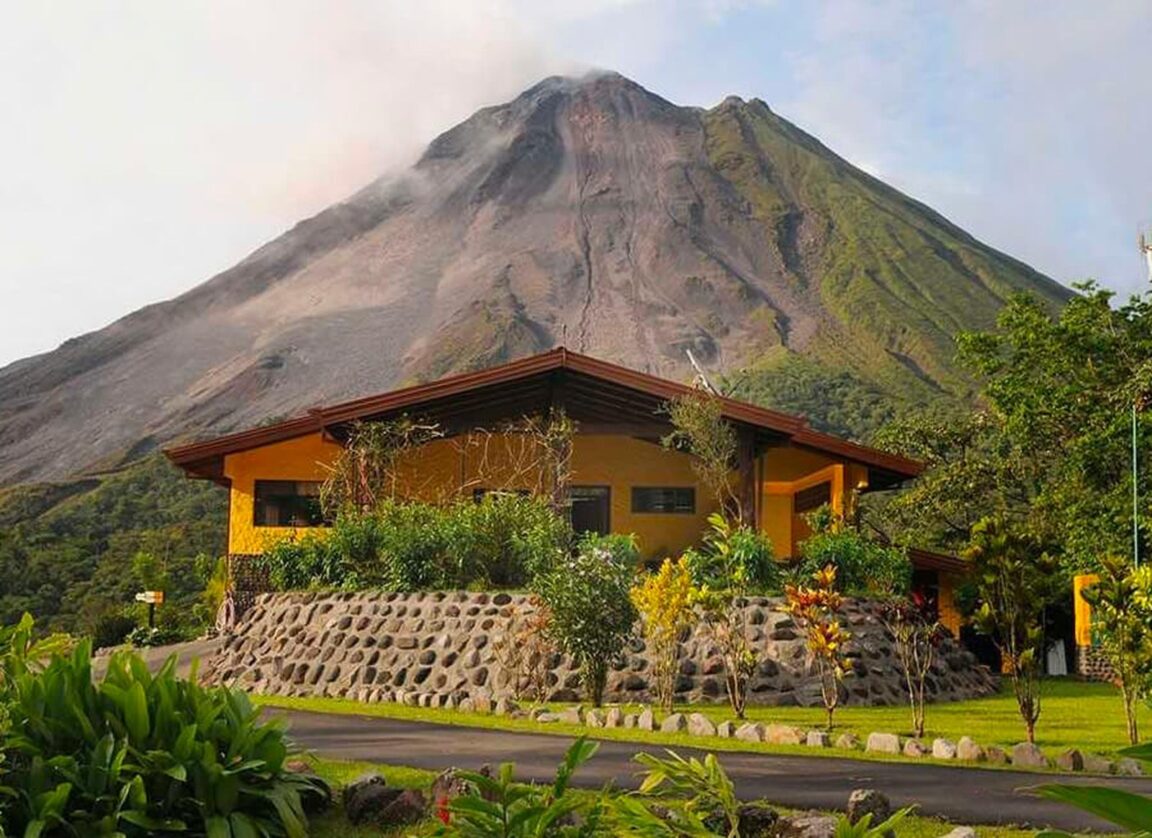
Image: Arenal Volcano rising behind the White Hawk Villa at Arenal Observatory Lodge, the only hotel inside Arenal Volcano National Park, Costa Rica. Photo via Arenal Observatory Lodge, arenalobservatorylodge.com, the property’s official website. Used with credit.