 River Callahan
Joshua Tree’s night sky is the attraction, and the park service plans for it that way: the National Park Service names four designated stargazing parking areas, identifies Cottonwood Campground and the Pinto Basin Road corridor as the darkest ground in the park, and asks visitors to stay awake and within 20 feet of their vehicle at the pullouts. Go on a moonless night, dress for a desert that turns genuinely cold after sunset, and book the southern campgrounds early, because the darkest sites are the first to go on new moon weekends.
Joshua Tree is a designated International Dark Sky Park, and the NPS describes it as offering some of the darkest nights in Southern California. That darkness is not evenly spread. The western side of the park sits closer to the light of Palm Springs and the Morongo Basin, while the eastern and southern reaches, down Pinto Basin Road toward Cottonwood, hold the deepest dark. Where you park after sunset matters as much as when you come.
Quick Facts
- Designated stargazing areas (NPS): The parking lots at Quail Springs, Hidden Valley, Cap Rock and Ryan Mountain.
- Darkest ground: Cottonwood Campground and Pinto Basin Road between the Cholla Cactus Garden and Cottonwood, per NPS guidance.
- The rule at pullouts: Stay awake and within 20 feet of your vehicle. No overnight parking or roadside camping.
- Park hours: Open 24 hours a day, every day of the year. Entrance fees still apply.
- Cottonwood Campground: 62 sites, reservations required year round on Recreation.gov, listed at $35 per night plus the park entrance fee, with drinking water and flush toilets.
- Eye adjustment: Allow 20 to 30 minutes for full dark adaptation, and use red light only once you are set up.
- Best planning tool: The moon phase. Bright moonlight washes out faint stars, so new moon weekends are the prize dates.
Where are the darkest places to stargaze in Joshua Tree?
Start with the NPS answer and work outward. The four designated stargazing areas, the parking lots at Quail Springs, Hidden Valley, Cap Rock and Ryan Mountain, are the sanctioned places to be in the park after dark without a campsite. They suit a single evening visit: arrive before sunset, let the light go, and stay beside the car as the rules require. Hidden Valley and Cap Rock put you among the boulder piles of the park’s famous western half, with Joshua trees silhouetted in the foreground of your sky.
For the darkest sky, drive south. NPS guidance names Cottonwood Campground as the darkest of the park’s nine campgrounds, far from town lights on the Colorado Desert side, and the stretch of Pinto Basin Road between the Cholla Cactus Garden and Cottonwood as the least trafficked, darkest corridor. The trade is distance: Cottonwood sits near the south entrance off Interstate 10, a long drive from the Joshua Tree and Twentynine Palms entrances, and its landscape is open desert rather than boulder fields. Photographers chasing the Milky Way core over a foreground subject often accept the western pullouts and their slightly brighter sky in exchange for the rocks and trees.
How cold does a Joshua Tree night actually get?
Colder than the daytime forecast suggests, in every month. Desert air holds little moisture, so heat leaves fast after sunset, and a mild afternoon can become a night that demands a proper insulated jacket, warm hat and gloves for anyone standing still beside a telescope or tripod. Stargazing is a stationary activity, which makes it feel colder than a hike at the same temperature. Dress for standing around in winter conditions even on a spring or autumn trip: insulated layers, wind protection, closed footwear, and a warm drink in a flask. Campers should rate their sleeping bags honestly for desert nights rather than for the daytime high.
The same dryness that chills you also dehydrates you, and there is no water at most pullouts and trailheads. Carry water for the night as well as the day, download maps before you lose signal inside the park, and tell someone where you plan to stop, because large parts of the park have no mobile coverage.
Which campgrounds book first for new moon weekends?
Cottonwood, for the darkness, and Jumbo Rocks, for the boulders and its 124 sites scattered through granite formations, lead the reservation rush, with Black Rock, Indian Cove and Ryan also reservable. The reservation window on Recreation.gov runs up to six months ahead, and NPS warns that park campgrounds are usually full on weekends from September through May, the prime stargazing season when nights are long and temperatures are workable. Hidden Valley, White Tank and Belle remain first come, first served, which makes them a gamble on a new moon Friday rather than a plan.
The practical order for a dark sky trip: pick your new moon dates first, set a reminder for the six month reservation opening, book Cottonwood or Jumbo Rocks the day the window opens, and keep a first come campground as the fallback rather than the strategy. If the park is full, gateway towns including Joshua Tree, Yucca Valley and Twentynine Palms hold motels and rentals a short drive from the north entrances, at the cost of driving back out after your session. Our overview of which national parks still require reservations helps place Joshua Tree in the wider system before you plan a multi park trip.
How do you get the most from the sky once you are there?
Arrive in daylight and scout your foreground, because boulder piles and Joshua trees are what turn a star photograph, and a night’s viewing, from generic to specific. Give your eyes the full 20 to 30 minutes of dark adaptation the NPS recommends, use red light only, and keep phone screens dimmed and faced down; one blast of white light resets everyone’s night vision, not just yours. Check the moon phase and moonrise time before choosing a date, and check the park calendar on arrival, since rangers run night sky programs through the year and the annual Night Sky Festival, held mainly at Sky’s the Limit Observatory in Twentynine Palms, is ticketed and capacity limited.
Season changes the show. Summer brings the bright Milky Way core but also extreme daytime heat and monsoon cloud risk; winter brings long nights, the crispest air and the coldest sessions. For a first desert dark sky trip, a moonless weekend in the cooler months, with a booked southern campsite and a warm layer you almost resent carrying, is the version of Joshua Tree that converts people. It pairs well, on a longer desert itinerary, with the very different skies in our guide to Atacama Desert stargazing in Chile.
Frequently asked questions
Can you stargaze in Joshua Tree without camping?
Yes. The NPS designates four parking areas for stargazing, at Quail Springs, Hidden Valley, Cap Rock and Ryan Mountain. Stay awake and within 20 feet of your vehicle, and do not sleep in the car or camp at the pullout.
What is the darkest campground in Joshua Tree?
Cottonwood Campground, near the south entrance, is named by the NPS as the darkest of the park’s nine campgrounds. It has 62 reservable sites, drinking water and flush toilets.
When is the best time of year for stargazing in Joshua Tree?
The September to May season offers long nights and workable temperatures, and campgrounds fill on weekends in those months. Choose a new moon weekend whenever you can, since moonlight is the single biggest variable.
Do I need a reservation for Joshua Tree campgrounds?
For Black Rock, Cottonwood, Indian Cove, Jumbo Rocks, Ryan and the Sheep Pass group sites, yes, through Recreation.gov, up to six months ahead. Hidden Valley, White Tank and Belle are first come, first served.
How should I dress for a night of stargazing in the desert?
For standing still in the cold: an insulated jacket, warm hat and gloves, layered clothing and closed shoes, even when the afternoon was mild. Desert temperatures fall fast after sunset in every season.
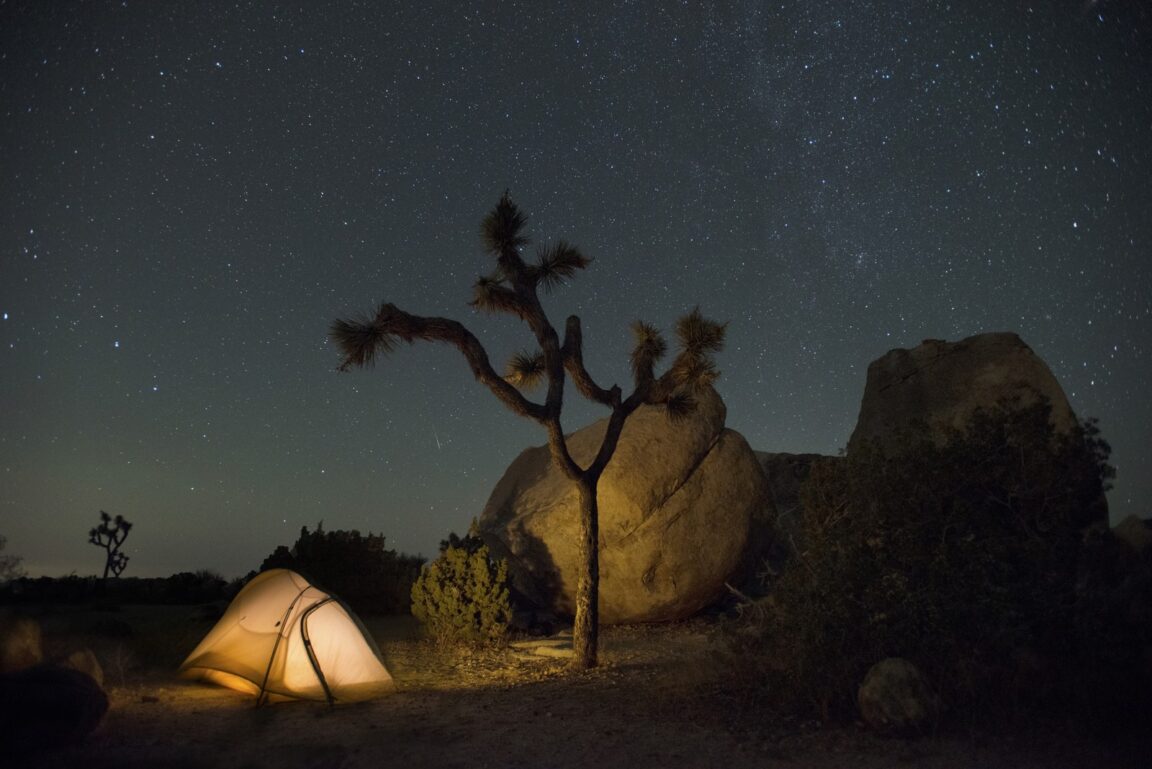
Image: A starry sky over Joshua trees and a campground tent at night in Joshua Tree National Park, California. Photo by Hannah Schwalbe, National Park Service, via npgallery.nps.gov, the park’s official source. Public domain, used with credit.