 Lucas Meyer
Great Sand Dunes is a park that runs on two clocks, and the whole visit improves once they are separated: daylight belongs to temperature, with cool sand in the morning, a surface that can turn punishingly hot by summer afternoon, and sledding saved for the soft light at either end of the day, while darkness belongs to the sky, in a certified International Dark Sky Park where the Milky Way needs no equipment on a clear, moonless night. Medano Creek, the shallow snowmelt stream at the base of the dunes, is the third clock and the shortest: it flows only in spring and early summer, peaking around late May into June. Rent a proper sand sled before you arrive, because the park rents nothing and ordinary snow gear does not slide, then order the day as creek or climb in the morning, shade at midday, sleds in the evening and stars from the campground or the amphitheatre area after dark.
Quick Facts
- Park: Great Sand Dunes National Park and Preserve, San Luis Valley, southern Colorado
- The dunes: The tallest in North America, rising up to about 750 feet against the Sangre de Cristo Mountains
- Hours: The park is open 24 hours a day, year-round; night entry is part of the point
- Entrance: $25 per private vehicle for 7 days; $45 for the park annual pass, per the National Park Service
- Dark sky status: Certified International Dark Sky Park since 2019
- Medano Creek: Seasonal snowmelt flow in spring and early summer only, typically peaking late May to early June, then drying up
- Sledding: Only specially designed sand sleds and sandboards work; rentals are in the gateway area and Alamosa, never inside the park
- Gateway town: Alamosa, roughly 35 minutes by road, with the fullest services and rental supply
- Facts checked: 25 November 2026, against nps.gov
Why does the day have to be split by temperature?
Because sand is a solar surface. The National Park Service warns that dune sand can reach around 150 degrees Fahrenheit on summer afternoons, hot enough to burn bare feet and dog paws, while the same slopes at 8 a.m. are cool, firm and easy to climb. Elevation complicates the picture in the visitor’s favour: the park sits high in the San Luis Valley, so air temperatures stay pleasant by Colorado standards even in summer, and the trap is purely the ground. The practical order follows from that single fact. Climb early, when the first ridge is in shadow or fresh light and the walk out from the Dunes Parking area is at its kindest. Treat midday as visitor centre, shade, creek or campground time. Return to the slopes in the evening, when the sand sheds its heat quickly, the light rakes across the dune faces, and the sledding runs sit in the best conditions of the day.
Winter inverts none of this logic, it just changes the numbers. Cold air, occasional snow on the dunes and early darkness make the night programme the headline and the climb a midday activity, when what sun there is has taken the edge off. Snow on the sand also changes the sledding rules, as the next section explains.
What are the sled rental rules that actually matter?
Three rules decide whether sledding works at all. First, the equipment rule: only sleds and boards designed for sand slide properly, with slick, waxable bases made for the purpose. Snow sleds, skis, snowboards, cardboard and improvised plastic mostly dig in and stop, and the walk back up a 300-foot slope carrying a sled that never worked is the park’s most avoidable disappointment. Second, the rental rule: the National Park Service does not rent equipment inside the park. Purpose-built sand sleds and sandboards are rented by outfitters in the gateway area just outside the entrance and in Alamosa, so the rental stop happens on the drive in, not after you park. Rental pricing is set by each outfitter and changes by season, so confirm the day rate and the deposit when you reserve rather than relying on any printed figure.
Third, the slope rule: sled on open sand away from vegetation, on the first high ridge and the broad faces reached by the walk out from the main dunes parking area, and match the slope to the rider. Short, moderate faces near the creek bed are the children’s territory; the long runs demand the climb to earn them. One winter exception completes the picture: when real snow covers the dunes, ordinary snow sledding becomes possible on the white slopes, a short-lived novelty the park itself notes, and the one time the sand-specific rulebook can be left in the car.
When does Medano Creek flow, and what is it for?
Medano Creek is the park’s spring miracle and its most perishable one. Snowmelt from the Sangre de Cristo Mountains gathers at the eastern edge of the dune field and spreads into a wide, shallow stream at the base of the sand, flowing in spring and early summer, typically building through April and May, peaking around late May into early June, and shrinking to nothing as the summer advances. At its best it develops surge flow, small waves pulsing down the creek bed in a rhythm found in very few places on earth, and it turns the dune base into something like a mountain beach: wading, paddling, skimboarding and sandcastle engineering with 14,000-foot peaks behind.
For a night-focused visit the creek matters as a scheduling fact rather than a swim. A late spring trip can have both, creek by day and dark skies by night, and that combination is the park’s single best weekend. A late summer or autumn trip should not budget creek time at all, because there will be no creek; the compensation is cooler sand, thinner crowds and longer nights. Check the park’s current creek conditions on nps.gov before promising anyone a paddle.
How does the night sky programme work from the campground?
Start with the certification. Great Sand Dunes was designated an International Dark Sky Park in 2019, a formal recognition of what the geography already guarantees: high elevation, dry air, a mountain wall blocking eastern light, and no town of any size nearby. On a clear night near new moon, the Milky Way is visible to the naked eye from anywhere in the open park, and the park is open 24 hours, so no permit or ticket stands between a visitor and 2 a.m.
The campground order that makes the most of it runs like this. Base at Piñon Flats Campground, inside the park near the visitor centre and the dunes, so the night session starts at your tent flap rather than after a drive. In the main season the park runs ranger night programmes, including astronomy evenings at the campground amphitheatre; the schedule is seasonal and posted by the park, so treat the amphitheatre programme as a bonus to check on arrival, not a promise. After any programme, or instead of one, walk out onto the open sand or the grassland edge away from campground lights, give your eyes a full twenty minutes to adapt, and keep every light red, dim or off. Campers should note that the campground is reservable in its main season and fills on dark-sky weekends; the stargazing plan and the booking plan are the same plan. Visitors without a campsite can still stay late in the day-use areas, since the park never closes, but the drive back to Alamosa on dark rural roads at midnight is the weakest version of the evening.
What else belongs in a Great Sand Dunes plan?
Very little, and that is the park’s charm. The visitor centre orients the geology, how wind piles valley sand against the mountains and the creek carries it back, in a loop that has held the tallest dunes in North America in place. The High Dune climb, about 1.5 miles round trip from the parking area across trackless sand, is the daytime summit most visitors aim at, and it belongs in the cool hours for the reasons above. For trip structure, set this park inside a wider parks journey using our explainer of which national parks require reservations, noting that Great Sand Dunes itself has no timed entry system, and compare its certified darkness with the desert skies in our Atacama stargazing guide.
Frequently Asked Questions
Can you really sled on the Great Sand Dunes?
Yes, on sleds and boards designed for sand, rented from outfitters outside the park in the gateway area or Alamosa. Snow sleds, cardboard and ordinary plastic do not slide on dry sand. The park itself rents no equipment.
When is Medano Creek flowing?
In spring and early summer only. Flow typically builds from April, peaks around late May into early June with the famous surge waves, and dries up as summer progresses. Check current conditions on nps.gov before a creek-focused trip.
Is Great Sand Dunes good for stargazing?
It is one of the best parks in the country for it. Certified as an International Dark Sky Park in 2019, open 24 hours, and far from city light, it shows the Milky Way to the naked eye on clear, moonless nights.
How much does Great Sand Dunes cost to enter?
A private vehicle pass costs $25 and lasts 7 days; the park annual pass is $45. There is no timed entry reservation system.
Where should you stay for a night sky visit?
Piñon Flats Campground inside the park is the strongest base, putting the amphitheatre programmes and the dark sand within walking distance of your tent. Alamosa, about 35 minutes away, holds the hotels and the widest rental choice.
How hot does the sand get?
The National Park Service warns that dune surfaces can reach around 150 degrees Fahrenheit on summer afternoons. Climb and sled in the morning or evening, and keep shoes on children and dogs off hot sand entirely.
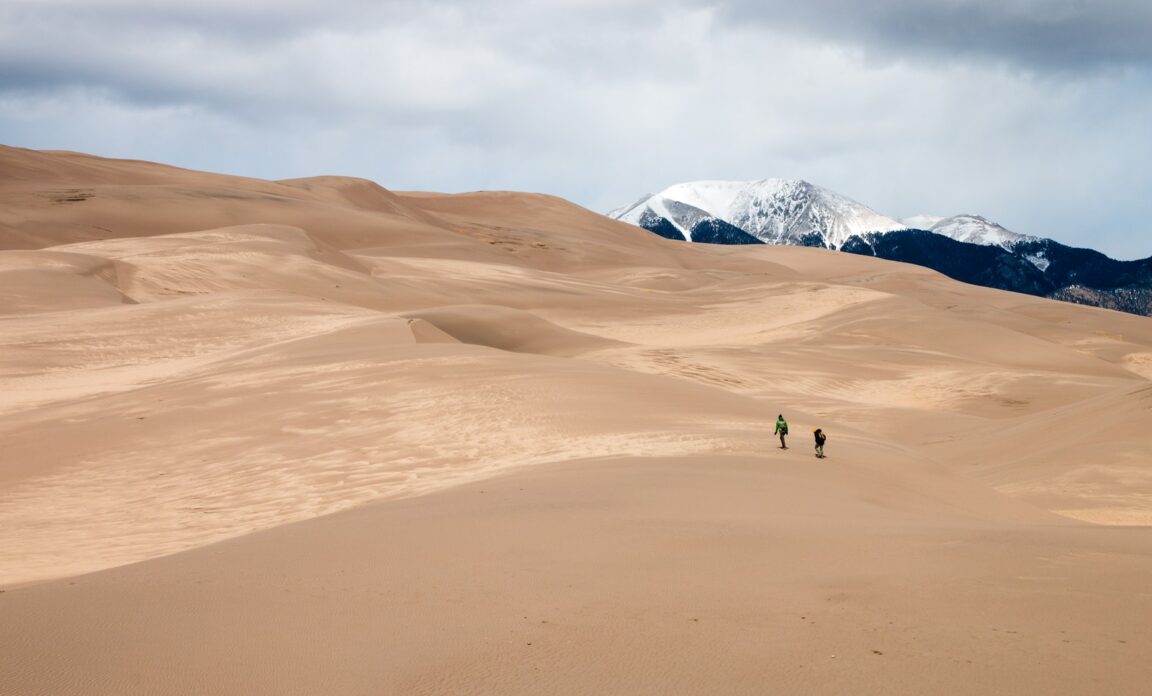
Image: Two hikers crossing the Great Sand Dunes with the snow-capped Sangre de Cristo Mountains behind. Photo by Mackenzie Reed, National Park Service (nps.gov), public domain, used with credit.