 Maya Chen
Lijiang divides sharply into two trips: the one the day buses do, arriving at ten to a packed old town and leaving by four, and the one you get by sleeping inside the old town and walking it at dawn, when the canals run clear, the Naxi grandmothers own the lanes and Jade Dragon Snow Mountain stands pink over the rooftops. This guide builds the second trip. Stay in Dayan old town, give the mountain one full early day with the cable car booked ahead, and spend the other days on the quieter old towns the buses skip: Baisha, the original Naxi settlement with its Ming dynasty murals, and Shuhe, the Tea Horse Road town that keeps Dayan’s beauty at half its volume.
Quick Facts
Where: Northwest Yunnan, China, at about 2,400 metres altitude; the thin air and strong sun are real, take the first day gently.
The old town: Dayan, a UNESCO World Heritage site since 1997, a car-free warren of canals, stone lanes and wooden Naxi houses.
The mountain: Jade Dragon Snow Mountain, 5,596 metres, visible from the town on clear mornings.
Cable cars: Glacier Park line tops out at a station at 4,506 metres, with a boardwalk climbing toward 4,680 metres; Spruce Meadow reaches 3,240 metres and Yak Meadow 3,950 metres.
The quiet alternatives: Baisha, about 8 to 10 km north, and Shuhe, between Dayan and Baisha.
Best seasons: April to June and September to November; summer brings the rains, winter brings cold, clear mountain views.
Dayan at Dawn: The Old Town Before the Buses
Dayan, Lijiang’s old town, was built by the Naxi people more than eight centuries ago and listed by UNESCO in 1997, and its design is water: springs from Black Dragon Pool feed a network of canals that threads the lanes, so that every street has its stream, its small stone bridge and its willow. The town has no walls and no grid; the lanes follow the water and the slope, which is why everyone gets lost and why getting lost is the correct first activity.
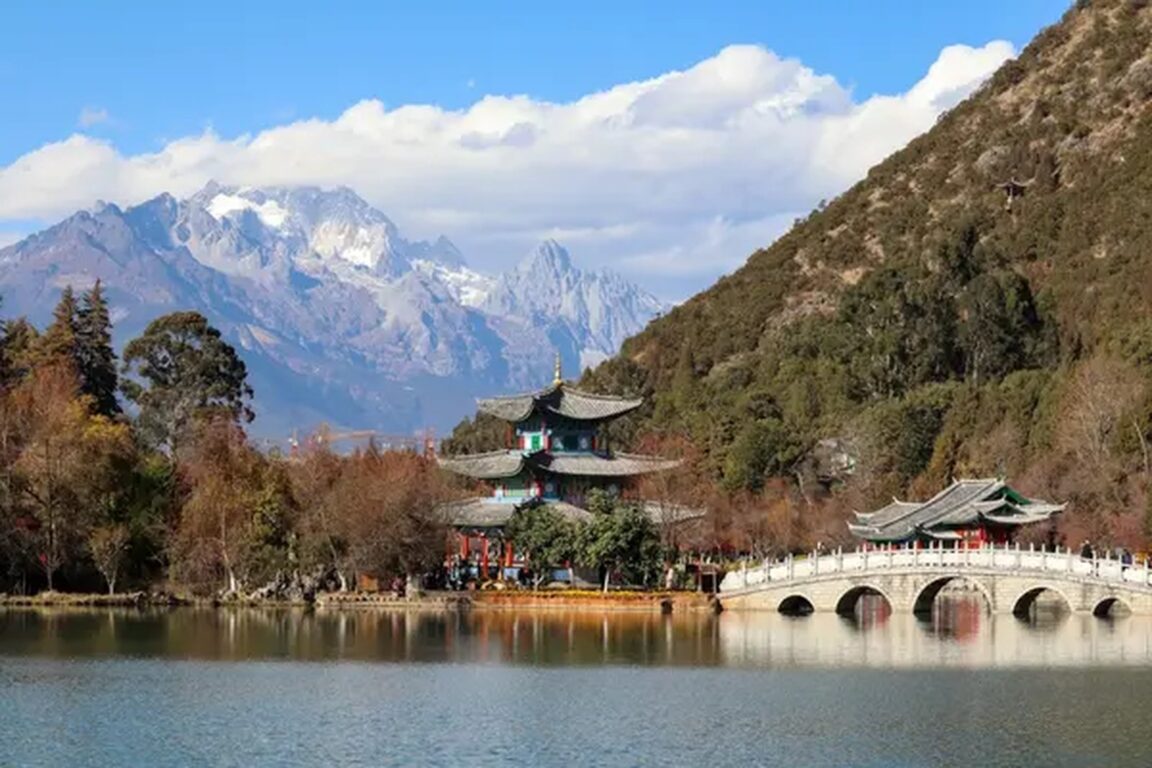
But the hour matters more than the route. Stay inside the old town, set an alarm, and walk at dawn, before the day-trip groups arrive from the hotels outside. In the early light the town belongs to its residents: shutters opening, canal water running clear before the day stirs it, market stalls setting up around Sifangjie, the central square, and the mountain framed at the end of north-running lanes. Photographers know this; the famous view of Jade Dragon Snow Mountain over the rooftops and across Black Dragon Pool, the image on this article, is a morning photograph. By ten the same lanes are a river of visitors, and the strategy flips: retreat to the old town’s edges, the quieter northern lanes near the water’s entry, or leave for Baisha entirely and return when the buses leave.
Black Dragon Pool and the Water’s Source
North of the old town, Jade Spring Park holds Black Dragon Pool, the spring lake that feeds Dayan’s canals and frames the postcard view: the five-arched bridge, the Deyue Pavilion on the water, and Jade Dragon Snow Mountain behind, doubled in the still pool on a windless morning. Go early for the reflection and the quiet, and pair it with the Dongba Culture Museum at the park’s edge, the best short introduction to the Naxi Dongba tradition: a living pictographic script, the only one of its kind still in use, written by Dongba priests in manuscripts that the museum displays alongside the tools and costumes of the ceremonies. An hour between the pool and the museum gives the old town’s decoration its meaning.
Baisha: The Original Naxi Town and Its Frescoes
Baisha, 8 to 10 kilometres north of Dayan, was the Naxi capital before the centre of power moved south, and it kept what Dayan commercialised away: a village scale, fields at the lanes’ ends, and the Baisha murals, Ming dynasty paintings in the Dabaoji Palace and Liuli Temple that blend Naxi, Tibetan, Han Chinese and Bai religious imagery on the same walls, Buddhist, Daoist and Tibetan Buddhist figures sharing panels in a way found almost nowhere else. The murals are fragile, dimly lit and genuinely extraordinary; go with a guide or a good translation app, because the iconography repays explanation.
Baisha also runs at village speed. Embroidery workshops line its main lane, where Naxi women still teach and sell the craft; cafes face the mountain across farmland; and the town empties by evening. Pair it with Shuhe on the way back: Shuhe, an old Tea Horse Road staging town, preserves Dayan’s canal-and-lane pattern in a smaller, calmer register, with the old market square and the museum of the caravan trade. Between them, Baisha and Shuhe answer the traveller who loves Dayan at dawn and wants that feeling at midday.
Jade Dragon Snow Mountain: Beating the Queue
The mountain is the region’s giant: 5,596 metres of glaciated ridge, the southernmost glacier country in China, hanging over the plain north of town. Its scenic area runs three cable cars, and choosing between them is the main decision. The Glacier Park line is the flagship: it climbs to a top station at 4,506 metres, where a boardwalk continues up toward 4,680 metres, the highest most visitors will ever stand; the altitude is the attraction and the hazard in one, and the line draws the longest queues. Spruce Meadow, at 3,240 metres, and Yak Meadow, at 3,950 metres, trade altitude for alpine pasture, forest and space.
The queue system rewards the prepared. Cable car tickets for Glacier Park are released in advance through the official booking channels and sell out in high season; book the earliest slot you can, arrive at the scenic area gate before your time, and carry the oxygen canister and warm layer that the altitude demands rather than treating them as souvenir upsells. At 4,500 metres, move slowly, skip the boardwalk climb if your head pounds, and remember that the mountain view from the meadows and from Black Dragon Pool loses nothing by being admired from below. Clear mornings are the mountain’s condition; like every range in this guide, it clouds by afternoon, so a Lijiang stay should hold the mountain day flexible and fire it on the first clear dawn.
Practical Notes
Lijiang’s airport and the rail station sit south of town; the old town is car-free, so expect to walk your bag in from a gate, and choose a guesthouse that will meet you. The altitude, about 2,400 metres in town and far higher on the mountain, argues for a gentle first day and serious sun protection year-round. Lijiang strings naturally with Dali to the south on the classic Yunnan route; sort entry formalities before departure with our explainers on China’s visa-free entry rules and the 240-hour transit visa-free policy.
Food and Evenings in the Old Town
Dayan after dark belongs to the bars of the canal lanes, live folk music spilling from wooden balconies, and to a food scene built on Yunnan ingredients: yak meat in its hotpot and skewer forms, flower cakes made with rose petals, rice noodles in every register, and the local baba flatbreads shared with Baisha up the road. Eat where the courtyards are full of local families rather than tour groups, and try the markets at the old town’s edges in the morning, when the produce of the surrounding farms comes in and the town shops for itself. The evening crowds are real, but they concentrate on a few famous lanes; two streets away the canals run quiet.
Frequently Asked Questions
Is it worth staying inside Dayan old town?
Yes, it is the single best decision in Lijiang. Sleeping inside the walls lets you walk the town at dawn and after the day buses leave, which transforms it. Choose a courtyard guesthouse on a quieter northern lane and arrange a gate pickup for your bags.
Which Jade Dragon Snow Mountain cable car should I choose?
Glacier Park for the altitude experience, topping out at 4,506 metres with a boardwalk toward 4,680 metres, if you book ahead and handle altitude well. Spruce Meadow (3,240 metres) and Yak Meadow (3,950 metres) for scenery, space and shorter queues. All three are best on a clear morning.
What are the Baisha murals?
Ming dynasty religious paintings in Baisha’s Dabaoji Palace and Liuli Temple, blending Naxi, Tibetan, Han and Bai traditions, with Buddhist, Daoist and Tibetan figures sharing the same panels. They are the finest surviving art of the old Naxi kingdom and the main reason to make the short trip north.
How is Lijiang different from Shuhe and Baisha?
Dayan is the largest and liveliest of the three old towns, a UNESCO-listed city in itself. Shuhe keeps the same canal town pattern at a calmer, Tea Horse Road scale; Baisha is the oldest settlement of the three and still a working village. Stay in Dayan, day-trip to both.
When is the best time to see Jade Dragon Snow Mountain?
Early morning, especially in the dry, clear months from autumn through spring. The peak stands over the old town and Black Dragon Pool at dawn and typically clouds over by afternoon in any season.
Featured image: Black Dragon Pool in Lijiang, with the Deyue Pavilion, the five-arched bridge and Jade Dragon Snow Mountain behind. Photo by Noppon Meenuch on Unsplash.