 Wei Chen
The Li River gives you two ways to travel the same famous water, and a good four days in Guilin and Yangshuo uses both: the big cruise boat from Guilin down to Yangshuo for the full 83 kilometre gallery of karst peaks on day two, then a small bamboo raft on the quieter Yulong River and a bicycle on the country lanes for the slow version on day three. Bookend the river days with a day in Guilin itself at the start and a flexible final day for the Xingping old town stretch, the part of the river printed on the 20 yuan note. Base two nights in Guilin only if you must; the better split is one night in Guilin and three in Yangshuo, because the countryside, not the city, is the destination.
Quick Facts
The cruise: Guilin to Yangshuo, about 83 km and roughly 4 hours, one-way downstream; boats do not return to Guilin, you come back by road.
Departure piers: 3-star boats use Mopanshan Pier, 4-star and 5-star boats use Zhujiang Pier; the piers are about 6.5 km apart and roughly 28 km, around 40 minutes, from central Guilin.
Reference fares: Around 215 yuan for 3-star and around 358 to 360 yuan for 4-star at last check; the official live price on the day governs.
The famous view: The Yellow Cloth Shoal scenery near Xingping, the landscape on China’s 20 yuan banknote.
Weather watch: Heavy rain in the April to June rainy season can suspend sailings; winter low water can shorten the route.
Yangshuo transport note: Yangshuo town has no railway station of its own; the high-speed station named Yangshuo is in Xingping, a bus ride away.
Day One: Guilin, the Warm-Up
Guilin deserves its day rather than a transit shrug. The city sits on the upper Li River among its own karst towers: Elephant Trunk Hill at the river bend is the municipal emblem, the Reed Flute Cave runs lit chambers through a limestone hill, and the lakes at the centre, joined by channels and crossed by bridges, make an evening walk of pagodas and reflections. Eat Guilin rice noodles in a local shop, where the dry style with gravy, pickled beans and peanuts precedes the broth poured at the end, and get an early night: the cruise piers are 40 minutes out of town and the boats leave in the morning.
Use day one for logistics too. Confirm which pier your ticket uses, Mopanshan for 3-star boats or Zhujiang for the 4-star and 5-star services, and how your transfer works; most tickets bundle the bus from the city. Decide the return from Yangshuo in advance as well, because the cruise is one-way and the road back is the default ending for anyone not staying on.
Day Two: The Li River Cruise, Guilin to Yangshuo
The cruise is the set piece: about 83 kilometres and four hours downstream through the densest karst scenery in China, peak after green peak folding into the river in the composition that Chinese landscape painting codified. The named sights come in sequence, each announced and each with its story: the hills that resemble a crown, a schoolboy, a bat; the fishermen with cormorants on bamboo rafts near the banks; and the climax at Yellow Cloth Shoal, where the river flattens into a mirror and the seven peaks reflect in the still water, the view chosen for the back of the 20 yuan note. The practical viewpoint is the open top deck; seats inside are for lunch and for rain.
Choosing the boat is simpler than the sales pages suggest. The 3-star boats from Mopanshan, around 215 yuan, cover the same river and the same views with a simpler lunch; the 4-star boats from Zhujiang, around 358 to 360 yuan, buy a better buffet, more deck space and fewer passengers per metre of rail. The scenery does not change with the star rating, so choose on crowd tolerance and budget. Two forces of nature can change the plan: in the April to June rainy season, flood water can suspend sailings entirely, and in the dry winter months low water can shorten the navigable route. Build the itinerary so the cruise sits on day two, with day four as the weather fallback, rather than on your last morning.
Day Three: Bamboo Rafts and Karst Cycling in Yangshuo
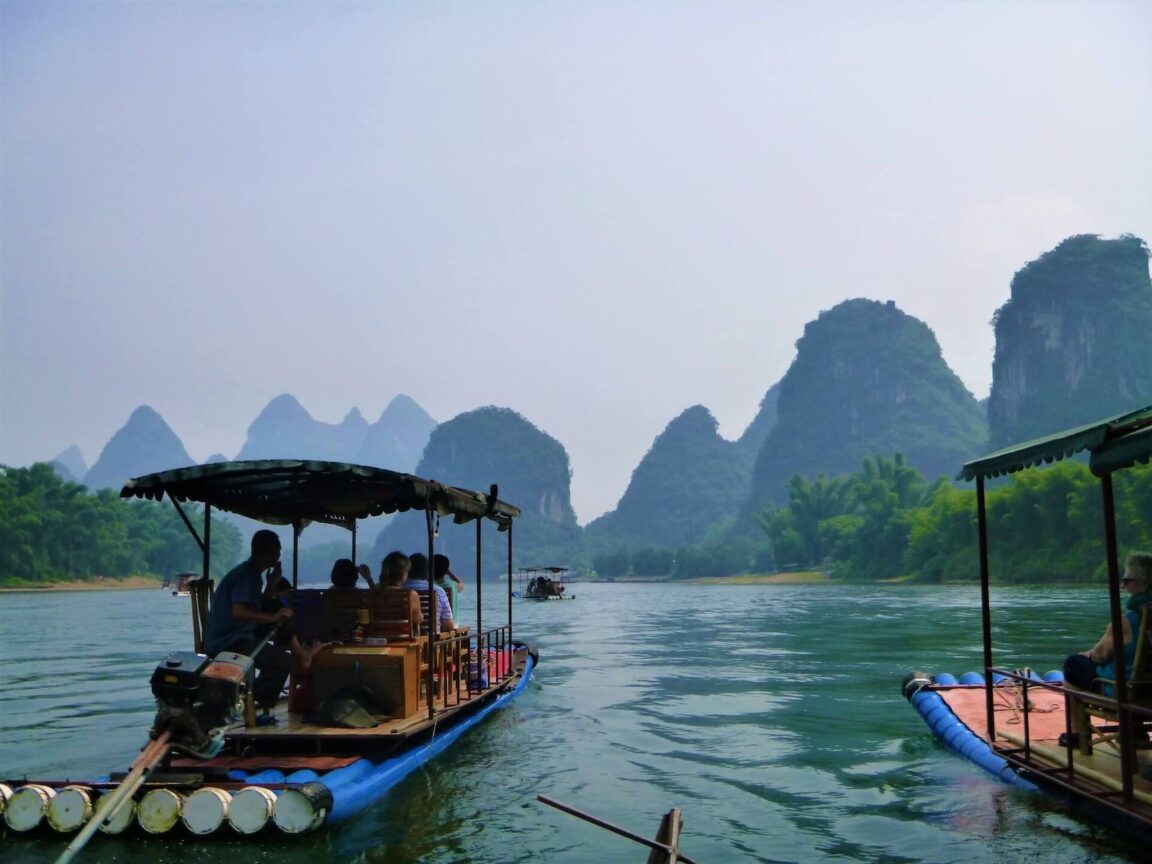
Yangshuo town, at the cruise’s end, is the base the landscape deserves: a lively small town, West Street at its commercial heart, ringed by the peaks and threaded by the Yulong River, the Li’s quieter tributary. Day three is the slow counterpoint to the cruise. In the morning, take a bamboo raft on the Yulong: the rafts here are poled by a boatman rather than motorised, the river is shallow and green, and the run passes under old stone bridges and between rice fields and towers at walking pace. It is the same karst grammar as the Li River written in a smaller, quieter hand, and most travellers rate it the better hour.
In the afternoon, rent bicycles and ride the country lanes south and west of town, the Ten Mile Gallery corridor and the village roads beyond it, where the peaks stand in farmland and every turn composes another scroll painting. The cycling is gentle, the lanes are villages rather than wilderness, and stops assemble themselves: a farmhouse lunch, a river swimming spot in season, a village market. Return the bikes by dark and give West Street its evening, when the street that serves a million visitors still manages to feed you well if you step one lane off it.
Day Four: Xingping and the 20 Yuan View
Keep the last day for Xingping, the old river town upstream of Yangshuo where the Yellow Cloth Shoal scenery lives. From Xingping’s wharves you can take the short local raft trips on the prettiest single stretch of the Li, walk the old street of the town itself, and stand at the viewpoint that matches the banknote view, the photograph every Chinese traveller on the river is quietly trying to take. Xingping also holds the area’s high-speed rail station, confusingly named Yangshuo station, which makes the town the natural final stop: raft in the morning, old town for lunch, and the train out in the afternoon, or the road back to Guilin for flights.
If weather moved your cruise, day four becomes the cruise day instead, with Xingping folded into day three; the four-day structure absorbs one lost day without losing either river. Before travelling, sort your China entry route with our explainers on visa-free entry and the 240-hour transit policy, and if the trip extends north, our route over the Mutianyu Great Wall by cable car and toboggan is the natural companion piece.
Cruise Versus Raft: The Honest Comparison
It is worth stating the trade plainly, because the sales material blurs it. The cruise boat is transport as much as sightseeing: eighty or more passengers, a commentary, a set lunch, and a river that performs on schedule. Its virtue is completeness, the whole corridor in one sweep, and its cost is company. The rafts, both on the Li at Xingping and on the Yulong, are the opposite bargain: a handful of passengers, no commentary beyond your boatman’s, and a pace slow enough to hear the water. Their virtue is intimacy and their limit is range. Travellers who choose only the cruise leave saying the Li River is spectacular and crowded; travellers who choose only the rafts leave saying it is peaceful and small. The four-day structure exists so that you do not have to pick a side in that argument.
Frequently Asked Questions
Cruise boat or bamboo raft: which is better?
They do different jobs. The cruise covers the full 83 km gallery of the Li River in about four hours and is the only way to see the whole corridor; the Yulong River rafts are slower, quieter and smaller in scale. With four days, do both, cruise on day two and raft on day three.
How much does the Li River cruise cost?
Reference fares at last check were around 215 yuan for a 3-star boat from Mopanshan Pier and around 358 to 360 yuan for a 4-star boat from Zhujiang Pier. Prices move, so treat the official live fare for your date as final, and confirm whether your ticket includes the transfer to the pier and lunch.
Can the cruise be cancelled for weather?
Yes. Heavy rain in the April to June season can raise the river and suspend sailings, and winter low water can shorten the route. Put the cruise early in the trip with a spare day behind it, and check the operator’s notice the night before.
How do I get back to Guilin after the cruise?
By road. The boats travel one-way downstream and do not return; buses and cars make the Guilin trip in roughly 1.5 hours, or continue from Yangshuo by train from Yangshuo station in Xingping.
Where is the 20 yuan note view?
At Yellow Cloth Shoal near Xingping, where seven peaks reflect in a calm stretch of the Li River. The cruise passes it, and Xingping’s local rafts and viewpoints on day four give you the unhurried version.
Featured image: Rafts on the Li River among the karst peaks between Guilin and Yangshuo. Photo by Conny Schneider on Unsplash.