 Wei Chen
The trick to eating well in Xi’an’s Muslim Quarter is to walk straight through the famous main street once, looking but not buying, and then eat in the side lanes where the residents eat. Beiyuanmen, the lantern-hung pedestrian street running north from the Drum Tower, is the quarter’s shop window; the food that built its reputation is one street over, on Xiyangshi, Dapiyuan, Damaishi and Sajinqiao, where the roujiamo counters slice beef to order, the biangbiang noodles are slapped against the counter within earshot, and a bowl of yangrou paomo starts with you tearing your own bread. Go hungry, go after the tour buses thin out, and graze in small portions across as many counters as you can manage.
Quick Facts
Where: The Hui quarter northwest of Xi’an’s Drum Tower, inside the city wall.
Main street: Beiyuanmen, roughly 500 metres of food stalls and shops running north from the Drum Tower.
Where locals eat: Xiyangshi, Dapiyuan, Damaishi and Sajinqiao streets, west and north of the main lane.
Must-eat list: Beef or lamb roujiamo, yangrou paomo, biangbiang noodles, pomegranate juice, persimmon cakes.
Indicative prices: Roujiamo around 8 to 15 yuan, biangbiang noodles around 20 to 35 yuan, paomo around 35 to 50 yuan, checked against 2026 street guides; confirm at the counter.
Good to know: The quarter is Hui Muslim; all food is halal, pork is absent, and alcohol is not part of the street culture.
The landmark: The Great Mosque in Huajue Lane, founded in 742 CE and built in Chinese style; entry is ticketed, around 25 yuan.
The Quarter and Its History
The Muslim Quarter is the home of Xi’an’s Hui community, whose presence in the city reaches back to the Tang dynasty, when Xi’an, then Chang’an, was the eastern terminus of the Silk Road and merchants from Persia and Central Asia settled where the routes ended. The quarter that grew around the Great Mosque has been a Hui neighbourhood for well over a thousand years, and the food is the living archive of that history: wheat noodles and flatbreads from the northern Chinese tradition, lamb and beef cooked with the cumin and chilli of the western routes, dried fruits, nuts and pomegranate from the desert trade, all of it halal, all of it seasoned by a millennium of adjustment to local taste.
The Great Mosque itself, tucked into Huajue Lane off the main street, is the quarter’s quiet centre: founded in 742 CE, built and rebuilt in Chinese architectural form, with courtyards, pavilions and a minaret shaped like a pagoda, and Arabic calligraphy worked into Chinese woodcarving. It is an active place of worship; visitors are ticketed, around 25 yuan at last check, and should dress and behave accordingly. Even a short visit reframes the streets outside: this is not a food theme park that happens to be old, it is a neighbourhood that happens to feed visitors extraordinarily well.
Beiyuanmen: The Shop Window
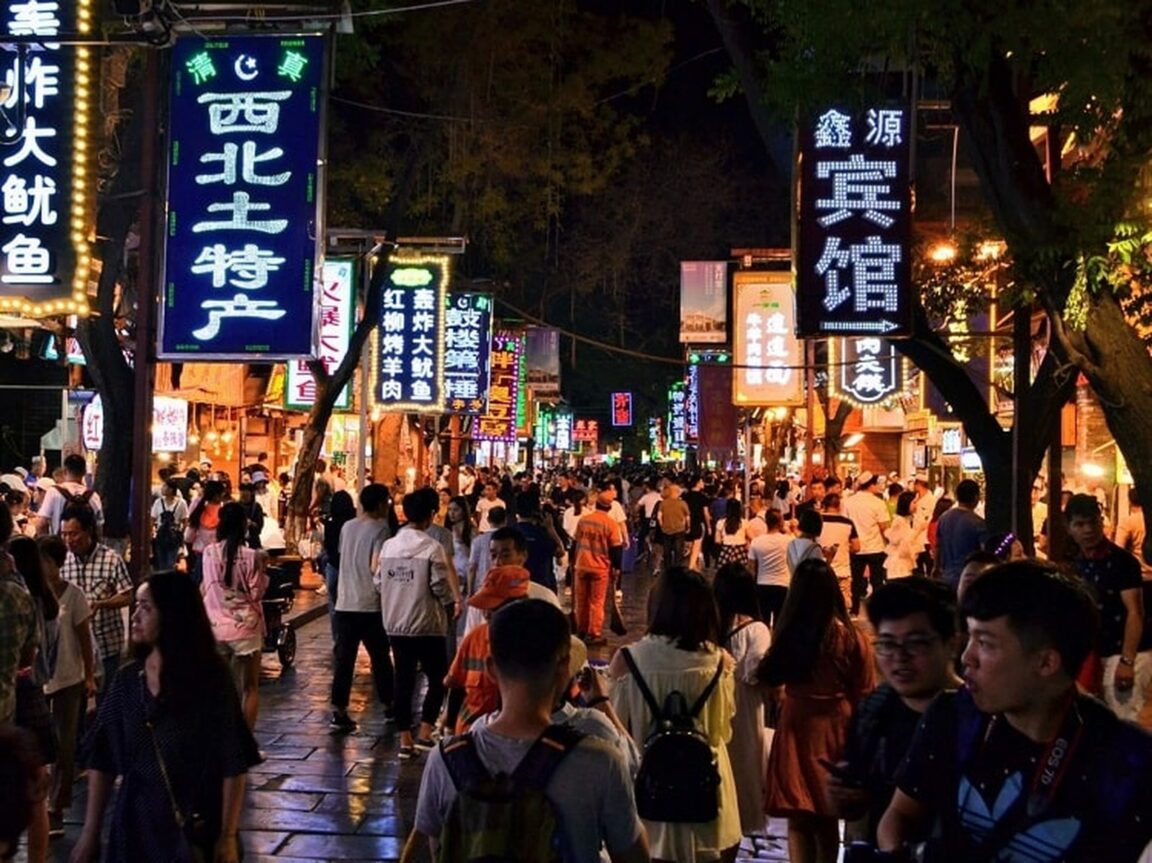
Beiyuanmen runs north from behind the Drum Tower for about 500 metres, and it is the street in the featured image: neon halal signage, steam, crowds, and every famous snack in the quarter represented at least three times. Walk it first as reconnaissance. Note the pomegranate juice presses stacking their spent fruit in pink pyramids, the persimmon cake fryers, the skewers grilling over charcoal, the candy makers pulling white strands of dragon’s beard, and the sheer theatre of a street that has fed travellers since the Silk Road. Buy the juice here if you buy anything, because the pressing happens in front of you and the quality is hard to fake, then take your appetite west.
The Side Streets: Where the Eating Happens
Xiyangshi, running parallel west of Beiyuanmen, is the quarter’s working high street, and the lanes beyond it, Dapiyuan, Damaishi and Sajinqiao, are where Xi’an residents argue about whose roujiamo is best. The pattern in the side streets is specialisation: a counter that does one thing, has done it for decades, and does it at a volume that keeps everything turning over. Queues of locals are the only reliable review system; join the longest one whose product you can identify, and order what the person in front of you orders.
Three dishes structure a side-street session. Roujiamo, often called the Chinese hamburger, is slow-braised beef or lamb, chopped with green pepper and a ladle of its own juices, stuffed into a baked baiji bun that should be crisp outside and soft within; expect to pay roughly 8 to 15 yuan. Biangbiang noodles are the theatre dish: a single belt of dough stretched and slapped against the counter, the slap is the biang of the name, then torn into wide ribbons and dressed with hot chilli oil poured sizzling over garlic, greens and vinegar; a bowl runs around 20 to 35 yuan, and the character for biang, a famous monster of 58 strokes, decorates every shop that serves them. Yangrou paomo is the slow dish: a lamb broth served with a dense unleavened bread that you tear yourself into pea-sized pieces, a process that takes ten unhurried minutes and is non-negotiable, before the kitchen cooks your crumbs in the broth with vermicelli and lamb slices; around 35 to 50 yuan, and the tearing is half the pleasure.
Sweet Things, Drinks and the Grazing Order
Between the savoury anchors, the quarter runs on sugar and fruit. Fresh pomegranate juice, pressed to order on Beiyuanmen and the side lanes, is the signature drink, tart and deep red. Persimmon cakes, fried patties of dried persimmon with walnut or rose filling, are the autumn and winter special. Zenggao, a steamed glutinous rice cake layered with dates and beans and sold from great clay pots, is breakfast food that works at any hour. Sour plum drink and the local yoghurt in its little ceramic jars cut the chilli oil between rounds.
The grazing order that works: start on Sajinqiao or Xiyangshi with a roujiamo while you are sharp enough to judge it, move to a paomo house for the sit-down centre of the session, tear your bread slowly, then walk it off through the lanes to a noodle shop for biangbiang as the finale, and take a pomegranate juice back through Beiyuanmen for the road. Two people sharing every dish can cover twice the counters; the portions are honest and the quarter punishes the greedy early.
Practical Notes
The quarter is busiest from late afternoon into the night, and at its best after about 19:00 when the lanes are fully lit and the evening crowd is local as much as tourist. Ramadan changes the rhythm, with many restaurants opening at sunset for iftar; if your visit falls in the fasting month, plan to eat after dark and treat the sunset hour in the quarter as a privilege to witness rather than a service to use. Carry cash or a working mobile payment setup, keep bags zipped in the crowds, and remember the etiquette basics of a Muslim neighbourhood: no outside food or alcohol brought in, and ask before photographing people at work. Xi’an pairs with the Terracotta Army as China’s great history double bill; before travelling, check your entry route in our guides to visa-free entry to China and the 240-hour transit visa-free policy.
Breakfast in the Quarter
Return in the morning and the quarter runs a second, quieter service: zenggao steaming in its clay pots, savoury tofu pudding, fried dough sticks with hot soy milk, and paomo houses serving the shift workers and school runs of the neighbourhood. A breakfast graze costs a fraction of the evening session, the lanes are empty enough to see the architecture, and the Great Mosque’s Huajue Lane is at its calmest. Travellers who only see the quarter lit and loud have seen its performance; the morning shows its life.
Frequently Asked Questions
What should I eat first in the Muslim Quarter?
A beef or lamb roujiamo from a side-street counter with a local queue, on Xiyangshi or Sajinqiao. It is the quarter’s benchmark dish, costs around 8 to 15 yuan, and tells you immediately what the fuss is about.
What is the difference between Beiyuanmen and the side streets?
Beiyuanmen is the famous pedestrian main street, spectacular and tourist-facing. The side streets west and north of it, Xiyangshi, Dapiyuan, Damaishi and Sajinqiao, are where residents eat, with specialist counters and better value. Walk Beiyuanmen for the show; eat in the lanes.
What is yangrou paomo, and why do I tear the bread?
It is a lamb soup into which a dense flatbread, torn by the diner into small pieces, is cooked with vermicelli and lamb. Tearing it yourself is the tradition and the texture control: small, even pieces cook evenly. Budget ten minutes for the tearing and order the bowl when you sit down.
Is all the food in the Muslim Quarter halal?
Yes. The quarter is the Hui Muslim neighbourhood around the Great Mosque, and its restaurants and stalls serve halal food; pork is not sold and alcohol is not part of the street scene. It is one of the easiest places in China to eat halal at every price level.
When is the best time to visit the quarter?
Evening, from about 19:00, when the lanes are lit, the grills are all running and the crowd mixes residents with visitors. Go on a weekday if you can; weekend nights on Beiyuanmen are shoulder to shoulder.
Featured image: Xi’an’s Muslim Quarter at night, its halal signage lit above the crowds. Photo by Kunal Kalra on Unsplash.