 Jonas Lindqvist
The threshold at Munich Airport is about six hours. Below six hours between flights, stay at the airport and use what makes Munich unusual: a working brewery between the terminals, sleeping cabins you can rent by the hour, and a central plaza that behaves like a small town square. At six hours or more, the S-Bahn into the city starts to pay, because the trains take roughly 40 to 45 minutes each way to the Hauptbahnhof and Marienplatz. Between those poles the Napcab maths decides the tired traveller choice: at the official rate of 15 euros an hour by day and 10 euros an hour at night, with a two hour minimum, a Napcab is a cheap hotel room for a three hour sleep and an expensive chair for a one hour doze. Work through those three numbers, brewery, bed and train, and a Munich connection stops being dead time.
Quick Facts
Airport: Munich Airport (MUC), two terminals joined by the Munich Airport Center, the plaza between Terminal 1 and Terminal 2.
The brewery: Airbrau, in the Munich Airport Center, brewing on site since 1999 and described by the airport as the world first airport brewery. Open daily 8:00 a.m. to 11:00 p.m., kitchen to 10:00 p.m.
Napcabs: 15 euros per hour by day, 10 euros per hour at night, minimum stay two hours, first come first served, paid by credit card. Each pod has a bed, desk, air conditioning and free Wi-Fi.
Into the city: S-Bahn lines S1 and S8 from the airport station, about 40 to 45 minutes to the Hauptbahnhof and Marienplatz, with a train roughly every 10 minutes between the two lines.
City fare used in this guide: A single ticket for zones M to 5 at 15.10 euros, and an Airport City Day Ticket at 17.50 euros for one adult, valid until 6:00 a.m. the next day. Fares checked 25 November 2026.
The rule: Under about six hours, stay. Six hours or more, the city is in play, provided your onward boarding time is protected.
What Can You Do With Two to Four Hours?
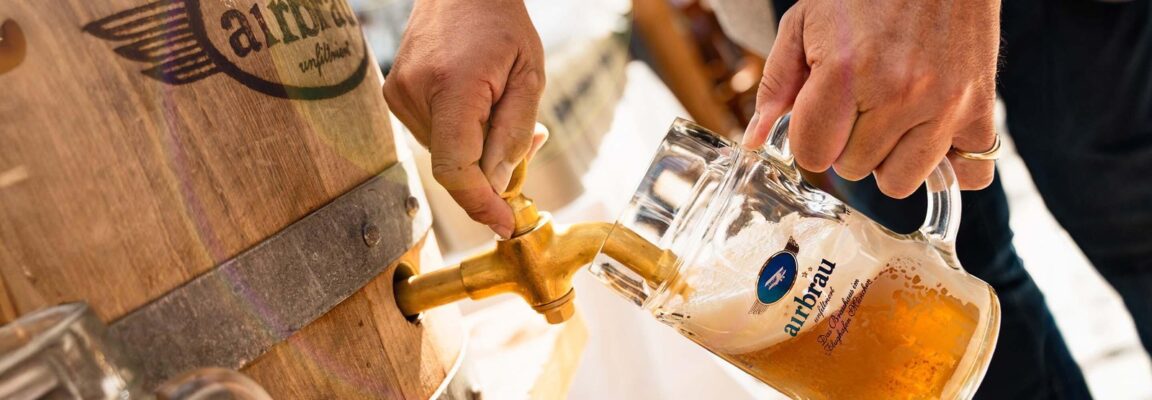
Eat and drink properly, landside, at the brewery. The official Airbrau page at Munich Airport sets out the proposition without embroidery: Bavarian pub culture, traditional dishes and home brewed beer from the world first airport brewery, brewed strictly under the purity law, with the brewing kettles visible in the restaurant. It has been brewing at the airport since 1999, serves daily from 8:00 a.m. to 11:00 p.m. with the kitchen closing at 10:00 p.m., and adds a beer garden under the plaza canopy plus brewery tours led by the brewmaster that end with a tasting. Location is the convenience: Airbrau sits in the Munich Airport Center between the terminals, so both a Terminal 1 and a Terminal 2 passenger can reach it without a bus, a train or a second security pass if you are arriving or are landside before departure.
One caution belongs in any honest layover guide, and it is about timing rather than quality. A brewery meal is a landside pleasure. If you are connecting airside and your onward flight leaves from a distant gate, the trip out and back through security eats the margin that makes the meal relaxing. In that case, use the airside food in your own terminal and save Airbrau for a trip where Munich is the origin, the destination or a long, protected connection. Travellers who collect airport layover strategies will find the same landside versus airside discipline running through our Singapore Changi long layover guide and the Doha Hamad long layover guide, where the best facility in the building is not always the right one for your connection.
How Do the Napcab Numbers Actually Work?
Do the arithmetic before you are tired enough to pay anything for a bed. The airport own announcement, Munich Airport on its Napcabs, gives the current terms plainly: the pods cost 15 euros an hour during the day and 10 euros an hour at night, with a minimum stay of two hours, they cannot be booked or reserved in advance and are allocated first come first served, and you check in and pay by credit card. Each pod contains a bed, a desk, air conditioning and free Wi-Fi, with room for luggage, and the newest pods sit on Level 3 in the public area, joining the established airside cabins.
So a two hour daytime nap costs 30 euros, a three hour overnight sleep costs 30 euros at the night rate, and a four hour daytime rest costs 60 euros. Compare those figures with the alternatives honestly. A bench costs nothing and delivers broken sleep in public. An airport hotel room costs a full night rate for what may be a three hour use. The Napcab wins in the narrow, common case: a night arrival, a morning departure, and three to five hours in which real sleep changes the next day. It loses for a short doze, where the two hour minimum charges you for time you will spend awake, and it carries one structural risk: first come first served means a full row of pods at midnight is possible, so have the bench and hotel fallback in mind on peak nights. For longer, planned stopovers, compare the approach in our JFK long layover guide, where the sleep decision is made before travel rather than at the gate.
When Does the S-Bahn Into Town Stop Making Sense?
Work backwards from boarding, not forwards from landing. The S-Bahn journey itself is the easy part: lines S1 and S8 run from the station beneath the Munich Airport Center to the city, taking about 40 to 45 minutes to the Hauptbahnhof and Marienplatz, and between the two lines a train leaves roughly every 10 minutes. The fare structure is set out in the Munich airport to city fare comparison, which lists the zones M to 5 single at 15.10 euros and the Airport City Day Ticket at 17.50 euros for one adult, valid until 6:00 a.m. the next day, so the day ticket pays for itself the moment you make one more journey in the city. Full route and service information sits on the official Munich Airport website, which is also where disruption notices for the airport appear first.
Now the threshold. A city dash needs the train out, the train back, a buffer for the return journey, airport security and a walk to the gate. That is roughly two and a half hours of pure logistics before you have seen a single sight. A four hour connection therefore buys about ninety minutes in the city at the price of every risk in the chain, which is a poor trade. A six hour connection buys around three hours in the centre, enough for Marienplatz, the Glockenspiel, a beer hall lunch and a calm return. An eight hour connection is a genuine half day in Munich. Below six hours, the brewery and the plaza give you Bavaria without the jeopardy, which is precisely what they are for. Travellers connecting in Europe on other hubs can apply the same backwards maths using our Amsterdam Schiphol long layover guide, and rail minded readers will enjoy the contrast with the Eurostar ski train from London to the Alps, a journey where the train is the holiday rather than the risk.
How Should You Spend the Plaza Hours?
Treat the Munich Airport Center as the destination it was designed to be. The covered plaza between the terminals holds the brewery and its beer garden, shops and supermarkets, seasonal markets and events under its canopy roof, and the S-Bahn station below, so a landside layover can run meal, walk, supplies and rest without ever feeling like a corridor. Arriving passengers should note the supermarkets in particular: they are the place to buy the picnic, the forgotten adaptor and the decent chocolate at city prices before a train or a flight, a small economy that regular Munich travellers use automatically.
Sequence a medium layover like this. First, confirm your onward gate area and the time you must be back airside, and set that time in your phone. Second, eat once, properly, at Airbrau rather than grazing. Third, decide sleep with the Napcab arithmetic above while you are still fed and rational. Fourth, if the connection stretches and the city threshold is met, go, and go promptly, because the value of the dash is in the centre, not in debating it in the plaza. That order, protect the flight, eat, rest, then roam, is the whole Munich method, and it works at four hours and at nine.
Frequently Asked Questions
How much does a Napcab cost at Munich Airport?
The airport lists 15 euros per hour during the day and 10 euros per hour at night, with a minimum stay of two hours. Pods are first come first served, cannot be reserved in advance, and are paid by credit card. Each pod has a bed, a desk, air conditioning and free Wi-Fi.
Where is the Airbrau brewery and when is it open?
Airbrau is in the Munich Airport Center, the plaza between Terminal 1 and Terminal 2. Its official page lists opening daily from 8:00 a.m. to 11:00 p.m., with kitchen hours to 10:00 p.m. It has brewed on site since 1999 and calls itself the world first airport brewery.
How long does the S-Bahn take from Munich Airport to the city?
About 40 to 45 minutes to the Hauptbahnhof and Marienplatz on lines S1 or S8, with a train roughly every 10 minutes between the two lines. A single ticket for zones M to 5 is listed at 15.10 euros, and an Airport City Day Ticket at 17.50 euros covers unlimited MVV travel until 6:00 a.m. the next day.
How long a layover do I need to visit Munich city centre?
Plan on six hours or more. The return train journeys, security and gate time consume roughly two and a half hours, so a six hour connection leaves about three hours in the centre. Shorter connections are better spent at the airport brewery, the plaza and, if you need sleep, a Napcab.
Can I book a Napcab in advance?
No. Munich Airport states that the Napcabs are available on a first come first served basis and cannot be booked or reserved in advance. On busy nights, treat a pod as a hope rather than a plan and know your hotel and rest area alternatives.
Image credit: Beer poured from an Airbrau branded barrel into an Airbrau glass mug at Munich Airport. Photo via Airbrau and Munich Airport, the airport official website (munich-airport.de).