 Elena Vasquez
Visit Wave Hill as a garden first and a gallery second, and the day falls into place: start with the perennial beds and the Flower Garden while the light is still fresh, step into the Marco Polo Stufano Conservatory before its midday closure, give Glyndor Gallery a focused hour rather than the whole afternoon, and save the Pergola Overlook and the Hudson view lawns for last, when the afternoon light turns across the river toward the Palisades. That order is the whole secret of this 28 acre estate in Riverdale, in the Bronx. Reverse it, gallery first and gardens as an afterthought, and the best of Wave Hill will already be behind you.
Wave Hill describes itself as a public garden and cultural center, and both halves are real. The difference is scale and staying power. The gardens cover the hillside in distinct, named rooms, from a formal Flower Garden to a hillside Wild Garden and a woodland trail, and they change completely with the seasons. The gallery, inside Glyndor House, holds thoughtful exhibitions about nature and culture that reward an hour of attention. Planned in that proportion, roughly two thirds garden and one third art and houses, a visit here feels unhurried even inside a short winter day. Facts in this guide were checked on November 25, 2026 against Wave Hill’s own visitor information, and opening times and prices should be rechecked there before travel, because special event days change both.
Quick Facts
Address: Front Gate, 4900 Independence Avenue, Bronx, NY, in Riverdale, at West 249th Street.
Grounds hours: Tuesday to Sunday, 10 am to 4:30 pm in the current winter schedule. Closed Mondays. Last entry 30 minutes before closing.
Admission: Adults $10. Students and seniors 65 and over $6. Children 6 and over $4. Members free. Admission is free all day on Thursdays, except for organized groups.
Gallery and house hours: Glyndor Gallery and Wave Hill House, 10 am to 4 pm. Glyndor Gallery closes daily from 12 pm to 12:30 pm.
Conservatory hours: 10 am to 4 pm, closing daily from 12 pm to 1 pm. Plan around that midday break.
Visitor center, shop and cafe: Perkins Visitor Center and The Shop, and The Cafe, 10:30 am to 4 pm.
Onsite parking: Members $10, non-members $13. An offsite lot, the Riverdale Park Parking Lot, is used when the onsite lot is full.
Free shuttle: Thursdays to Sundays, hourly, from Metro-North Riverdale station and from the 1 subway terminus at Van Cortlandt Park and West 242nd Street.
Time needed: Two to three hours for the gardens, conservatory and gallery without rushing. Longer in spring and summer.
How should a first visit to Wave Hill be ordered?
Arrive close to the 10 am opening and walk the outdoor gardens first, while the beds are quiet and the gardeners’ work is still visible in the paths. The estate rewards a loose clockwise logic: entrance plantings, the Flower Garden and the Paisley Bed, the Conservatory while it is open, then the wilder ground, the Wild Garden, the Aquatic and Monocot Gardens and the woodland, with Glyndor Gallery fitted in after its 12:30 pm reopening if the morning has run long. Finish on the lawns by the Pergola Overlook. Anyone building a wider New York garden day can pair this logic with the season by season approach in our Brooklyn Botanic Garden by season guide, which makes the same point in a different borough: in a serious garden, timing by season and by hour matters more than covering every path.
There is a practical reason for the garden first order, beyond preference. Two of the indoor spaces close in the middle of the day. The Conservatory shuts from 12 pm to 1 pm and Glyndor Gallery shuts from 12 pm to 12:30 pm, both confirmed on the official visit page. A visitor who starts indoors can easily lose the late morning to those closures and then face the gardens in flattening light. A visitor who starts outdoors can use the midday pause exactly as it was surely intended, for the cafe in Wave Hill House, the shop in the Perkins Visitor Center, or a slow bench break, and then step into the gallery when it reopens.
What do the perennial beds and the Flower Garden offer by season?
The Flower Garden is the formal heart of Wave Hill, an English cottage style garden enclosed by a rustic cedar fence, with central beds planted by colour. Wave Hill’s own seasonal guides describe it changing character completely across the year, and that is the right way to set expectations. In late spring it is at its most exuberant, with unique cultivars filling the beds. Through summer, colourful salvia carries the display, joined later by aster and dahlia, which the garden’s fall guide notes persist until the first frost. A November visit, in other words, is not a flower visit in the spring sense. It is a structure visit: seed heads, late colour, ornamental grasses, the bones of the beds, and the surrounding trees doing most of the visual work.
Spring is the season the estate itself leads with. Its visitor pages describe glory-of-the-snow, the first bloom of the year, spreading across the grounds and carpeting the woodlands, followed by flowering trees in April. The Paisley Bed, a single seasonal bed shaped like its namesake pattern, is replanted to a new design, which makes it the quickest single indicator of what the garden team is doing that season. The Gold Border, planted with warm hued plants chosen to emphasise golden light, and the Shade Border, a small woodland setting of native and Asian species that favour low light, repay slow looking in any season, because both are about foliage and texture as much as flowers.
The Wild Garden, on its hillside, is the deliberate contrast. Narrow paths meander through naturalised style plantings, with small spring flowers such as crocus, dwarf iris and species tulips tucked into crevices in early spring, and many fall blooming perennials later in the year. Treat it as the second act of the garden visit rather than a shortcut between formal beds. The Aquatic Garden offers the opposite mood again, a tranquil, geometrically framed pool with neatly trimmed hedges and pergolas, where aquatic plants are the display in the warm months. The Monocot Garden beside it goes bold and fast growing, with foliage as the theme. Walking all three in sequence, formal, wild and aquatic, is what makes Wave Hill feel much larger than 28 acres.
What is inside the Marco Polo Stufano Conservatory?
The Conservatory is named for Marco Polo Stufano, Wave Hill’s founding Director of Horticulture, and it is best understood as three small rooms with three different climates. Wave Hill’s own guide to the Marco Polo Stufano Conservatory describes the Palm House, in the centre, as an open and airy space filled with floral scents, colours and foliage through the cooler months, noting that in summer most of its inhabitants move out into the Flower Garden and beyond. That seasonal swap is why a winter visit should not skip the glasshouse: in the cold months, the Palm House is carrying planting that the outdoor beds cannot.
On one side sits the Tropical House, where rainforest conditions are maintained by damping down, hosing the floor and heating pipes with water two or three times a day to hold high humidity. The aim, in the words Wave Hill quotes from Tom Christopher, author of Nature into Art: The Gardens of Wave Hill, is a jungle understory of filtered light packed with ferns, bromeliads and other tender plants. On the other flank, the Cactus and Succulent House is the room collectors linger in. Its waist high benches run down both sides of a long, narrow space, plants from the Americas, including cactus, on the left and plants from other continents on the right, with more than 1,100 container grown plants in the house. Read that left and right arrangement before walking it, and the room becomes a comparison rather than a blur of pots.
Nearby, the T.H. Everett Alpine House holds a collection that, in the garden’s own seasonal wording, never fully sleeps and explodes with flowers in spring, a reminder that at Wave Hill even the smallest glasshouse has a season when it leads. The Herb Garden and Dry Garden, terraced into the foundations of former greenhouses, complete the working garden picture. None of these spaces is large. Their pleasure is density and labelling, the feeling of a collection tended plant by plant, which is exactly why the conservatory belongs in the late morning, taken slowly, rather than in a rushed final half hour.
When should Glyndor Gallery get its hour?
Glyndor Gallery sits inside Glyndor House, the Georgian Revival mansion on the south side of the estate, built for the Harriman family in 1888 and rebuilt in 1927 after a fire. Today its rooms present solo and thematic group exhibitions, plus the Sunroom Project Space, which hosts site responsive solo projects by early career New York area artists selected through an annual open call. The curatorial thread is consistent: new ways of thinking about the relationship between nature and culture. That is why the gallery works best after the gardens, not before. A visitor who has just walked the Wild Garden and the Conservatory reads nature and culture exhibitions with the actual plants still in mind.
Give it a bounded hour. The gallery and Wave Hill House are open from 10 am to 4 pm, with the gallery closing from 12 pm to 12:30 pm, so an early afternoon slot, after the conservatory and lunch, fits the building’s own rhythm. When exhibitions are on view in spring, summer and fall, public tours led by Gallery Greeters run on Thursdays and Saturdays at 2 pm and last about 45 minutes, a detail listed by NYC Parks in its Wave Hill gallery tour listing and worth timing a Thursday or Saturday visit around. The Sunroom and Sun Porch spaces, bright rooms that frame the garden outside their windows, are the part of the gallery visit most specific to this estate; no white cube downtown can borrow a view like that. Wave Hill House itself, the older mansion dating to 1843, whose past tenants included Mark Twain, is now the hub for public programs and the cafe, and it deserves a short look even by visitors who skip a program.
Why save the Pergola Overlook and the lawns for the afternoon?
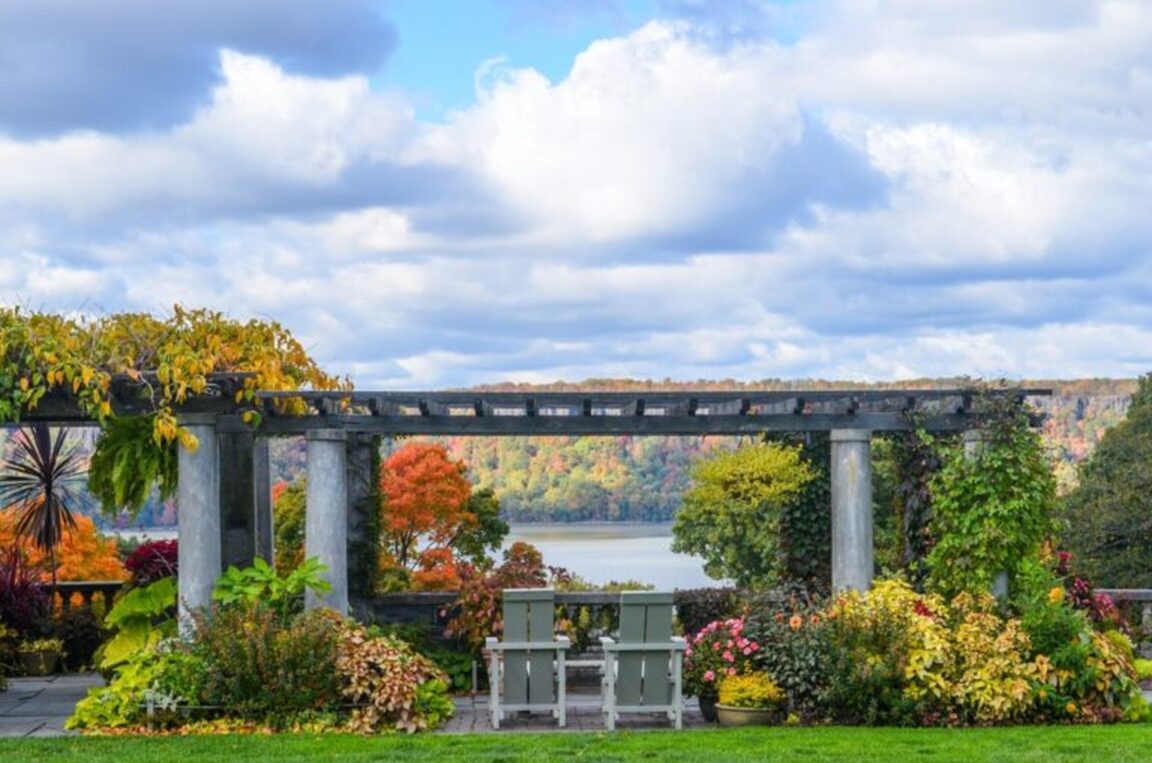
Because the view is the estate’s closing argument, and afternoon is when it argues best. The Pergola Overlook, an Italianate structure draped with climbing plants, frames the Hudson River and the New Jersey Palisades beyond it. In the morning the lawns and overlook are pleasant. Later in the day, as the sun drops toward the Palisades, the river light softens, the cliffs take colour, and the garden’s west facing slope becomes the best seat on the property. Wave Hill’s own photography of the pergola, including the image at the top of this guide, shows exactly that arrangement: chairs set under the pergola, planting in front, and the river and wooded Palisades filling the frame.
The lawns around Wave Hill House and the Kate French Terrace, the bluestone terrace beside the cafe planted through mid fall with exotic foliage plants and seed sown annuals, are the natural places to slow down at the end. There is no need to fill this part of the visit. Sit, look across the river, and let the garden do the work. Travellers who like a New York day built around one strong viewpoint and a lot of green quiet will also enjoy the ferry and lawn logic in our Governors Island ferry day guide, a harbour counterpart to this river bluff, and the second look structure of our New York in 5 days itinerary, which deliberately widens a trip beyond a Manhattan checklist in the same spirit.
How does the Riverdale walk in actually work?
Wave Hill is about 12 miles from midtown Manhattan, and the journey is simpler than its hilltop position suggests. Wave Hill’s official directions for getting to Wave Hill set out three public transport routes, each ending with the estate’s free shuttle on Thursdays to Sundays. By Metro-North, take the Hudson Line to Riverdale station; walking from the station, uphill at first, takes about 15 minutes, or connect with the free shuttle, which picks up at the station hourly from 10:05 am, with the last pick up at 4:05 pm. By subway, take the 1 train northbound to its last stop, Van Cortlandt Park and West 242nd Street; the free shuttle runs hourly from West 242nd, stopping on the northwest corner of Broadway and Manhattan College Parkway, arriving 25 minutes past the hour from 10:25 am, with the last pick up at 3:25 pm.
By bus, the BxM1 express runs between the East Side of Manhattan and Riverdale and the BxM2 between the West Side and Riverdale, while the Bx7 and Bx10 stop at West 252nd Street, a six minute walk from the front gate. Drivers use the onsite lot, with the Riverdale Park offsite lot as the overflow, and shuttle pick ups from the parking lots run 45 minutes past the hour from 10:45 am. The walk in through Riverdale is part of the pleasure on a dry day: quiet, mansion lined residential streets that feel suburban long before the gate appears. On a wet day, or with limited mobility, plan around the shuttle instead, and note that Wave Hill warns that parts of the gardens are less accessible because of the sloping topography, even though the indoor spaces have accessible entrances. Visitors extending the day in the Bronx afterwards will find a natural food finish in our Bronx Arthur Avenue food guide, across the borough, and a contrasting indoor museum hour in our Noguchi Museum Queens guide for another day entirely. A Hudson focused extension is equally easy: our Hudson Valley Cold Spring day trip from New York follows the same river north by train.
What should visitors know before they go?
Three practical points decide whether a Wave Hill day runs smoothly. First, the day of the week. The estate is closed on Mondays, and Thursdays are both free and shuttle served, which makes Thursday the obvious value choice, with the predictable trade off that free days draw more visitors. Second, the midday closures. Build lunch or a lawn break around the Conservatory closing from 12 pm to 1 pm and the gallery closing from 12 pm to 12:30 pm, rather than discovering them at a locked door. Third, the last entry rule: admission ends 30 minutes before the 4:30 pm grounds closing in the winter schedule, and the gallery, house and conservatory all close at 4 pm, so an arrival after 2 pm leaves the visit badly compressed.
Prices also vary on special event and premium weekends, including Mother’s Day, Father’s Day and Sunset Wednesdays, when admission rises to $15 for adults, $10 for students and seniors and $8 for children, as listed on the official visit page. Check that page on the morning of travel. Dress for a hillside garden rather than a flat park: paths climb, the woodland trail ambles along wooded slopes for about half a mile, and the river bluff is exposed to wind even when Manhattan feels sheltered. In late November that means a real coat, not a city jacket, and shoes that can handle damp paths.
Frequently Asked Questions
Is Wave Hill free on any day?
Yes. Admission is free all day on Thursdays, except for organized groups, and members enter free year round. Children under 6 also enter free under the standard admission structure listed by Wave Hill.
How long does a visit to Wave Hill take?
Allow two to three hours for the gardens, the Conservatory and Glyndor Gallery at a relaxed pace. The indoor spaces close at 4 pm and the grounds at 4:30 pm in the winter schedule, so a morning arrival makes the full visit far easier.
What is the best way to reach Wave Hill without a car?
Take Metro-North’s Hudson Line to Riverdale, or the 1 subway to Van Cortlandt Park and West 242nd Street, then use the free Wave Hill shuttle, which runs hourly on Thursdays to Sundays from both stations. Full timings are on the official getting here page linked in this guide.
When is the Conservatory closed during the day?
The Marco Polo Stufano Conservatory closes daily from 12 pm to 1 pm, and Glyndor Gallery closes daily from 12 pm to 12:30 pm. Plan the garden walk or lunch around those breaks.
Can visitors see the Hudson River and the Palisades from Wave Hill?
Yes. The Pergola Overlook and the west facing lawns look directly across the Hudson River to the New Jersey Palisades. Saving them for the afternoon gives the softest light across the water.
Image: The Pergola Overlook at Wave Hill, with the Hudson River and the Palisades beyond. Photo by Wave Hill, via wavehill.org, the subject’s own official website.