 Kwame Mensah
Plan an August trip to Accra around Chale Wote by doing three things in order: base yourself outside Jamestown but within a short taxi ride, give the festival’s closing weekend and its procession day your full attention, and spend one quieter morning walking the old town’s forts, lighthouse and fishing harbour with a local guide, because the murals make far more sense once the streets underneath them do. Chale Wote, produced by the Accra collective Accra Dot Alt since 2011, is a week long takeover of Jamestown, Accra’s oldest district, by street art, performance, music, film and food. It is free, it is crowded, and it rewards visitors who arrive with a plan rather than a hope. Facts in this guide were checked on November 25, 2026 against the organiser’s own published material, linked at each claim.
Quick Facts
What: Chale Wote Street Art Festival, a week long festival of street art, murals, performance, music, film and food, produced by Accra Dot Alt.
Where: Jamestown, the historic Ga fishing district of old Accra, Ghana, around the lighthouse, James Fort and Ussher Fort.
When: Annually in August. The organiser describes it as an annual week long August event, now in its sixteenth year of production; exact dates for each edition are announced by Accra Dot Alt.
Cost: Street programming is free and open. Guided festival tours are offered by the organiser for a fee; contact chalewote@accradotaltradio.com.
Base: Sleep in Osu, Cantonments or the central Accra hotel districts and travel in; Jamestown itself has very little visitor accommodation.
Time needed: A full festival week if you can; a long weekend covering the closing days and the procession at minimum.
What Chale Wote is, and who makes it
Chale Wote began in 2011 as a one day street art event and grew into West Africa’s defining street art festival. Its producer, Accra Dot Alt, is an Accra based collective and cultural network, and its own Chale Wote festival and tours page describes the festival as an annual week long event in August, in its sixteenth year of consistent production of community focused art across street art, music, food, fashion and film, drawing local and international artists who collaborate to make new work in the streets themselves. That last point is the festival’s character: this is not art shipped in and hung. Murals are painted live on Jamestown walls during the week, performances happen in the street and in courtyards, and the Ga community that lives in Jamestown is host, subject and audience at once. The festival’s name is Ghanaian pidgin slang for flip flops, the everyman footwear of the street, which tells you the register it aims for: art at pavement level, in the open, for the people who live where it happens.
The Jamestown the festival takes over
Jamestown is where Accra began, a Ga fishing community that grew around two seventeenth century European trading forts on the Gulf of Guinea shore. James Fort was built by England’s Royal African Company in 1673 and later served as a prison until 2008; Kwame Nkrumah, Ghana’s first president, was held there in 1950 and 1951. A short walk east stands Ussher Fort, begun by the Dutch in 1649 as Fort Crèvecœur. Above the harbour rises the Jamestown Lighthouse, a red and white banded tower of the 1930s, about 28 metres tall, built on the site of an 1871 light; the University of North Carolina’s lighthouse directory entry for Ghana records the station’s history and its four flash light character. Below it, the fishing harbour remains a working beach of painted wooden canoes, net menders and fish smokers, and the surrounding Bukom area is famous across Ghana for its boxing gyms, which have produced world champions from a few dense streets. During Chale Wote, all of this becomes the venue: murals colonise the walls between the forts, the procession moves through the same streets the canoes’ crews walk at dawn, and visitors who understand the district’s layers get a festival and a history lesson in the same steps. Travellers extending a Ghana trip west along the coast should pair this with a guided visit to Elmina Castle, the older and graver counterpart to Jamestown’s forts.
The week, and the procession day
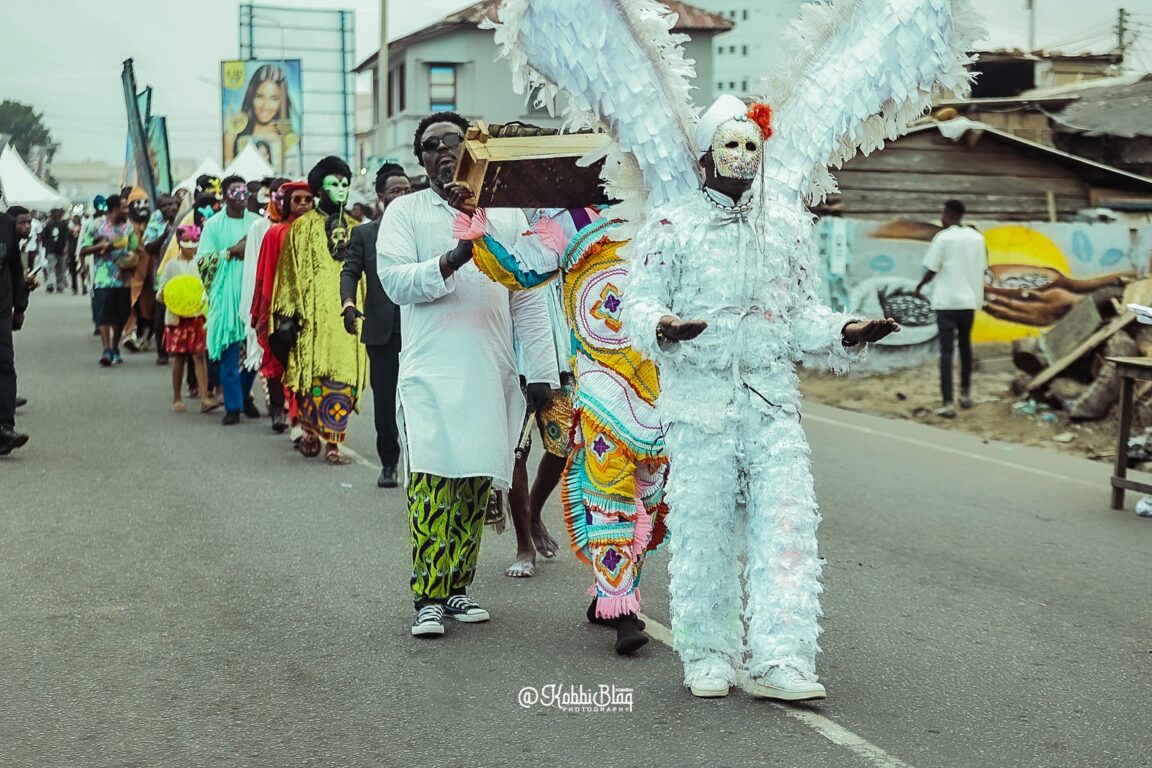
The festival week builds. Early days belong to the painting: artists at work on walls across Jamestown, smaller performances, film screenings, talks and the food and fashion stalls that line the active streets. The crowds thicken toward the weekend, when the headline performances, concerts and the festival’s great procession take place. The procession is the image of Chale Wote that travels the world, and it is the one on this page’s featured photograph, taken during a festival procession for the organiser’s own site: costumed performers, masquerade figures in towering feathered and raffia dress, drummers, dancers and thousands of followers filling a Jamestown street end to end, with fresh mural work on the walls beside them. Treat the procession day as unmissable and plan backwards from it. Arrive early, claim a position on a main street before the crowd seals it, carry water, and accept that moving against the flow is impossible once the procession passes. Photographers should note the etiquette that applies all week: ask before photographing people, especially performers in costume and residents in their own doorways, and expect some artists to ask a small fee for posed portraits. It is their work and their street.
Planning an August trip around it
Accra in August sits in the cooler, drier break between Ghana’s two rainy seasons, with temperatures moderated by the sea breeze, which is part of why the festival lives in this month; pack for warm days, dust and one heavy shower anyway. Fly into Kotoka International Airport and base in Osu or Cantonments for the widest choice of hotels and restaurants, travelling to Jamestown by taxi or ride hailing app in around twenty minutes outside the worst traffic. Book accommodation early once the year’s dates are announced on Accra Dot Alt’s own site, because the festival draws a regional and diaspora crowd and Accra’s better rooms tighten in festival week. Entry planning for Ghana deserves its own read: see the Ghana diaspora visa easement explainer for the current entry picture, and check your own visa position well before August. In Jamestown, go with a guide at least once. The organiser itself runs Chale Wote tours, bookable through the festival page, and community guides work the district year round; a guide opens compounds, explains the Ga shrines and family houses a stranger would walk past, and routes you through the festival’s spread out sites efficiently. Festival veterans of other street celebrations will recognise the rhythm and can compare it with Trinidad Carnival’s fetes and J’Ouvert for the Caribbean version of a city given over to costume, and with Timket in Gondar for another African festival where a religious procession fills historic streets. Chale Wote’s difference is that its cathedral is a working fishing town, and its art stays on the walls when the crowds go home, which is the best reason to come in August and then walk Jamestown again, quietly, on the morning after.
Frequently asked questions
When is Chale Wote held?
Chale Wote is an annual week long festival held in August in Jamestown, Accra. Accra Dot Alt, the organiser, announces each edition’s exact dates on its own site; the festival has run since 2011 and is in its sixteenth year of production.
Is Chale Wote free?
The street festival itself, the murals, processions and street performances, is free and open to everyone. The organiser also runs guided Chale Wote tours for a fee, bookable through its festival page, and individual artists may ask a small fee for posed photographs.
Where should I stay for Chale Wote?
Stay in Osu, Cantonments or central Accra, where the hotels are, and travel into Jamestown, roughly twenty minutes by taxi or ride hailing app. Jamestown is a residential fishing community with very little visitor accommodation of its own.
What else should I see in Jamestown during the festival?
Walk the old town with a local guide: James Fort, built in 1673 and a prison until 2008, Ussher Fort, the red and white Jamestown Lighthouse, and the working fishing harbour below it. Go in the morning before the festival crowds peak.
Is it acceptable to photograph the murals and performers?
Murals in the street are photographed freely. For people, ask first: performers in costume and Jamestown residents should always be asked, and some artists charge a small fee for posed portraits. A guide smooths these conversations considerably.
Image: A costumed masquerade figure leads the procession through a Jamestown street during the Chale Wote Street Art Festival, Accra, with murals on the wall behind. Photo by Kobbi Blaq, via accradotaltradio.com, the festival organiser Accra Dot Alt’s own website.