 Hana Kim
Suncheon Bay is a day that should be built backwards from sunset: arrive at the wetland by early afternoon, walk the boardwalks through Korea’s largest reed colony while the light is still high, cross Mujingyo Bridge and climb to Yongsan Observatory in time to watch the sun drop over the S-shaped waterway and the bay’s circular reed islands, and use the morning for the National Garden, which the same ticket covers. Visitors who come at opening time and leave at lunch see a pleasant reed field. Visitors who stay for the last hour see why this tidal bay, on South Korea’s south coast in Jeollanam-do, is a Ramsar wetland and part of a UNESCO World Heritage listing. Facts in this guide were checked on November 25, 2026 against the reserve’s official channels and the Korea Tourism Organization, linked at each claim.
Quick Facts
Where: Suncheon Bay Wetland, 513-25 Suncheonman-gil, Suncheon-si, Jeollanam-do, on Korea’s south coast.
Admission: 10,000 won for adults on the reserve’s current fee schedule, with lower rates for teenagers and children and free entry for seniors 65 and over. One ticket covers both the wetland and Suncheonman National Garden on the same day.
Ticketing hours: 08:00 to 17:00 from November to February, to 18:00 in March, April, September and October, and to 19:00 from May to August. Visitors may stay roughly an hour after ticket sales end.
Getting there: City bus 66 from Suncheon Station, about 35 minutes to the wetland entrance. Suncheon is reached by KTX on the Jeolla line from Seoul Yongsan in under three hours.
Best light: The hour before sunset from Yongsan Observatory. In winter, sunset falls early enough that a 17:00 ticketing close still allows the full show.
Time needed: Two to three hours at the wetland alone, a full day with the National Garden added.
Why this wetland matters
Suncheon Bay is where the Dongcheon and Isacheon rivers meet the sea, and the meeting has built one of the most productive tidal systems in Korea: broad mudflats, salt marsh, and a reed colony of around five square kilometres that the Jeollanam-do provincial government describes in its Suncheon Bay Wetland Reserve introduction as the biggest colony of reeds in the country, with reeds standing taller than a grown adult. The bay was registered as a Ramsar wetland in 2006, and its mudflats now form part of Getbol, Korean Tidal Flats, inscribed by UNESCO as a World Heritage site in 2021 for the habitat they give migratory birds on the East Asian Australasian Flyway. The emblem species is the hooded crane, which winters here in growing numbers alongside curlews, spoonbills and dense flocks of smaller waders that work the mud at low tide. None of this requires specialist knowledge to enjoy. It requires timing, which is what the rest of this guide is for. Travelers planning a wider Korea season around it should read the best time to visit South Korea for blossom and autumn alongside this guide, because the bay’s golden reed season and Korea’s autumn colour peak overlap in late October and November.
The wetland walk, in the right order
Start at the ecological exhibition hall near the entrance if the day’s tide and bird news matters to you, then take the boardwalk out into the reeds. The reserve’s trail system, described on the Suncheon Bay Wetland official site, runs on raised wooden walkways above the mud, so the walk is flat, exposed and suitable for any reasonable fitness level, with no shade worth the name. The reeds close in above head height in the mature sections, crabs and mudskippers work the channels below the boards, and the soundscape is wind and birdsong rather than traffic. Allow an unhurried hour for the loop through the reed field before pushing on, and carry water and a hat in any month, because the same openness that gives the bay its huge sky gives the walker no shelter from it.
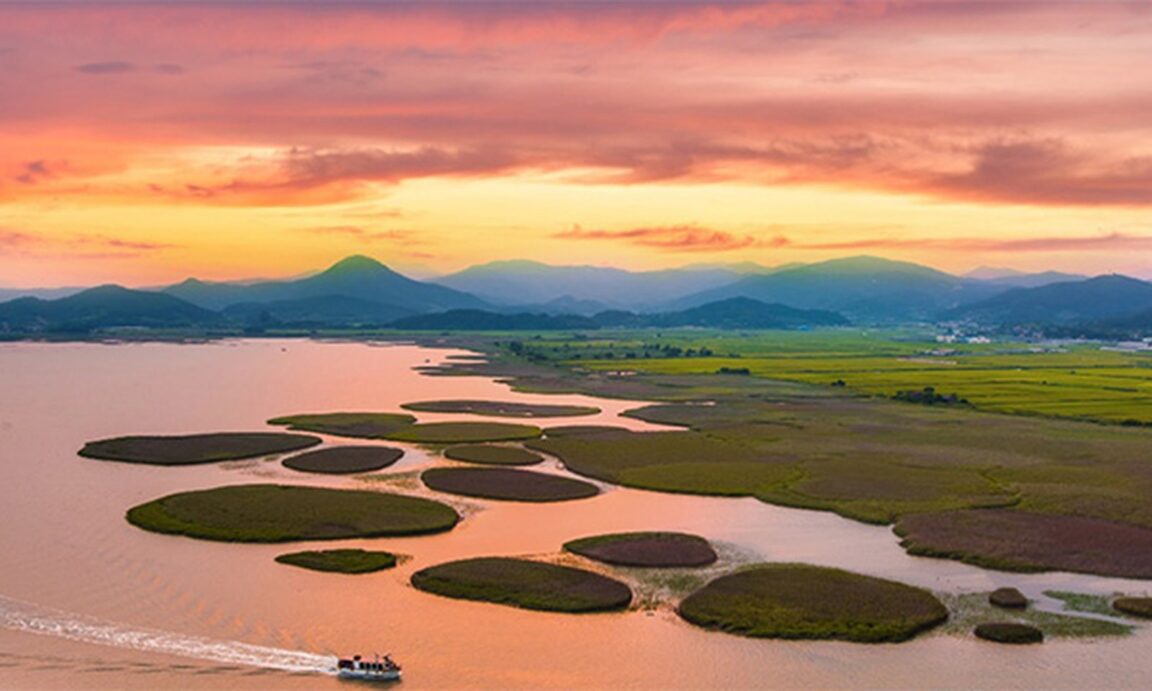
The walk’s destination is Yongsan Observatory. The Korea Tourism Organization’s Yongsan Observatory listing describes the approach exactly as walkers find it: follow the trail through the reed field, cross the Daedae Estuary on Mujingyo Bridge, and climb the low hill to the observatory, from which the bay’s large S-shaped waterway opens out below. This is the view on the featured photograph of this page: the curving channels, the round reed islands that form where the current slows, and the mountains of the bay’s rim beyond. The observatory is open from 08:00 to sunset, varying by season, and the climb is short but stepped, so anyone with limited mobility should plan the reed loop and the bridge as the day’s high point instead and take the sunset from the boardwalk level, where it is nearly as good.
Timing the day: tides, season and light
Three clocks run at Suncheon Bay. The first is the tide: at low tide the mudflats shine and the wading birds concentrate along the waterline; at high tide the channels fill and the bay reads as open water. The second is the season. The reeds are green and lush through summer, turn gold from late October, and stand tawny through winter, which is also when the hooded cranes are present, roughly from late autumn into early spring. The third is the day itself. Morning light is clean and the boardwalks are quiet, but the observatory faces the sunset, and the S-curve view is at its best in the last hour, when the reed islands go dark against lit water. In winter that hour comes conveniently early; from November to February tickets stop selling at 17:00, so enter by mid afternoon at the latest and walk out to Yongsan as the light turns. Note that site facilities such as the sightseeing boat run reduced schedules on Mondays, and the reserve and garden close on the last Monday of the month on the current published pattern, so check the official site before fixing a Monday visit. Entry formalities for the wider trip are covered in the South Korea K-ETA exemption explainer, and arrivals through Incheon can use the Incheon Airport layover and transit tour guide before travelling south.
The garden and the old town, on the same ticket
Suncheonman National Garden, about seven kilometres inland from the wetland, was created for the 2013 Suncheon Bay Garden Expo and kept as a permanent public garden of themed national gardens, a wetland center and broad lawns. Because one ticket covers both sites on the same day, the natural order is the garden in the morning, when its paths are quiet, then the wetland for the afternoon and sunset. A small PRT vehicle, the Sky Cube, links the garden with the wetland area for those who want the transfer itself to be part of the day; the city bus does the same job more cheaply. For an old town counterweight, Nagan Eupseong, a walled Joseon era fortress village with residents still living among its thatched houses, sits within the same Suncheon excursion area and is bundled with the garden and wetland on the city’s combined multi site ticket. It deserves two hours of a second day rather than a rushed hour of the first. Travelers continuing along this coast can pair Suncheon with Tongyeong, the south coast port and islands city further east, and anyone mixing nature days with Korea’s design museums should look at Museum SAN in Wonju, the Ando and Turrell museum, as the trip’s architectural counterpoint.
Frequently asked questions
What is the best time of day to visit Suncheon Bay?
Late afternoon into sunset, from Yongsan Observatory. Enter the wetland by mid afternoon, walk the reed boardwalks, cross Mujingyo Bridge and be at the observatory for the last hour of light over the S-shaped waterway.
How much does Suncheon Bay Wetland cost?
Adult admission is 10,000 won on the reserve’s current fee schedule, and the same ticket includes Suncheonman National Garden on the same day. Seniors aged 65 and over enter free, and children and teenagers pay reduced rates. Confirm the current schedule on the official site before travel.
When are the reeds golden and the cranes present?
The reeds turn gold from late October and hold their colour into winter. Hooded cranes winter at the bay roughly from late autumn to early spring, so a November to February visit combines golden reeds, winter birds and an early sunset.
How do you get to Suncheon Bay without a car?
Take the KTX on the Jeolla line to Suncheon Station, then city bus 66, about 35 minutes, to the wetland entrance. The National Garden is served from the same station area, and the Sky Cube links the garden and wetland.
Is Suncheon Bay suitable for children and less mobile visitors?
The reed field boardwalks are flat and step free, and work well for children and most mobility levels. The climb to Yongsan Observatory is stepped; less mobile visitors can take the sunset from the boardwalk and bridge level instead, where the view across the mudflats is still excellent.
Image: Sunset over Suncheon Bay, South Korea, with the bay’s circular reed islands, a tour boat on the channel and the mountain rim beyond. Photo via Suncheon City, scbay.suncheon.go.kr, the bay’s official website.