 Maya Chen
Kanchanaburi deserves two days, not a rushed day trip, and the order matters: start with the war cemetery in the cool of the morning, do the museum work while the story is fresh, ride the surviving railway across the bridge it made famous, and save Erawan Falls for a full second day. Done that way, a town 129 kilometres north-west of Bangkok stops being a photo stop and becomes what it actually is, one of the most important Second World War sites in Asia set inside some of the easiest river and forest scenery in Thailand.
Quick Facts
- Where: Kanchanaburi town, western Thailand, at the meeting of the Khwae Yai and Khwae Noi rivers
- Distance from Bangkok: 129 kilometres north-west, according to the Commonwealth War Graves Commission
- War cemetery: Kanchanaburi War Cemetery on Saeng Chuto Road, with 5,085 Commonwealth casualties buried or commemorated and 1,896 Dutch war graves
- Cemetery hours listed by the CWGC: 08:00 to 17:00 Monday to Friday and 08:00 to 12:00 Saturday
- The railway today: Trains still run on the surviving Thai section of the Burma-Siam railway as far as Nam Tok
- Erawan distance: Erawan National Park is 65 kilometres from Kanchanaburi along Route 3199
- Erawan entry, Department of National Parks rate: 300 baht for a foreign adult and 150 baht for a foreign child, with a separate small vehicle charge at the gate
- Erawan Falls: Seven tiers over a trail of about 1.5 kilometres from the trailhead to the top tier
- Best plan: History in town on day one, the railway ride fitted around it, and Erawan as the whole of day two
Why the History Has to Come First
Most visitors arrive, walk the bridge, take the photograph and leave with the film version of the story. That sequence gets Kanchanaburi backwards. The bridge is the symbol, but the cemetery and the museums are the substance, and they change what the bridge means when you finally stand on it.
The Tourism Authority of Thailand guide to Kanchanaburi puts the same pieces together in the right spirit, pairing the iconic Bridge over the River Kwai and the historic Death Railway with Erawan Waterfall and the province’s river life. Read that pairing as a two-day structure rather than a checklist. History first, landscape second, and neither one squeezed.
There is a useful comparison here. Our guide to Battambang in Cambodia, its river town calm and its bamboo train, covers a place where a rail ride is light relief. Kanchanaburi is the opposite case: here the railway is the memorial.
Step One: Kanchanaburi War Cemetery, Early
Go to the cemetery first, before the heat builds and before tour groups arrive. The Commonwealth War Graves Commission page for Kanchanaburi War Cemetery places it beside Saeng Chuto Road, the main road through town, close to the site of the former Kanburi prisoner of war base camp, through which most prisoners passed on their way to other camps along the line.
The numbers on that CWGC page are the ones to carry in with you. There are now 5,085 Commonwealth casualties of the Second World War buried or commemorated in this cemetery, and there are also 1,896 Dutch war graves. The graves of those who died during the construction and maintenance of the Burma-Siam railway, the Americans excepted because their remains were repatriated, were transferred from camp burial grounds and isolated sites along the railway into three cemeteries, at Chungkai and Kanchanaburi in Thailand and at Thanbyuzayat in Myanmar.
Inside the entrance building, look for the Kanchanaburi Memorial. The CWGC records that it names 11 men of the army of undivided India who are buried in Muslim cemeteries in Thailand, where their graves could not be maintained. It is a small detail that widens the story usefully. The railway dead were not only British, Australian and Dutch, and the cemetery is honest about the limits of what could be gathered and marked after the war.
The CWGC visiting information adds practical warnings: a large, firm and level car park, an extremely uneven municipal pavement in front of the cemetery that is a trip hazard, and the plain warning that there may be snakes in the cemetery. Arrive in daylight, watch your footing and stay on the paths.
Behaviour needs no elaborate code. This is a burial ground, not a backdrop. Keep voices low, keep off the graves, and give anyone looking for a specific name the space to do it. A register book is held at the site office, according to the CWGC, which is the starting point for tracing an individual grave.
Step Two: The Museums, and What Each One Does
With the cemetery done, the museums stop being a blur of photographs and captions, because you have just walked past the names those displays are about.
The Thailand-Burma Railway Centre, across from the cemetery area, is the structured option: how the railway was planned, how the camps worked, and how a line built to supply a Japanese army in Burma consumed the men who built it. Do it second, while the cemetery is still fresh.
The JEATH War Museum does something different. The name itself is an explanation. As the Tourism Authority of Thailand’s Kanchanaburi material sets out, JEATH stands for the six countries involved in building the railway: Japan, England, America, Australia, Thailand and Holland. The museum sits south of the town centre next to Wat Chaichumphon, and its replica camp setting is deliberately rough and close up. Where the Railway Centre explains, JEATH confronts.
You do not need both museums if time is short, but you do need one, and you need it before the bridge. The 1957 film was fiction built on a real atrocity, and the museums are where that distinction gets made properly.
None of these sites is large, and none needs a full day alone. The power of the route is cumulative, which is why the second day can go to the falls without guilt.
Step Three: The Bridge, Read Properly
Now the bridge. The Tourism Authority of Thailand Kanchanaburi itinerary describes how, thanks to several films and books, the Bridge on the River Khwae has become notoriously famous, and notes that the damaged bridge was renovated by the Thai government in 1946 after the Second World War. It also records the Bridge of the River Kwai Memorial Week, held during late November to early December each year, with an exhibition on the war and the history and archaeology of the bridge.
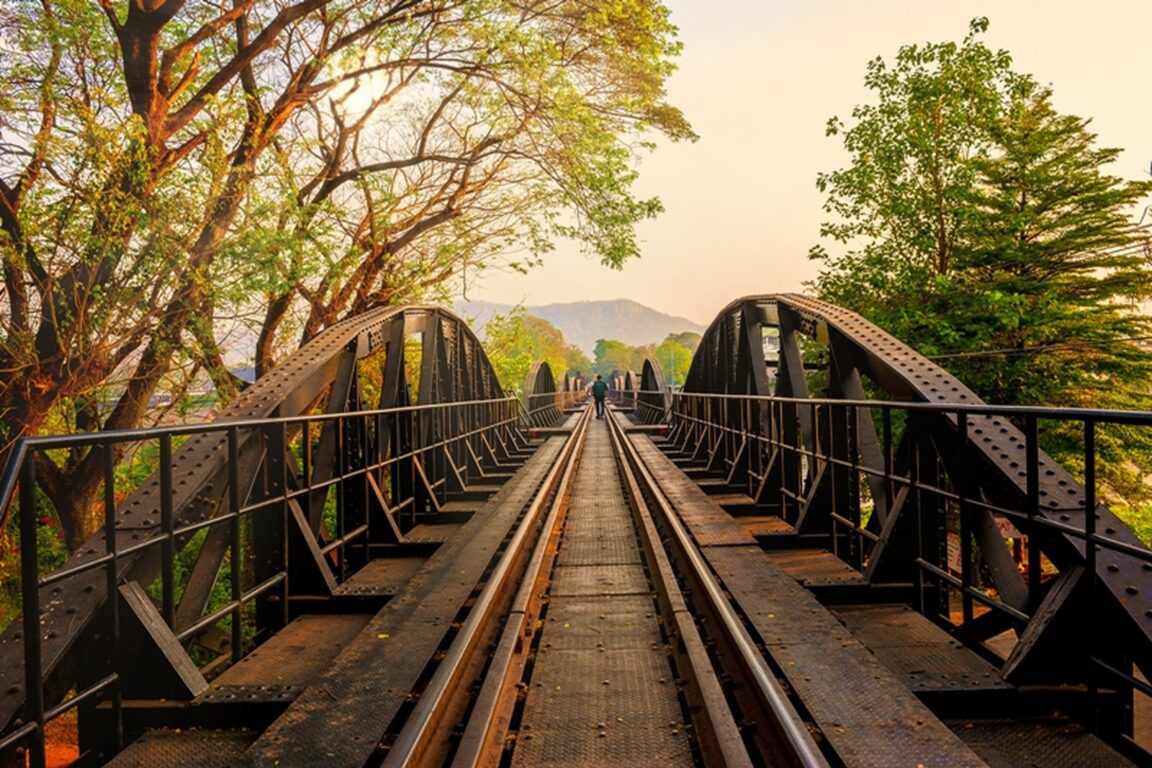
Standing on the deck, look at the spans. The curved steel spans are the originals, and the two straighter spans in the middle are post-war replacements for sections destroyed by Allied bombing. That mix is the bridge’s real biography: built under occupation, bombed by the side whose prisoners built it, and repaired into peacetime service.
Walk it slowly and stay alert. This is not a preserved ruin closed to traffic. It is a working railway bridge, and trains still cross it. Keep to the refuges and walkways when a train approaches, and treat any timetable information as something to confirm at the station on the day rather than something to build a tight schedule around.
Step Four: Ride the Railway That Still Runs
The strongest argument against the day-trip version of Kanchanaburi is the train. The Burma-Siam railway was 424 kilometres long when completed, according to the CWGC history, and only the first section in Thailand survives in service, with trains still running as far north as Nam Tok. Riding that surviving section, across the bridge and up the Khwae Noi valley, is the closest a visitor can get to understanding the line as a line, rather than as a set of isolated sites.
The ride also reframes the geography. From the train, the cuttings, river bends and trestle sections arrive in sequence, and the scale of building a railway through this terrain with hand labour becomes harder to wave away. The stretch through the Tham Krasae area, on the way to Nam Tok, is the part riders talk about afterwards.
Plan it loosely and honestly. These are ordinary local services, not a heritage operation with guaranteed connections, so check departures at Kanchanaburi station, allow slack, and have a road fallback for the return if the day runs long. If paperwork is part of your wider Thailand planning, sort it before you travel with our Thailand Digital Arrival Card guide, so a border formality never eats into a short history trip like this one.
Day Two: Erawan Falls, the Reason to Stay Over
Erawan is what turns Kanchanaburi from a day trip into a stay, and it needs the time a day trip cannot give it. The Tourism Authority of Thailand puts Erawan National Park at 65 kilometres from Kanchanaburi along Route 3199. That is a real journey out and back, before a single tier is climbed, which is why bolting it onto the end of a cemetery and museum morning shortchanges both halves of the trip.
The park itself is substantial. Erawan National Park was established on 19 June 1975 as Thailand’s 12th national park, covers about 550 square kilometres in the Tenasserim Hills, and is governed by the Department of National Parks, Wildlife and Plant Conservation. Its headline attraction, set out on the Department of National Parks, Wildlife and Plant Conservation site that administers the park, is a waterfall named after Erawan, the three-headed white elephant of Hindu mythology, whose shape the top of the falls is said to resemble.
The falls have seven tiers, and the distance from the trailhead to the top tier is about 1.5 kilometres. The lower tiers are an easy, shaded walk between wide pools, and the upper tiers get steeper, rougher and quieter, which is the reward structure of the whole place. Visitors who stop at tier two have seen a pretty waterfall. Visitors who keep climbing have earned the version with space and forest.
Swimming is part of the point, in the designated pools, and the small fish there are famous for nibbling at the feet of anyone sitting still in the shallows. Wear shoes with real grip, expect wet rock above the lower tiers, and keep a dry bag for a phone. The park can close the falls or restrict swimming after heavy rain, and it has done so in 2026, so check conditions before setting out.
On cost, use the Department of National Parks rate and budget in cash: 300 baht for a foreign adult and 150 baht for a foreign child, with Thai visitors at 60 baht and 30 baht, plus a small separate charge per vehicle at the gate. Arrive early. An early start beats both the heat on the upper trail and the crowds that concentrate at the lower pools by late morning, and it leaves time to climb down without rushing the last, steepest sections.
Season shapes the falls. The park’s year divides into a rainy season from May to October, a cool season from November to January and a hot season from February to April. Rain brings volume, drama, closures and slippery rock. The cool season brings the most comfortable walking, and late in the hot season the water runs thinner.
How to Put the Two Days Together
Day one belongs to the town. Cemetery early, Railway Centre next, JEATH if you have the appetite for both museums, then the bridge on foot, then the train up the valley. Sleep in Kanchanaburi, ideally by the river, where the Tourism Authority of Thailand’s slow travel coverage points to floating raft houses and a town that rewards an unhurried evening.
Day two belongs to Erawan, whole and unshared. Leave early, climb as high as conditions and fitness allow, swim on the way down, and keep the return unhurried.
For travellers building a longer Asia loop, the contrasts help. Our Jeju Island travel guide makes a similar case for giving an island of waterfalls more than a day, while our guide to what to eat in Da Nang is a reminder that food deserves planned time on a regional trip. Kanchanaburi makes the same argument in a graver register: the important places repay sequence and time.
Frequently Asked Questions
How many days does Kanchanaburi need?
Two days is the honest minimum for the full story. One day covers the war cemetery, a museum, the bridge and a railway ride in town. Erawan Falls, 65 kilometres away, needs a second day of its own. A Bangkok day trip can touch the bridge, but it cannot do the history and the falls properly.
What order should the history sites be visited in?
Cemetery first, museum second, bridge third, train last. The cemetery supplies the names and the scale, the museum supplies the context, and both change what the bridge and the ride mean. Reversing the order turns the day into a photo stop followed by homework.
How many people are buried at Kanchanaburi War Cemetery?
The Commonwealth War Graves Commission records 5,085 Commonwealth casualties of the Second World War buried or commemorated there, plus 1,896 Dutch war graves. The graves were gathered after the war from camp burial grounds and isolated sites along the southern section of the Burma-Siam railway.
Does the Death Railway train still run?
Yes. Trains still run on the surviving Thai section of the Burma-Siam railway, across the River Kwai bridge and up the valley as far as Nam Tok. Services are ordinary local trains, so confirm departure times at the station on the day and allow slack in your plans.
How much does Erawan National Park cost, and how long is the falls trail?
Under the Department of National Parks rate, foreign adults pay 300 baht and foreign children 150 baht, with a small separate vehicle charge. The falls have seven tiers, and the trail from the trailhead to the top tier is about 1.5 kilometres, getting steeper and rougher above the lower tiers.
Can you swim at Erawan Falls?
Yes, in the designated pools along the trail, subject to park conditions on the day. After heavy rain the park can close the falls or stop swimming, as it has during 2026, so check with the park before travelling and follow ranger instructions at the pools.
Photo: Bridge over the River Kwai, Kanchanaburi, by the Tourism Authority of Thailand, via tourismthailand.org, Tourism Authority of Thailand.