 Kwame Mensah
Give Elmina Castle half a day, not an hour: the guided tour through St. George’s Castle in Elmina, Ghana, moves from storehouses and chapels to the slave dungeons and the Door of No Return, and it carries an emotional weight that should not be rushed or immediately followed by a busy schedule. The Ghana Museums and Monuments Board, which cares for the castle, lists opening hours of 9:00am to 4:30pm daily, so arrive in the morning, take the full guided tour, and leave quiet time afterwards for the fishing harbour, the lagoon and the town before travelling on.
Quick Facts
- Site: St. George’s Castle, known as Elmina Castle, in Elmina in Ghana’s Central Region, cared for by the Ghana Museums and Monuments Board (GMMB).
- Founded: By the Portuguese in 1482 as São Jorge da Mina, on a narrow promontory between the Atlantic Ocean and the Benya River, according to GMMB.
- Later rulers: Taken by the Dutch in 1637, reconstructed under Dutch rule between 1770 and 1775, and ceded to the British on 6 April 1872, according to GMMB.
- Status: A historical museum today and a UNESCO World Heritage Site, as part of Ghana’s forts and castles listing.
- Opening hours: 9:00am to 4:30pm daily, as published by GMMB and checked on 25 November 2026.
- Entrance fees: GMMB’s published schedule, reviewed on 1 July 2023 and checked on 25 November 2026, lists Ghanaian adults at GH¢20 and non-Ghanaian adults at GH¢80, with lower rates for students and children. Confirm at the gate, as fees are reviewed periodically.
- Tour format: Guided tours cover the former storehouses and slave dungeons, the chapels and the governor’s chamber, according to the castle museum. Allow at least half a day including time afterwards.
- Nearby: Elmina’s fishing harbour beside the castle, and Fort Coenraadsburg (St. Jago), the Dutch cemetery and Posuban shrines within walking distance, according to GMMB.
What is Elmina Castle, and why does it matter?
GMMB describes St. George’s Castle as the first major European construction in tropical Africa. The Portuguese selected the site because the narrow promontory offered a natural harbour in the lee of a low headland, a short distance from both the Atlantic and the Benya River. Named São Jorge da Mina after the patron saint of Portugal, the castle gave the Portuguese a trade monopoly in the area and access to the region’s gold, and gold was its first business.
The castle’s history then darkened. GMMB records that enslaved people were being imported through Elmina in the early 16th century in exchange for gold and ivory, and after the Dutch ousted the Portuguese in 1637, the Dutch trades centred on gold and enslaved people. The castle was reconstructed between 1770 and 1775 and remained the focal point of Dutch activity on this coast until it was ceded to the British in 1872. In the centuries of the transatlantic slave trade, Elmina became one of the best known points of departure for enslaved Africans shipped across the Atlantic, and that history, not the architecture, is why most visitors come.
After 1872 the building served at different times as a police recruit training centre and a secondary school. It is now a historical museum, and UNESCO includes it among Ghana’s listed forts and castles. Understanding that sequence before arrival matters: this is not a picturesque fort with a sad room attached. The dungeons are the centre of the story, and the whitewashed walls and sea views sit in deliberate, uncomfortable contrast with what happened inside them.
How does the guided tour unfold?
Visits run with a guide, and the castle museum describes the route as taking in the former storehouses and slave dungeons, the chapels and the governor’s chamber. In practice the tour builds a contrast that is the whole point of the place. The upper levels hold the governor’s spacious, sea facing rooms and the chapels, including the Portuguese church that is among the oldest parts of the complex. Below and behind them are the dungeons where enslaved men and women were held in crowded, airless conditions before being forced through the Door of No Return to the ships.
The dungeons and the Door of No Return
The dungeons are difficult spaces, and guides do not soften them. Visitors are told about the numbers held, the lack of light, air and sanitation, and the punishments used against resistance, including a cell where those who resisted were left to die. The route ends, as the captives’ route ended, at the Door of No Return, the small opening in the sea wall through which enslaved people were loaded onto boats. Many visitors, especially those of African descent for whom this is a place of ancestral memory, treat this part of the tour as a moment of mourning and reflection. Follow the guide’s lead, keep voices low, and be thoughtful about photography, asking before photographing other visitors and avoiding posed pictures at the door.
The museum inside the castle
The St. George’s Castle Museum, established in 1996 and opened in 1997 within the castle, adds context that the bare rooms cannot. GMMB lists its exhibits as photographs showing the castle across the centuries, displays on the Asantes of Elmina and on local trading activities with Europeans, gold weights, shackles, murals, and local textiles, stools, stone implements, ceramics, bottles, clay, glass and beads. The gold weights and trade goods are worth slow attention: they explain the gold trade that built the castle before the slave trade consumed it, and the Asante displays connect the castle to the inland kingdom whose king, Prempeh I, was later held prisoner here by the British, a cell the tour also shows.
How long should a visit take, honestly?
Plan for half a day at minimum. The guided tour itself takes roughly an hour or more depending on the group and questions, the museum deserves its own unhurried pass, and the most common mistake is scheduling something cheerful immediately afterwards. Build in an hour after the tour with nothing fixed in it. Some visitors sit on the walls or by the harbour, some walk, some simply need lunch and quiet. School groups and large tour groups can make the dungeons crowded, so an early arrival, close to the 9:00am opening, usually means a smaller group and a calmer visit.
Wear shoes suited to worn stone stairs and uneven floors, bring water, and carry small notes for the entrance fee. Photography rules and any filming permissions should be confirmed at the desk on arrival, as they can differ between the courtyard, the museum rooms and the dungeons.
What continues outside the walls?
Elmina did not stop when the castle’s trading ended, and the town outside the walls is part of the visit, not an afterthought. GMMB points to the picturesque fishing harbour right beside the castle, where brightly painted canoes crowd the lagoon and the day’s catch comes in under the castle walls. It is a working harbour, so watch, buy fish or a drink from local sellers if you wish, and ask before taking close photographs of fishermen and their boats.
Within walking distance, again according to GMMB, are Fort Coenraadsburg, also called Fort St. Jago, on the hill opposite, built by the Dutch to protect the castle from attack from that side; the Dutch cemetery; and Elmina’s Posuban buildings, the colourful concrete shrines of the town’s asafo companies. The hill at St. Jago also gives the clearest view back across the harbour to the castle itself, which helps make sense of the site as a whole. Travellers building a wider African heritage journey can pair this coast with our guide to what a safari week in Tanzania costs for the practical side of a longer trip, or with our Panorama Route driving guide for another African journey best taken slowly.
How should visitors behave at a site like this?
Treat Elmina as a memorial that happens to be a museum, not an attraction that happens to be sad. Listen more than you talk on the tour. Do not treat the dungeons as a photo backdrop. If descendants of enslaved people in your group are grieving, give them space rather than conversation. Buy the official ticket, take the official guide, and consider a purchase from the castle’s craft shop or the town’s sellers, so that the visit contributes something to the community that keeps this place. Finally, leave time to decompress. Almost everyone who visits thoughtfully is quieter afterwards than they expected to be, and a plan that respects that is a better plan.
Frequently Asked Questions
What are Elmina Castle’s opening hours and entrance fees?
The Ghana Museums and Monuments Board lists opening hours of 9:00am to 4:30pm daily. Its published fee schedule, reviewed on 1 July 2023 and checked on 25 November 2026, lists Ghanaian adults at GH¢20 and non-Ghanaian adults at GH¢80, with lower student and child rates. Fees are reviewed periodically, so confirm the current rate at the gate or with GMMB before travelling.
How long does the guided tour take?
Allow at least half a day for the whole visit. The guided tour through the storehouses, dungeons, chapels and governor’s chamber takes roughly an hour or more, the museum inside the castle deserves additional time, and most visitors benefit from unhurried time afterwards at the harbour rather than a tight onward schedule.
Why is it called the Door of No Return?
It is the opening in the castle’s sea wall through which enslaved Africans were forced onto boats for the Atlantic crossing, a departure from which almost none returned. It is the emotional centre of the tour and a place of mourning and remembrance, particularly for visitors of African descent.
Is Elmina Castle a UNESCO World Heritage Site?
Yes. GMMB notes that St. George’s Castle is featured on the UNESCO World Heritage List, as part of the listing of Ghana’s forts and castles. Founded by the Portuguese in 1482, GMMB describes it as the first major European construction in tropical Africa.
What else is there to see in Elmina after the castle?
The working fishing harbour sits directly beside the castle, and GMMB lists Fort Coenraadsburg (St. Jago), the Dutch cemetery and the town’s Posuban shrines within walking distance. The harbour and the view from the St. Jago hill make a gentle, reflective way to close the visit.
Can visitors take photographs inside Elmina Castle?
Confirm the current photography rules at the entrance desk on arrival, as they can vary by area of the castle and museum. Whatever the rules, be restrained in the dungeons and at the Door of No Return, and always ask before photographing other visitors or harbour workers at close range.
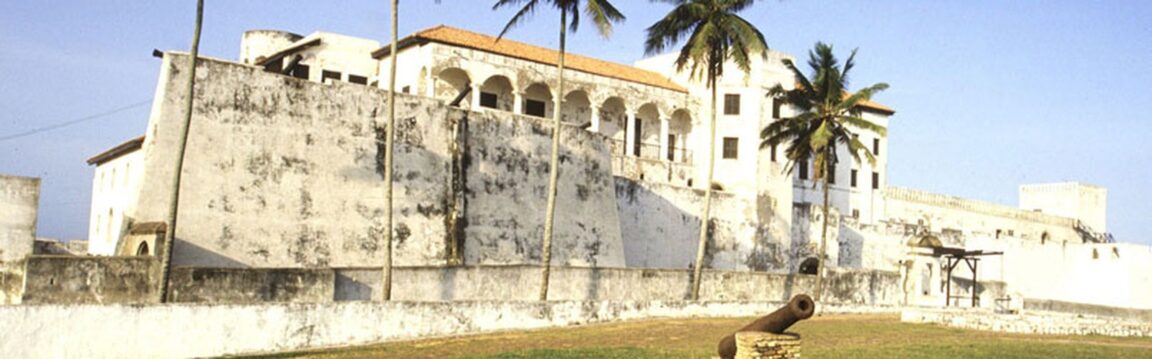
Image credit: Elmina Castle (St. George’s Castle), Ghana. Photo via the Ghana Museums and Monuments Board, the castle’s custodian, at gmmb.gov.gh, used with credit.