 Omar Haddad
Build your Nizwa week around Friday, and build Friday around dawn. The livestock market beside the souk starts soon after sunrise and is largely finished by mid morning, the great round tower of Nizwa Fort is best climbed in the cool first hour after it opens, and the souk rewards shoppers who judge silver, pottery and dates by craft rather than by the souvenir rows nearest the gate. Nizwa, the old capital of the Omani interior, is about 165 kilometres southwest of Muscat, and it is the rare heritage city that still works for a living. Arrive the night before, sleep within walking distance of the fort, and let the town set the timetable.
Quick Facts
- Where: Nizwa, Ad Dakhiliyah Governorate, Oman, at the foot of the Al Hajar Mountains, roughly 165 kilometres from Muscat by road.
- The fort: Nizwa Fort, built under Imam Sultan bin Saif Al Ya’rubi in the mid seventeenth century, with a round tower about 34 metres high and 45 metres across.
- Fort entry: Commonly listed at 5 Omani rials per adult. Confirm the current price at the ticket desk on the day, as tariffs can change.
- Fort hours: Generally 8 in the morning to 8 in the evening, with a Friday midday closure for prayers, typically 11:30 to 1:30. Verify on the day at the gate.
- The market: The Friday livestock market runs from around 6 or 7 in the morning and winds down by about 9 to 10:30. There is no entry fee.
- Best season: October to April, when interior temperatures are comfortable for a full morning outdoors.
Friday First: The Goat Market’s Early Hour
Every Friday, farmers and traders from the villages of the interior bring goats, sheep and cattle to the open ground beside Nizwa Souq, and the animals are walked around a circular ring while buyers inspect them and call out prices. It begins early, in the cool of the day, and the liveliest trading is generally done by about 9 in the morning, with the ring emptying well before Friday prayers. This is not a performance staged for visitors. It is the weekly economics of the oasis made visible, and it has run in this form for generations.
The etiquette is simple and worth respecting. Stand at the edge of the ring rather than inside the flow of animals and handlers, keep clear of the loading areas where pickups arrive, dress modestly as you would anywhere in the Omani interior, and ask before taking close photographs of people. The market costs nothing to watch, and it gives a traveller more understanding of Nizwa in one hour than a museum can in three: this is a trading city first, and everything else, the fort, the souk, the silver, follows from that.
Practical timing follows from the market’s hours. Stay in Nizwa on Thursday night rather than driving from Muscat on Friday morning. Walk to the market by about 7, watch the peak of the trading, then move into the souk as the stalls open fully and the fort ticket desk starts its day. Travellers who arrive at 10 on a Friday have missed the point of the week, however good their fort visit turns out to be.
The Fort at Opening: Climbing the Round Tower
Nizwa Fort was raised in the mid seventeenth century by Imam Sultan bin Saif Al Ya’rubi, the ruler who expelled the Portuguese from Oman, and its construction took around twelve years. Its heart is the enormous circular tower, a drum of packed earth and stone faced in plaster, designed in the age of cannon to absorb shot rather than shatter. Foundations run deep below the tower, an underground stream supplied the garrison, and the interior is a deliberate maze of false doors, murder holes and shafts above stairways where boiling date syrup could be poured on attackers who had forced their way inside.
Climb it first, in the first hour. The rooftop platform, ringed with cannon openings, gives the geography lesson that makes the rest of Nizwa legible: the date palm oasis spread below, fed by the falaj channels, the souk roofs at the tower’s foot, the old quarters of Al Aqr beyond, and the bare ridges of the Al Hajar Mountains closing the horizon. In the cool of the morning the platform is comfortable and quiet. By late morning in the warmer months it is neither, and the same views cost considerably more effort.
Below the tower, the fort’s rooms hold exhibitions on Omani history, crafts and daily life, and the residential and administrative quarters show how the fort worked as a seat of government as much as a stronghold: council rooms, a prison, stores for dates and grain, and living space for the Imam’s household. Allow two hours for the whole complex if the exhibitions hold your attention, ninety minutes at a brisk pace. Visitors planning the wider trip should also read our explainer on Oman’s visa free entry and eVisa rules before booking, and those extending to the coast can pair Nizwa with our stay guide to Al Bustan Palace in Muscat.
The Souk: Silver, Pottery, Dates and Halwa
Nizwa Souq stands directly beside the fort, and it is organised the way a working market should be, by trade. Separate halls and rows serve fruit and vegetables, fish and meat, dates, spices, pottery and silver, and local families shop here alongside visitors, which keeps prices and quality honest. The souk is busiest in the morning and again from late afternoon into the evening, with a quieter middle of the day, and Friday distorts the pattern around prayers.
Judge purchases by craft. In the silver rows, the khanjar, the curved dagger that appears on Oman’s national emblem, ranges from modern tourist pieces to serious antique work in silver over horn and wood. Ask what the materials are, ask how old a piece is, and be suspicious of age claimed too easily. Nizwa silver jewellery, bracelets, rings and coffee pots, carries the same test: weight, workmanship and finish tell you more than the first price quoted. In the pottery rows, look for the unglazed red clay ware of the region, water jars, incense burners and cooking pots, functional forms that have changed little because they do not need to.
Then eat your way through the edible rows. Nizwa is a date town, and the date hall stacks varieties from across the interior, with khalas among the most prized for eating fresh. Omani halwa, the dense, ghee rich sweet scented with saffron, cardamom and rosewater, is sold from great copper pots and is traditionally offered with unsweetened qahwa coffee, the bitterness setting off the sweetness. Buy dates and halwa here rather than at the airport: the range is wider, the turnover faster and the tasting more generous.
Beyond the Fort Walls
A traveller with a second day in Nizwa should walk the old quarter of Al Aqr, where restored mudbrick houses, carved doors and narrow lanes show the domestic city behind the monumental one, and follow the falaj channels that still carry water through the oasis. Falaj Daris, one of the five Omani aflaj inscribed by UNESCO in 2006, runs through a park a few kilometres north of the centre and shows the gravity fed engineering, underground galleries surfacing into open channels, on which the whole settlement depends. Day trips reach further: Bahla, with its UNESCO listed fort and pottery workshops, and the palace fort at Jabrin, are both within easy driving distance and complete the picture of the interior’s fortified age.
Frequently Asked Questions
What day is the Nizwa goat market?
Friday only. Trading starts around sunrise, is liveliest in the early morning and is mostly finished by about 9 to 10:30. Stay in Nizwa the night before to see it properly.
How long do you need at Nizwa Fort?
Ninety minutes to two hours covers the tower climb, the rooftop views and the exhibition rooms. Go at opening for cooler temperatures and a quieter platform.
How much does Nizwa Fort cost?
Entry is commonly listed at 5 Omani rials per adult, with children under six free. Confirm the current tariff at the ticket desk, as prices can change.
Can you visit Nizwa as a day trip from Muscat?
Yes, the drive takes roughly ninety minutes to two hours each way, but a day trip cannot catch the Friday market at its peak. For the market, stay overnight in Nizwa on Thursday.
What is Nizwa Souq known for?
Silver jewellery and khanjars, regional pottery, dates from the interior oases, spices, frankincense and Omani halwa, sold in a working market used by local families.
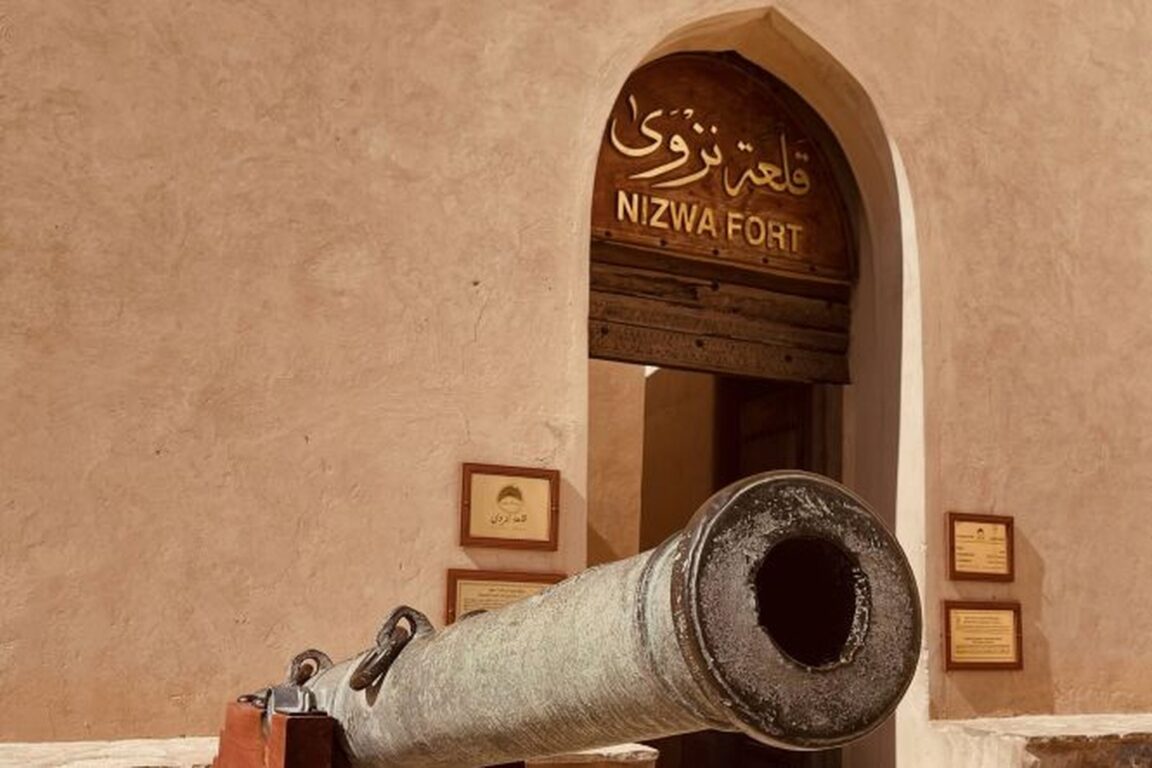
Featured image: The entrance to Nizwa Fort, Oman, with a cannon below the fort’s Arabic and English name sign. Photo by Saif Almanji, via Unsplash (Unsplash License), Unsplash photo SkRCV-_qiNY.