 Omar Haddad
A four day Nile cruise between Luxor and Aswan follows a fixed temple order set by the river itself: Luxor’s East and West Banks first, then the sail south through the Esna lock to Edfu’s Temple of Horus and the double temple at Kom Ombo, and finally Aswan, where Philae, the High Dam and the Unfinished Obelisk close the programme and Abu Simbel waits as an early morning add on. Read the itinerary in that order before you book, because the ships all call at the same temples; what you are really choosing is the direction of travel, the pacing of the Luxor days, and the deck your cabin sits on for the felucca hour views at Aswan.
Quick Facts
- Route: Luxor to Aswan, upstream and southbound, or the reverse sailing from Aswan to Luxor
- Duration: Four days and three nights is the classic short sailing; some programmes sell the same route as a four night, five day version with a fuller Luxor day
- Temples in order, southbound: Karnak and Luxor Temple, the Valley of the Kings, Hatshepsut’s temple and the Colossi of Memnon, then Edfu, Kom Ombo, and Philae at Aswan
- The lock: Ships pass the Esna lock between Luxor and Edfu, and lock timing can shift the day’s schedule
- Abu Simbel: Not a river call; it is a separate early morning road or air excursion from Aswan, booked as an add on
- Best cabin logic: Upper decks for the views, midship for the least motion and engine noise, and a Nile facing cabin on whichever side the ship moors
- Guiding: Scheduled sightseeing on standard programmes is led by an Egyptologist guide, with entrance fees sometimes included and sometimes payable separately, so check your specific booking
Day one in Luxor: the East Bank before you sail
Southbound programmes typically board in Luxor around midday and spend the first afternoon on the East Bank. Karnak comes first, and it deserves the order. The complex grew over many centuries of pharaohs, and its Great Hypostyle Hall, with its forest of carved columns raised under Seti I and Ramesses II, is the single largest set piece of the cruise. Go with the guide through the hall, then use any free minutes at the sacred lake and the scarab statue rather than racing for the exit, because the scale of Karnak only settles once you stop moving.
Luxor Temple follows, ideally towards evening. It stands in the middle of the modern city, aligned with Karnak along the ancient avenue of sphinxes, and it changes character as the light drops and the floodlights come on. Many programmes time this visit for late afternoon for exactly that reason. Sleep aboard in Luxor; the ship has not sailed yet, and the biggest day of the cruise is tomorrow.
Day two: the West Bank, then the river takes over
The West Bank day starts early, and it should. The Valley of the Kings holds the rock cut tombs of the New Kingdom pharaohs, and a standard ticket typically covers entry to a selection of open tombs, with the most famous tombs, such as Tutankhamun’s, ticketed separately when open. The painted tomb of Ramesses VI is the one guides most often use to show what the decoration could do at its best. From the valley, programmes continue to the mortuary temple of Hatshepsut at Deir el Bahari, terraced against the cliffs, and stop at the Colossi of Memnon, the two seated statues that are all that stands above ground of Amenhotep III’s temple.
Then the cruise becomes a cruise. The ship sails south for Esna and its lock, where vessels queue to pass between river levels and the schedule can stretch. Treat lock time as part of the product rather than a delay: it is the hour the sun deck earns its keep, with the riverbanks, the feluccas and the first real sense of Upper Egypt sliding past. Travellers pairing the cruise with Cairo time should read our guide to visiting the Grand Egyptian Museum for the before or after days.
Day three: Edfu in the morning, Kom Ombo at sunset
Edfu is the morning call, reached from the dock by horse carriage or vehicle depending on the programme. Its Temple of Horus is the best preserved temple in Egypt, a Ptolemaic building whose walls carry the myth of Horus and Seth in carved detail, and whose pylon, courtyard and sanctuary survive as a complete sequence rather than a ruin to be imagined. Because every cruise calls here, the temple is busiest when several ships dock together; the early sailing has the quieter temple, which is one quiet argument for checking your ship’s Edfu timing when you book.
The afternoon sail to Kom Ombo is the prettiest short leg of the route, and the temple is timed for late light. Kom Ombo is a double temple, built symmetrically for two gods: Sobek, the crocodile god, and Haroeris, the falcon headed Horus the Elder. Everything is paired, from the entrances to the sanctuaries, and the small crocodile museum beside the temple holds mummified crocodiles found in the area. Visiting at sunset, with the river behind the columns, is the version of this temple worth arranging your day around.
Day four in Aswan: Philae, the dam and the felucca hour
Aswan closes the southbound programme. Philae, the island temple of Isis, is reached by small boat, and it was moved stone by stone to its present island when the Aswan High Dam’s reservoir threatened the original site, a rescue story the guides tell well. The High Dam itself and the Unfinished Obelisk, still lying in its ancient granite quarry with the cracks that abandoned it, complete the standard sightseeing set.
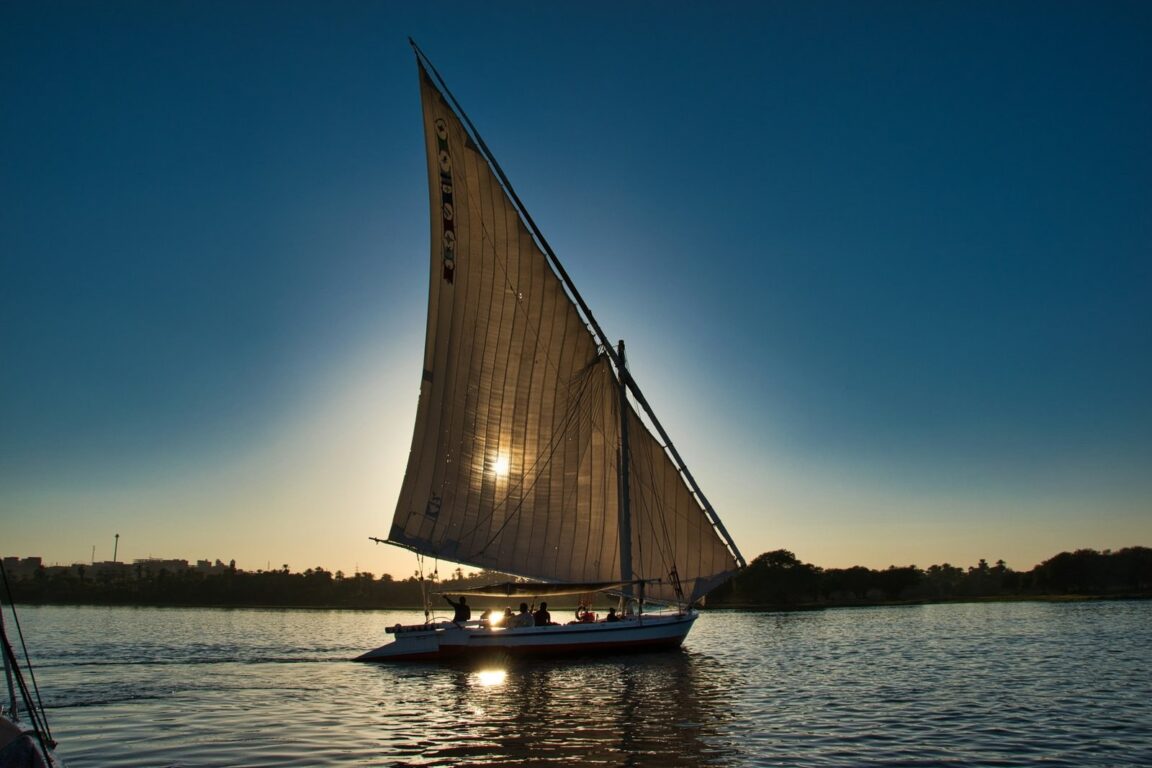
Then comes the hour this guide’s featured image is about. In the late afternoon, feluccas, the traditional lateen sailed boats of the Nile, take visitors out around Aswan’s islands, past Elephantine and the botanical garden island, in the steadiest light of the day. Whether your felucca sail is included or sold on board, take it. After three days of temples at marching pace, an hour under sail at Aswan is the memory the cruise is actually sold on, and it is why the deck question below matters: the views you bought are river views, and they peak here.
Does Abu Simbel fit a four day cruise?
Yes, but only as an add on, and only if you accept what it costs the day. Abu Simbel, the twin temples of Ramesses II and Nefertari, lies roughly 280 kilometres south of Aswan by road. Excursions leave Aswan in the very early morning, convoy or drive south, spend a short time at the temples, and return around midday; a flight option shortens the road hours when it operates. On a four day sailing, the excursion is usually offered from Aswan at the end of a southbound cruise, or before boarding on a northbound one. It fits travellers who know it is the one sight they would regret missing. It does not fit travellers who have already found the cruise’s early starts wearing; the temples are extraordinary, and the alarm clock is real. Book it in advance rather than on board if it matters to you, because seats and convoy places are finite.
Which deck should your cabin be on?
Deck choice is the decision most buyers leave to chance, and it is the one that shapes the sailing days. Upper deck cabins sit closest to the sun deck and furthest from engine and mooring noise, and they give the felucca hour and the Esna lock their full height advantage; they are the default recommendation for this route. Midship cabins on any deck move the least and sit away from both the engines at the stern and the anchor machinery at the bow. Lower deck cabins are the honest budget choice on a four day sailing, because the programme keeps you ashore or on the sun deck for most daylight hours anyway. One mooring reality applies on every deck: Nile cruise ships often tie up side by side in Luxor and Aswan, so a cabin can face another ship rather than the river for a night. That is normal on this route, it changes as ships sail, and it is a reason to spend your view time on deck rather than paying a large premium for a window you may only sometimes use. For what to wear and pack for the river’s temperature swings, see our guide to packing for Egypt in winter, from Cairo mornings to Nile cruise decks.
Southbound or northbound: which direction is better?
The temples are identical; the rhythm is not. Southbound, Luxor to Aswan, front loads the two biggest days and lets the cruise relax as it goes, ending with Aswan’s feluccas and the Abu Simbel option. Northbound, Aswan to Luxor, starts gently and builds to the Valley of the Kings as a finale, and it is the direction most often sold as the four day, three night standard. Choose southbound if you want the hard sightseeing done while you are fresh. Choose northbound if you prefer a crescendo. Either way, confirm what your specific programme includes, because entrance fees, guiding and the felucca sail are bundled differently across operators, and the cheapest headline price is often the one with the most costs waiting on board.
Frequently Asked Questions
How many nights is a four day Nile cruise?
Four days usually means three nights aboard, with boarding around midday on day one and disembarkation after breakfast on day four, and the Luxor sightseeing split across the first two days on a southbound sailing. Some operators sell a four night, five day version of the same route with a slower Luxor pace, so check the night count, not just the day count, when comparing prices.
Which temples does every Luxor to Aswan cruise visit?
The standard set is Karnak and Luxor Temple on the East Bank, the Valley of the Kings, Hatshepsut’s temple and the Colossi of Memnon on the West Bank, the Temple of Horus at Edfu, the double temple at Kom Ombo, and Philae, the High Dam and the Unfinished Obelisk at Aswan.
Is Abu Simbel included in a Nile cruise?
Usually not. Abu Simbel is a separate excursion from Aswan, most often by road in the early morning or by air when flights operate, and it is booked and paid as an add on. Arrange it in advance if it is a priority.
What is the Esna lock and will it delay the cruise?
The Esna lock moves ships between two levels of the Nile south of Luxor. Ships can queue for it, so programmes treat the passing time as flexible. Build no tight connection plans around lock day and enjoy it as sailing time.
Are entrance fees included in the cruise price?
It varies by operator. Some programmes bundle sightseeing with an Egyptologist guide and entrance fees; others include the guiding and charge fees separately. Confirm the arrangement for your exact sailing before you book.
Image: A felucca under sail at sunset on the Nile at Aswan. Photo: Gijs Jakobs, via Unsplash (Unsplash License), hosted copy via Nile Cruise Direct. Used with credit.