 Lucas Meyer
Drive Morocco’s Atlantic coast from Essaouira to Agadir in two or three easy days, not one long push: keep your passport, driving licence, rental agreement and the car’s papers together for police checkpoints, stop at a women’s argan co-operative on the inland side of the coast road, and break the journey in the surf villages of Sidi Kaouki, Imsouane and Taghazout so that no single day behind the wheel runs much past two hours. That rhythm, plus a calm routine at checkpoints, is what turns a simple coastal transfer into one of Morocco’s most rewarding short road trips.
Quick Facts
- Route: Essaouira south to Agadir on the coastal N1 road, through Tamanar, Imsouane and Taghazout.
- Driving pattern: Short hops of roughly one to two hours between surf towns, rather than a single full day drive.
- Start point: Essaouira, whose medina UNESCO inscribed as a World Heritage Site in 2001 as an outstanding example of a late 18th century fortified port town.
- Key landscape: The argan country of southwestern Morocco, recognised by UNESCO as the Arganeraie Biosphere Reserve, where argan trees grow nowhere else on this scale.
- Paperwork to carry: Passport, home driving licence, rental agreement and vehicle documents, kept together and within reach.
- Best stops: A women’s argan co-operative for the cracking and pressing demonstration, Sidi Kaouki for a first beach break, Imsouane for its long bay wave, and Taghazout for a surf town overnight.
- Driving style: Slow down well before checkpoints and villages, watch for pedestrians, animals and parked vehicles at the road edge, and avoid driving this rural coast after dark where possible.
Why start in Essaouira rather than driving straight through?
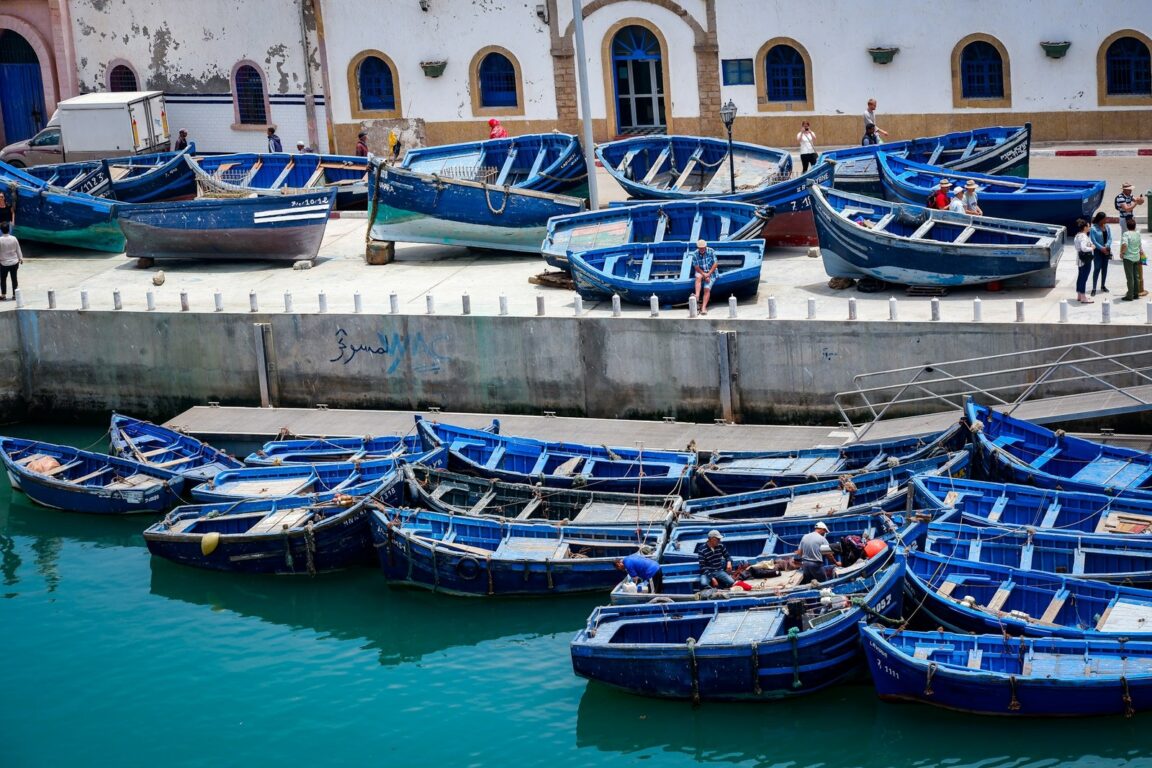
Essaouira sets the tone for the whole coast, and it deserves at least a morning before the car is collected. UNESCO describes the medina as a fortified port town built in the late 18th century under Sultan Mohammed ben Abdallah, laid out with the involvement of the French engineer Théodore Cornut and influenced by European military architecture of the period. That history is still legible at street level: straight main streets inside the walls, sea bastions with old cannon facing the Atlantic, and a working fishing port where blue wooden boats crowd the harbour below the ramparts.
Start at the port, where the catch is sorted and grilled fish stalls serve lunch near the water, then walk the Skala sea bastion before leaving town. Travellers who want the fuller town story first can read our Essaouira travel guide, which covers the medina in depth. The practical point for drivers is timing: leave after the morning port scene and after fuel, water and a phone charge have been sorted, rather than rushing out at dawn and arriving everywhere before anything opens.
What paperwork and checkpoint etiquette actually matter?
Police checkpoints are a normal feature of main roads in Morocco, including this coast, and they are rarely a problem for a prepared driver. Slow right down as you approach, follow any signal to stop, and wait to be waved through or spoken to. Keep the car documents, the rental agreement, your licence and your passport in one folder in the cabin, not buried in luggage in the boot, so that a request for papers takes seconds rather than a roadside unpacking.
How to handle a checkpoint calmly
Approach slowly, stop where indicated, turn the music down and greet the officer politely. A simple greeting in French or Arabic goes a long way. Hand over documents when asked, answer questions about where you are travelling from and to, and wait to be waved on before pulling away. Do not photograph checkpoints or officers. If a fine is ever discussed, ask for the official process and paperwork rather than improvising at the roadside. Most encounters end in under a minute with a wave, especially when the driver has clearly slowed down in good time and the papers are in order.
Speed, villages and the edges of the road
The greater risk on this route is not checkpoints but speed through places where the road is also the village main street. Children, market stalls, donkeys, goats and parked trucks all share the edges of the N1. Treat every built up stretch as a place to slow right down, expect vehicles to stop without much warning, and keep a generous gap to the car ahead. Plan fuel stops in the larger towns rather than assuming every village has a station, and try to finish each day’s driving in daylight, when the road and its edges are far easier to read.
Where do the argan co-operatives fit into the drive?
South of Essaouira the road enters argan country. UNESCO recognised the Arganeraie as a Biosphere Reserve in 1998, and the knowledge and practices around the argan tree were later inscribed on UNESCO’s Representative List of the Intangible Cultural Heritage of Humanity. The tree, Argania spinosa, is endemic to this part of southwestern Morocco, and its fruit has been cracked, roasted and pressed by local women for generations.
A co-operative stop, typically around the Tamanar stretch of the road, shows the work behind a bottle of oil: the hard nuts are cracked between stones by hand, the kernels are sorted, and for culinary oil they are roasted before grinding and pressing. Cosmetic oil uses unroasted kernels, which is why the two products smell and taste so different. A good visit lasts long enough to watch the cracking and grinding, taste the difference between culinary oil and the nutty paste called amlou, and buy directly from the women who made it.
How to judge a co-operative stop
Choose a stop where the production is visibly happening, where prices are clearly marked, and where the person explaining the process can say which village the nuts came from. Clearly labelled bottles, a working demonstration area and no pressure to buy large quantities are all good signs. Goats photographed in argan trees near the road are a famous sight in this region, but treat roadside goat photo stops arranged for tips as a photo opportunity rather than a natural scene, and never stop the car in a live traffic lane for a picture. Pull fully off the road or skip the shot.
Which surf towns break the drive best?
Sidi Kaouki, the first pause
Sidi Kaouki, a short drive south of Essaouira, is the natural first stop: a broad, windswept beach, a small cluster of cafes and surf hire, and a much slower pace than the town you have just left. It works as a coffee and beach walk break, or as a first night for travellers who left Essaouira late. The wind that makes Essaouira famous for kitesurfing is present here too, so a swim is a conditions based decision on the day, following local advice and any flags or warnings at the beach.
Imsouane, the long wave
Imsouane sits in a bay celebrated for an exceptionally long right hand wave that draws surfers from across Europe in the winter season. Even non surfers will enjoy the harbour, the grilled fish lunches and the spectacle of the bay on a good swell day. The access road drops down to the village, so take it slowly and park considerately in the busy centre. Imsouane makes the best overnight of the middle section because the late afternoon light on the bay and the evening harbour scene reward staying rather than passing through.
Taghazout and Tamraght, the surf hub finish
Taghazout, with neighbouring Tamraght, is the best known surf base on this coast, a village that has grown around famous point breaks while keeping a small centre of cafes, board hire shops and surf camps. It is close enough to Agadir to serve as a final night before returning the car, and busy enough in season that parking and accommodation are easier with a little planning. Agadir itself, largely rebuilt after the 1960 earthquake, offers the wide beach, the marina and the hilltop kasbah viewpoint as a gentle urban finish to a rural drive. Travellers continuing inland afterwards can pair this coast with our guide to car free Fes for a contrast between Atlantic Morocco and the great inland medina cities.
How should the days be divided?
Two days is comfortable and three is better. On day one, leave Essaouira late morning, stop at an argan co-operative, pause at Sidi Kaouki and sleep in Imsouane. On day two, drive the shorter hop to Taghazout, surf or watch the point breaks, and continue to Agadir in the late afternoon if the car is due back there. With a third day, add a full Essaouira morning at the start or a surf day in Taghazout at the end, rather than adding more distance. The coast rewards slowness: the distances look short on a map, but villages, checkpoints, photo stops and fish lunches all take time, and a plan with slack absorbs them happily instead of turning them into stress.
What should be packed in the car?
Keep a day bag in the cabin with water, sunscreen, a layer for the Atlantic wind, swimwear and a towel for beach stops, and small cash notes for cafes, parking attendants and co-operative purchases. Put the documents folder, phone charging cable and any medication in the same cabin bag. Luggage in the boot should be out of sight at stops, and nothing of value should be left visible in a parked car at a beach or viewpoint, the same rule that applies on any road trip anywhere.
Frequently Asked Questions
How long does it take to drive from Essaouira to Agadir?
The coastal road can be driven in a single day, but the trip is far better split over two or three days with overnight stops in Imsouane or Taghazout. Short daily hops leave time for co-operative visits, surf beaches and harbour lunches, and avoid arriving after dark on an unfamiliar rural road.
Are police checkpoints a problem for foreign drivers in Morocco?
No, provided the driver slows down, stops when signalled and has the passport, licence, rental agreement and vehicle papers ready. Most checks take under a minute. Keep documents together in the cabin, be polite, and never photograph a checkpoint.
What is the difference between culinary and cosmetic argan oil?
Culinary argan oil is made from roasted kernels, giving it a deep nutty flavour used in cooking and in amlou. Cosmetic oil is made from unroasted kernels and has a lighter scent. A co-operative visit on the Essaouira to Agadir road is the clearest way to see and taste the difference at the source.
When is the surf best on this coast?
The main surf season runs through the cooler months, when Atlantic swells are most consistent at breaks around Imsouane, Taghazout and Agadir. Summer brings smaller waves and stronger wind, which suits learners at beach breaks and kitesurfers around Essaouira and Sidi Kaouki. Conditions vary daily, so check the local forecast and surf school advice on arrival.
Can this drive be done in the opposite direction?
Yes. Starting in Agadir and finishing in Essaouira works just as well, and many travellers prefer ending with Essaouira’s medina, port and ramparts. The same pacing applies: short hops, daylight driving, documents ready and at least one co-operative stop in the argan country between the two towns.
Image credit: Blue fishing boats in Essaouira port, Morocco. Photo by Emma Van Sant, via Unsplash, Unsplash License.