 Wei Chen
Three days in Hanoi divide cleanly by quarter: give the Old Quarter the mornings, when its trade streets are setting up and the coffee is strongest, put the Ho Chi Minh Mausoleum first on its day because it opens early and closes before lunch, spend one afternoon in the boulevards of the French Quarter, and start at least one day at dawn on Hoan Kiem Lake, when the city does its exercises around the water before the scooters take over. Hanoi rewards travellers who read it as a set of distinct districts rather than a single checklist, and three days is exactly enough to do that: one day anchored in the Old Quarter, one in the monumental west around Ba Dinh, and one that moves between the French Quarter, the Temple of Literature and West Lake.
Quick Facts
- Structure: Day 1 Old Quarter and Hoan Kiem Lake; Day 2 Ba Dinh and the Mausoleum, then the Temple of Literature; Day 3 French Quarter, then West Lake.
- Mausoleum hours: Tuesday, Wednesday, Thursday, Saturday and Sunday mornings only. From 1 November to 31 March, 8:00 am to 11:00 am, and to 11:30 am on Saturdays, Sundays and public holidays; from 1 April to 31 October, 7:30 am to 10:30 am, and to 11:00 am at weekends. Closed Mondays and Fridays, and for a period of annual maintenance announced each year. Entry is free.
- Mausoleum rules: Shoulders and knees covered, hats off, silence inside, and cameras and bags deposited before entering the chamber. Check the Mausoleum Management Board’s current notice before building a day around it.
- Base: Sleep in or beside the Old Quarter; everything on Day 1 is walkable and the other districts are short rides west and south.
- Train Street: Access is restricted and policed. View trains only from the authorised cafes and crossings, never walk the tracks, and check the situation on the day.
- Best hour in the city: Dawn at Hoan Kiem Lake, around 5:30 to 6:30 am, when the lakeside fills with exercise groups.
Day 1: The Old Quarter by its trade streets
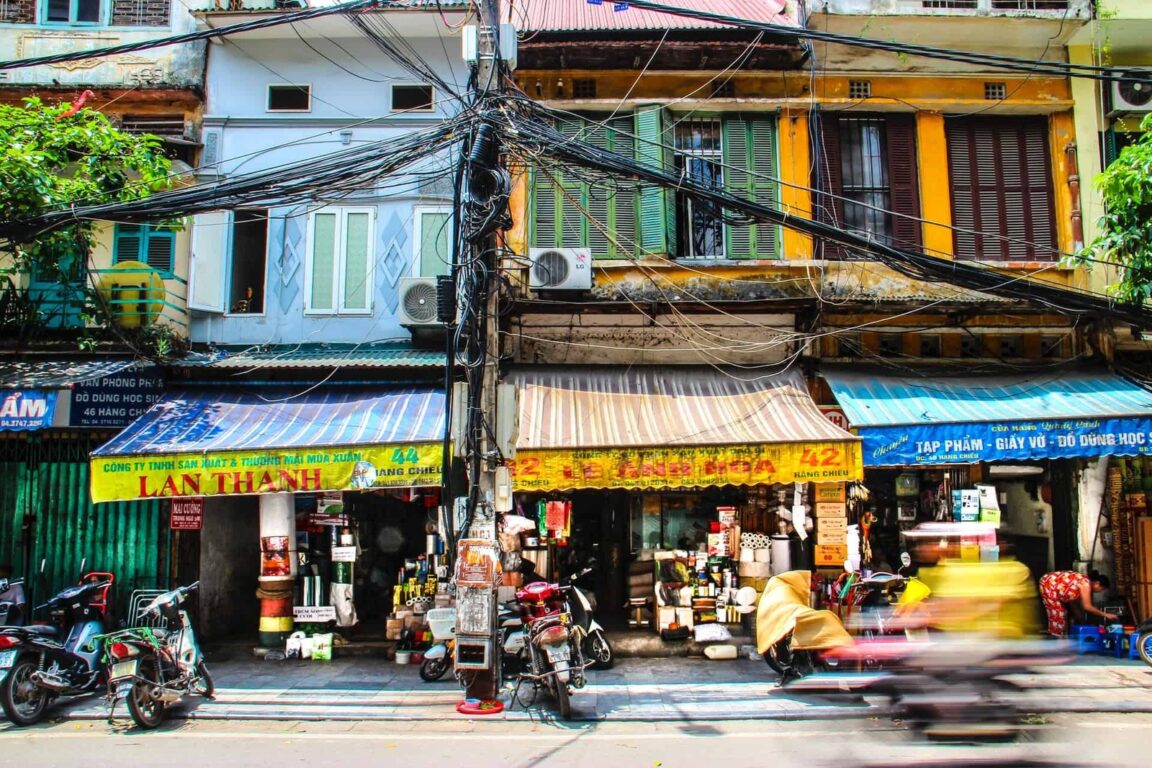
The Old Quarter’s famous 36 streets were organised by trade, and many still are: a street for silk, a street for metalwork, a street for paper goods and festival offerings, a street for bamboo. Reading the street signs as a directory is the day’s real activity. Start early, when shopkeepers are raising shutters and the first pho stalls are steaming, and walk the quarter in a loose loop north of Hoan Kiem Lake: Hang Bac for jewellery and money changers’ history, Hang Gai for silk, Hang Ma for paper goods, which changes its stock with every festival, and the streets around Dong Xuan Market, the quarter’s covered wholesale heart.
Build the day’s eating into the walking rather than stopping it: pho for the first breakfast, bun cha at midday, the dish of grilled pork in broth with noodles that Hanoi claims as its own, and egg coffee, whisked yolk over strong coffee, in a cafe up a narrow stairway in the afternoon. St Joseph’s Cathedral, the late 19th century granite church at the quarter’s southwest edge, anchors the late afternoon, and the streets around it fill with students on small stools drinking lemon tea. Finish at Hoan Kiem Lake as the lights come on: the red Huc Bridge to Ngoc Son Temple is the city’s most loved view, and on weekend nights the streets around the lake close to traffic and become a promenade.
Day 2: Ba Dinh at opening, then the Temple of Literature
The Mausoleum decides this day’s shape, so start it there. Ho Chi Minh’s Mausoleum on Ba Dinh Square, where he read Vietnam’s declaration of independence on 2 September 1945, admits visitors on five mornings a week only, in a short window that ends by 11:00 am in winter, and the queue forms early. Entry is free, the line moves in silence in twos, and the visit itself takes minutes: a slow file past the embalmed body in the granite chamber. Dress is enforced at the gate, so cover shoulders and knees, and expect to deposit cameras and bags at the free counter before the final queue. Because the Mausoleum closes on Mondays and Fridays and shuts entirely for annual maintenance, confirm the current notice from the Mausoleum Management Board before fixing this day; if it is closed, Ba Dinh Square, the Presidential Palace grounds and the stilt house, and the One Pillar Pagoda beside the square still make the trip west worthwhile.
From Ba Dinh, turn south to the Temple of Literature, Vietnam’s first university, founded in 1070 and dedicated to Confucius: five courtyards of gates, pavilions and the stone stelae recording doctoral graduates, set in gardens that are the calmest green space in the centre. It pairs naturally with the Mausoleum as the day’s second half, state ceremony in the morning and scholarship after lunch. Travellers heading north afterwards into the mountains will find the same early start discipline pays off on the Ha Giang Loop, and those routing through China can pair this itinerary with three days in Chengdu.
A note on Train Street
The short section of track where trains pass within arm’s reach of cafes draws visitors every day, and its rules have tightened repeatedly: barriers, police checks and closures come and go, and access for visitors has been restricted for safety. The honest advice is to treat it as a bonus, not a plan: go only if the cafes on the authorised section are open and staff are seating guests, stay behind the barriers, never step onto the tracks for a photograph, and leave without argument if officials close the street. The times of trains change and are posted locally; a cafe owner, not a blog, is the current source on the day.
Day 3: The French Quarter afternoon and West Lake
The French Quarter, southeast of Hoan Kiem Lake, is Hanoi at its most spacious: broad tree lined boulevards, the Opera House modelled on Parisian lines, the grand hotels and embassy villas, and Trang Tien street’s bookshops and ice cream parlour. It takes an afternoon rather than a day, and it contrasts deliberately with the Old Quarter’s density: this was the colonial administrative city, built wide, where the Old Quarter was built close. The History Museum and the Women’s Museum, both in or near the quarter, are the two indoor stops worth choosing between.
End the trip at West Lake, the city’s largest, in the late afternoon. The Tran Quoc Pagoda, Hanoi’s oldest, stands on a small island on the lake’s eastern shore, and the lakeside road fills towards sunset with coffee stands and couples on parked scooters. Dinner back in the Old Quarter closes the loop: three districts, three registers of the same city, and no day that repeated another.
Getting between the quarters
Hanoi’s districts are close, and the friction is traffic rather than distance. The Old Quarter to Ba Dinh is about two and a half kilometres, ten to fifteen minutes by taxi or ride hailing car in the early morning when the Mausoleum run should be made, and twice that at rush hour. Walking it, by way of the streets west of the lake, takes thirty to forty minutes and is a good dawn option in the cooler months. Within the Old Quarter, walk everything: its streets are narrow, parking is scarce, and the quarter’s pleasures are at pavement level. Cyclos and the electric cars that tour the Old Quarter and the Ba Dinh area suit travellers who want the geography explained as they move, but they are sightseeing, not transport. Keep small notes and coins for street food stalls, carry the hotel’s address written in Vietnamese for drivers, and agree the ride hailing pickup point before leaving a sight, because Old Quarter streets close, narrow and change direction around a visitor with confidence.
Frequently asked questions
What are the Ho Chi Minh Mausoleum opening hours?
Mornings only, on Tuesdays, Wednesdays, Thursdays, Saturdays and Sundays. In winter, 1 November to 31 March, it opens 8:00 am to 11:00 am, and to 11:30 am on Saturdays, Sundays and holidays. In summer the window is 7:30 am to 10:30 am, and to 11:00 am at weekends. It is closed on Mondays and Fridays and during an annual maintenance closure, so check the Management Board’s notice before you go. Entry is free.
Which day should I visit the Mausoleum?
Build it into your second day, and check the calendar first: a Monday or Friday arrival means moving this whole day. Weekday mornings are quieter than weekends.
Is Train Street open to visitors?
Access is restricted and changes with enforcement. Cafes on the authorised section seat guests when the street is open, and officials close it when it is not. Never walk on the tracks, and treat a closure as final for that day.
Where should I stay for this itinerary?
In or beside the Old Quarter. Day 1 becomes entirely walkable, the lake is minutes away at dawn, and Ba Dinh and West Lake are short rides. The French Quarter is the quieter, grander alternative and still close.
What is the Old Quarter’s street per trade system?
Its streets were historically each home to a single trade or craft guild, and many keep the pattern: silk on Hang Gai, paper goods on Hang Ma, metalwork and jewellery on and around Hang Bac. The street name’s first word, Hang, means merchandise.
Is three days enough for Hanoi?
For the city itself, yes: the Old Quarter, Ba Dinh, the Temple of Literature, the French Quarter and West Lake all fit without rushing. Ha Long Bay is a separate day trip or overnight and should not be squeezed into these three days at the city’s expense.
Featured image: Street life in Hanoi’s Old Quarter. Photo by Florian Wehde, via Unsplash (Unsplash License), hosted copy via We Travel There.