 Elena Vasquez
Start at the top, not at the postcard. Procida rewards the traveller who climbs first to Terra Murata, the walled hilltop at 91 metres, reads the island from the abbey terrace, and only then drops down to the coloured houses of Marina Corricella. Ferries and hydrofoils from Naples take roughly 40 minutes by hydrofoil and about an hour by ferry, with further links from Pozzuoli and Ischia, so the island works as a day trip. It works better as an overnight, when the last boats leave and Corricella goes back to being a working fishing harbour. This guide sequences the climb, the abbey and the ferry choice in that order.
Quick Facts
- Island: Procida, smallest of the Gulf of Naples islands, about 4 square kilometres, between Ischia and the mainland at Capo Miseno
- Highest point: Terra Murata, 91 metres, the fortified original settlement
- From Naples: Hydrofoils from Molo Beverello in about 40 minutes; slower car ferries from Calata Porta di Massa in about an hour. Operators include Caremar, SNAV, Alilauro and Medmar; check the operator site for the sailing day timetable
- From Ischia: Ferry and hydrofoil links of roughly 25 to 35 minutes, useful for a two island stay but tight for a two island day
- On the island: Small local buses loop between Marina Grande, Terra Murata and Marina Chiaiolella; most sights are walkable
- Best months: May, June and September for warm seas and thinner crowds
- Checked: Routes and timings checked 25 November 2026 against operator and island sources
Which ferry, and which port, decides the shape of the day
Naples has two departure quays and they are not interchangeable. Hydrofoils and fast craft leave from Molo Beverello, below Piazza Municipio, while the larger ferries leave from Calata Porta di Massa, about a kilometre further east. A traveller who walks to the wrong quay with a timed ticket loses the sailing, so the first decision is printed on the ticket itself. The hydrofoil is the day tripper’s boat: fast, foot passengers only in practice, and priced above the ferry. The ferry is the overnight traveller’s boat: slower, cheaper, and the one that takes luggage without fuss.
Pozzuoli, reached from Naples on the metro and Cumana lines, is the quieter alternative. Crossings from Pozzuoli are shorter, the quays are calmer, and the fares are usually a little lower. From Ischia, the link is a hop of under 40 minutes, which tempts travellers into doing both islands in one day. Resist it. The timetables rarely align well enough to give either island a fair share of hours, and Procida’s whole appeal is its slowness. Choose one island per day, or sleep on one and day trip to the other.
All Procida sailings dock at Marina Grande, also called Marina di Sancio Cattolico, on the island’s north coast. From the quay, Corricella is a walk of 10 to 15 minutes, Terra Murata a steep climb of 20 to 25 minutes, and the far marina of Chiaiolella a bus ride or a long walk across the island. In rough weather crossings can be cancelled, hydrofoils first, so a winter day trip should always carry a margin before any onward connection from Naples.
Terra Murata: the walled land at the top of the island
Terra Murata means walled land, and the name is the history. When pirate raids threatened the coast, Procida’s people lived up here, inside 17th century defensive walls on the island’s highest ground, and the settlement still reads as a fortress village: narrow lanes, archways, houses turned inward, and sudden terraces where the ground falls away to the sea. The climb from Marina Grande is steep and mostly stepped. Take it in the morning, before the heat and before the day boats fill the lanes below.
Two buildings anchor the hilltop. The Abbey of San Michele Arcangelo, founded as a Benedictine monastery in the 11th century and rebuilt over the centuries, is the island’s spiritual centre, dedicated to Procida’s patron, whose feast on 29 September brings a procession through these streets. Its church, library and the views from its terrace repay a slow visit; opening arrangements vary by season, so check the notices at the door rather than assuming daily hours. Beside it stands the Palazzo d’Avalos, built in the 16th century as a noble residence and used as a prison from the 19th century until its closure in 1988. Its scale surprises everyone: this was one of Italy’s significant island prisons, and its walls dominate the skyline you see from the ferry.
The terrace beside the old prison is the island’s great viewpoint. Ischia sits close to the west, Capri shows on a clear day to the south, and Vesuvius closes the mainland horizon. This is the moment the island explains itself: Corricella below, the Chiaia beach crescent under the cliff, and the Vivara islet tied to the far shore by its bridge.
Marina Corricella, read properly after the climb
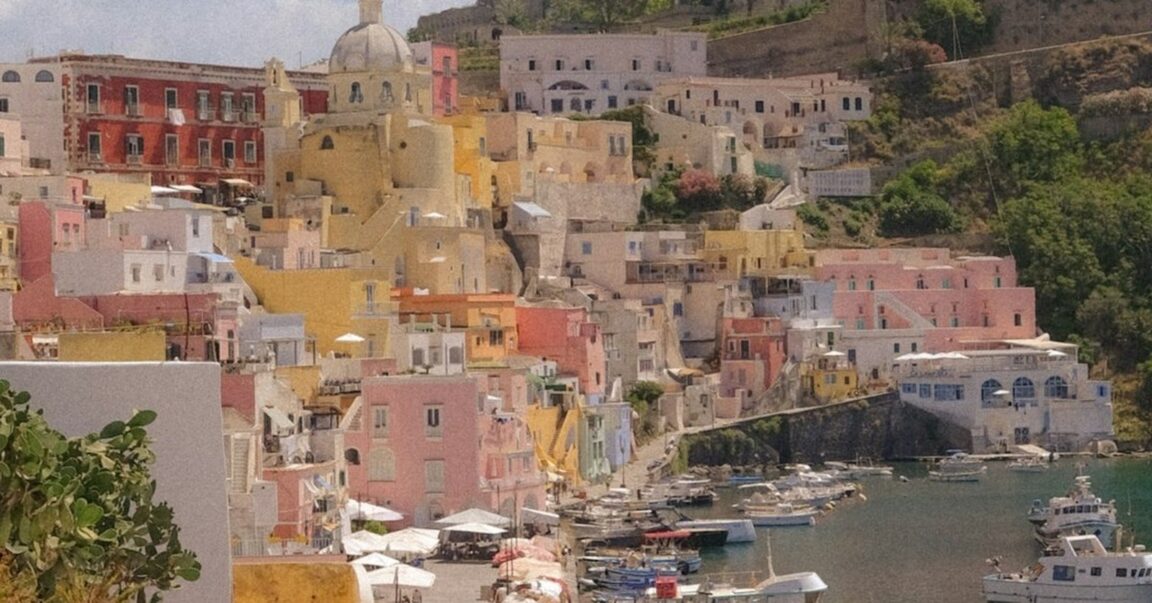
Corricella is the view on every postcard, a 17th century fishing village folded into a bay with no cars, reached on foot down stepped lanes. The tall houses in pink, yellow, ochre and blue were painted, local tradition says, so fishermen could pick out their own home from the water. Arches at street level once sheltered boats and nets; many now hold small restaurants and cafes. The harbour was the waterfront setting for the film Il Postino, which fixed this view in the imagination of a generation of travellers.
Seen after Terra Murata, Corricella makes more sense. It was the working port of the community that slept behind walls above it, and it still works: boats land fish here, nets are mended on the quay, and the morning is given to the harbour before it is given to visitors. Come down from the hilltop in time for a late morning coffee, take lunch at a harbour table if you are day tripping, and understand that the midday crowds thin sharply once the early afternoon boats take day visitors back to Naples.
Beaches, Vivara and the far side of the island
Procida’s beaches are small and volcanic. Chiaia, a sheltered crescent below Terra Murata reached by a long flight of steps, is the most dramatic and the closest to the old town. Ciraccio, on the west coast, is the island’s longest stretch of dark sand and the best choice for a full beach afternoon. Chiaiolella, the marina on the south side, pairs a swim with the island’s second harbour scene, and from here a bridge crosses to Vivara, a crescent shaped islet protected as a nature reserve. Access to Vivara is controlled and changes, so check the current visiting arrangements locally before building a day around it.
The island’s food follows its boats and its lemon groves. Procida lemons are famously large and fragrant, worked into salads, desserts and liqueurs, and the pastry to look for is the lingua di bue, a flaky shell filled with lemon cream. None of this needs a famous restaurant. It needs a harbour table, the day’s fish, and time.
Day trip or overnight: the honest answer
A day trip covers the essentials honestly: an early hydrofoil, the Terra Murata climb, Corricella, one beach, and a late ferry back. What it cannot give you is the island’s best hour, the evening after the day boats leave, when the harbours empty and dinner is eaten at local pace. Procida was Italian Capital of Culture in 2022, the first island to hold the title, and the attention has grown its small hotel and apartment supply, but July and August still book out early. In the quiet months many seasonal businesses close, ferries continue, and the island belongs to its roughly ten thousand residents. For more Campanian season planning, see our guide to the Barcelona cruise embarkation day for port day discipline, and our St Gilgen and Wolfgangsee guide for another small place that rewards staying past the day crowd.
Frequently Asked Questions
How long is the ferry from Naples to Procida?
Hydrofoils from Molo Beverello take about 40 minutes. Conventional ferries from Calata Porta di Massa take about an hour. Check the operator’s timetable for your exact sailing, as times vary by season and weather.
Can Procida be done as a day trip?
Yes. An early crossing gives enough hours for Terra Murata, Corricella and a beach. Staying overnight adds the quiet evening harbour, which many travellers rate as the best part of the island.
Which port in Naples do I need?
Hydrofoils use Molo Beverello and ferries use Calata Porta di Massa. The quay is printed on your ticket; the two are about a kilometre apart, so confirm before you set out.
Is Procida better than Ischia or Capri?
It is different rather than better. Procida is smaller, quieter and more residential, with fewer sights and hotels. Ischia offers thermal parks and scale; Capri offers glamour and crowds. Procida offers a working island at walking pace.
When is the best time to visit Procida?
May, June and September balance warm seas with manageable crowds. July and August are busy and hot; winter is quiet, with some businesses closed but ferries still running.
Image: Marina Corricella, Procida, with its pastel harbour houses above the fishing boats. Photo by Alexis Fauvet on Unsplash (hosted copy via Love to Visit Italy), Unsplash License.