 Sofia Rossi
Buy the combined ticket, start in the palace, and keep the garden for the climb it deserves. Palazzo Pitti and the Boboli Gardens together cost 22 euros bought on the day or 25 euros booked in advance, per the Uffizi Galleries’ published prices, and the pairing works in one direction: the Palatine Gallery’s hung rooms first, while you are fresh, then out into Boboli and up the hill. The palace is open Tuesday to Sunday from 8.15am to 6.30pm. The gardens open at 8.15am too but close at 4.30pm in the November to February season, with last admission an hour before closing, and that earlier garden deadline is the fact that should shape the whole visit.
Quick Facts
- Palace hours: Tuesday to Sunday, 8.15am to 6.30pm. Closed Mondays, 1 January and 25 December, per uffizi.it
- Garden hours: Opens 8.15am daily except the first and last Monday of each month and 25 December. Closes 4.30pm in January, February, November and December; 7.10pm in June, July and August. Last admission one hour before closing
- Palace ticket: 16 euros on the day, 19 euros in advance, covering the Palatine Gallery, Gallery of Modern Art, Museum of Costume and Fashion, Treasury of the Grand Dukes, Museum of Russian Icons and the Palatine Chapel
- Boboli ticket: 10 euros on the day, 13 euros in advance
- Combined Pitti and Boboli: 22 euros on the day, 25 euros in advance. The five day PassePartout covering the Uffizi, Pitti and Boboli costs 40 euros
- Porcelain Museum: Closed for refurbishment until further notice, per the gardens’ official page, so plan the hilltop for the Knight’s Garden viewpoint instead
- Checked: Hours and prices checked 25 November 2026 against uffizi.it
The palace first: the gallery order that skips the crush
Palazzo Pitti is not one museum but a stack of them inside the Medici’s vast Oltrarno palace, and the mistake most visitors make is drifting. The single palace ticket covers every collection, so the order is a choice, and the right first choice is the Palatine Gallery on the piano nobile. Its rooms keep the grand ducal hang: Raphaels, Titians and Rubens arranged as a palace collection rather than a textbook, in gilded rooms that were lived in before they were looked at. Go here at opening, when the rooms are quietest, and give it the best hour of the visit.
After the Palatine, choose by appetite rather than completeness. The Gallery of Modern Art, despite its name, holds Italian art from the late 18th century into the 20th, including the Macchiaioli, Tuscany’s own answer to the Impressionists. The Museum of Costume and Fashion is Italy’s national fashion collection and the palace’s most distinctive smaller museum. The Treasury of the Grand Dukes and the Russian Icons reward specialists. Trying to do everything at equal depth produces the glazed fatigue the combined ticket is often blamed for; two collections done properly beat six done at a march.
The palace ticket office closes an hour before the museum, and the building’s scale is deceptive: the walk from Piazza Pitti’s entrance to the garden door through the Ammannati courtyard is a visit in itself. Keep water with you for the gardens, where the official advice is the same, since drinking fountains exist but the grounds are large and almost entirely sloping.
Boboli: the climb, the fountains and the closed museum to plan around
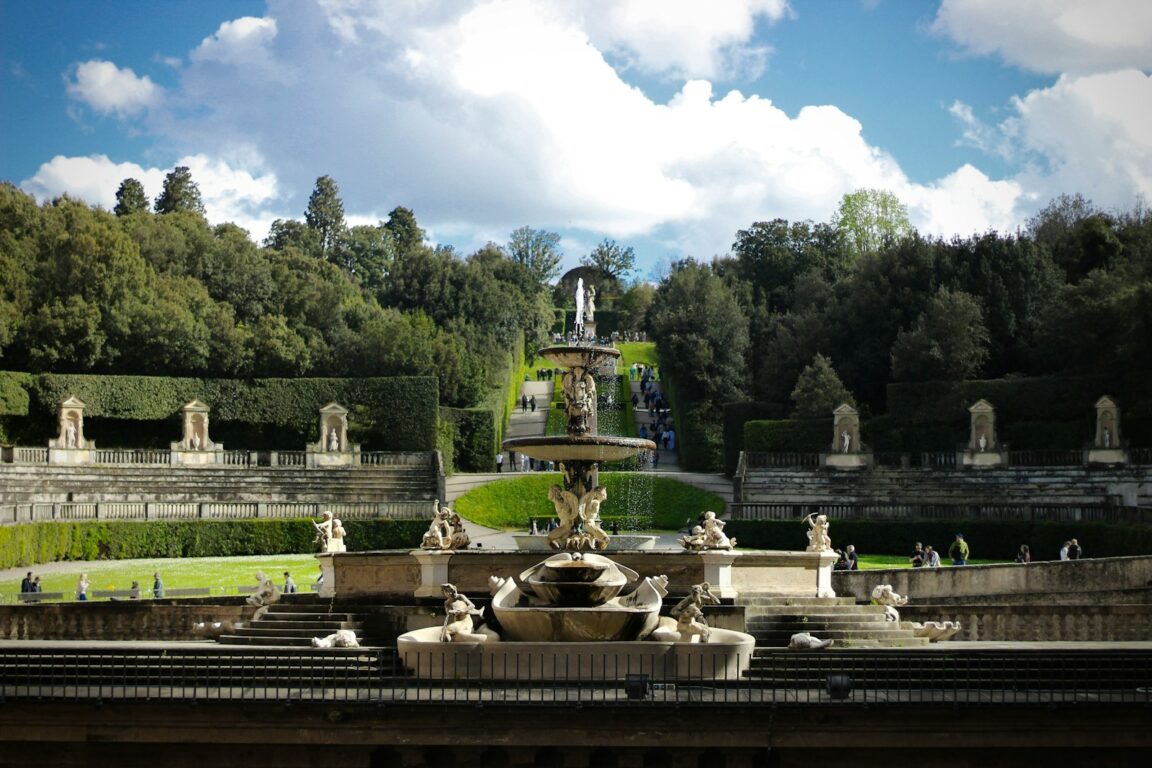
Boboli begins where the palace ends, rising behind it in terraces laid out for the Medici from the 16th century and extended by the Lorraine and Savoy successions. The amphitheatre, hollowed from the quarry that supplied the palace stone, opens the garden; above it the Fountain of Neptune marks the climb’s first goal, and the long central axis draws you up toward the Knight’s Garden, the walled terrace near the top whose view over Florence is the garden’s great payoff. The Fountain of the Ocean, the Buontalenti Grotto near the palace entrance, the Lemon House and the 18th century Kaffeehaus pavilion fill out a full garden visit.
Older guides send travellers up here for the Porcelain Museum, housed in the Casino del Cavaliere at the top of the climb. At the time of checking, the Uffizi’s official gardens page states plainly that the Porcelain Museum remains closed for refurbishment works until further notice. Build the hilltop around the Knight’s Garden terrace and the views instead, and treat any reopening notice on uffizi.it as the authority. This is exactly the kind of detail that dates a guidebook, so check the page again before a visit built around the porcelain.
Garden discipline matters more than garden knowledge. In winter the gardens close at 4.30pm and last admission is 3.30pm, so a palace morning that runs long can quietly consume the garden. In summer the gardens stay open to 7.10pm and the order can relax. The gardens can also close or change hours at short notice in dangerous weather, and the gravel and clay paths are steep in places; the official accessibility notes say the garden is visitable only with an accompanying person for those who need step free routes, with accessible entrances at Pitti Square and Porta Romana.
The garden gates, and the exit that makes the evening
Boboli has several gates, and they are a planning tool. Entry and exit are possible from the palace itself, from the Annalena gate on Via Romana, from Forte di Belvedere above, and from Porta Romana at the garden’s southern edge. The traveller’s trick is to finish at the right gate. Exiting toward Via Romana and the Annalena side drops you into the Oltrarno’s Santo Spirito quarter, Florence’s artisan neighbourhood, where the piazza of Santo Spirito holds the city’s most local evening scene of cafes and small restaurants. A Pitti and Boboli day that ends with dinner in Santo Spirito has used the geography properly: palace, garden climb, garden gate, dinner streets, in one unbroken line with no backtracking across the river.
Pair this visit with our Uffizi booking guide if you are weighing the 40 euro PassePartout, which covers both palaces and the gardens over five days, and with our Pitigliano guide for the Tuscan day trip that contrasts with Florence’s polish.
How the ticket maths changes with the Uffizi in the plan
The combined ticket is the right buy for a Pitti and Boboli day, but travellers also visiting the Uffizi should run the PassePartout comparison before paying. The five day pass covering the Uffizi, Palazzo Pitti and the Boboli Gardens costs 40 euros, against 25 euros for the Uffizi booked in advance plus 25 euros for Pitti and Boboli booked in advance bought separately, a saving that grows if the Vasari Corridor is not in the plan. The pass requires booking the Uffizi admission first, as the first museum visited, and then spreads the Oltrarno palace and gardens across the following days, which suits a Florence stay of three days or more far better than a single heroic day of all three sites.
Two cautions belong with the maths. First, the day of entry prices quoted in this guide are cheaper than the advance prices because the advance price carries the booking fee, so a traveller willing to queue at the palace ticket office on a quiet weekday morning pays less than one who books ahead; in peak season the queue can consume the saving in time. Second, reduced tickets at 3 euros and the free admission categories follow the Italian state museum rules published on the Uffizi site, and eligibility is checked at entry, so carry the document that proves it. Prices and rules here were checked on 25 November 2026 against uffizi.it and can change with the museum’s published price list.
Frequently Asked Questions
How much is the combined Palazzo Pitti and Boboli ticket?
The combined ticket costs 22 euros bought on the day of entry or 25 euros bought in advance, per the Uffizi Galleries’ published prices. Bought separately on the day, the palace costs 16 euros and Boboli 10 euros, so the combined ticket saves 4 euros.
What are the Boboli Gardens’ closing times?
The gardens open at 8.15am and close at 4.30pm in January, February, November and December, at 5.30 or 6.30pm in the shoulder months depending on daylight saving, and at 7.10pm in June, July and August. Last admission is always one hour before closing, and the gardens close on the first and last Monday of each month.
Is the Porcelain Museum open?
No. The official gardens page states that the Porcelain Museum remains closed for refurbishment until further notice. Plan the Boboli hilltop around the Knight’s Garden viewpoint instead.
Which should I visit first, the palace or the gardens?
The palace first, for the Palatine Gallery at its quietest, then the gardens. In winter, protect the garden time: Boboli’s last admission is 3.30pm when it closes at 4.30pm.
Can I leave Boboli into Santo Spirito?
Yes. Use the exits toward Via Romana and the Annalena gate to finish in the Oltrarno, a short walk from Piazza Santo Spirito and its evening restaurants.
Image: The Fountain of the Ocean and the amphitheatre terraces in the Boboli Gardens, Florence. Photo by Lorenzo Turroni on Unsplash (hosted copy via Walks of Italy), Unsplash License.