 Camille Baptiste
Puebla rewards an overnight stay, not a detour. The city, about 100 kilometres east of Mexico City, pairs a UNESCO listed historic centre founded in 1531 with working talavera tile workshops, the Great Pyramid of Cholula next door, and a mole tradition serious enough that local restaurants fill with bookings from the city itself. A day trip compresses all of that into a cathedral, a rushed lunch and a bus ride home. Two days lets the pieces fall into the order they deserve: tiles first, while the workshops are working; Cholula early, before haze hides the volcano; and mole at a table booked in advance, at the pace the sauce demands.
Quick Facts
Founded: 1531, laid out from scratch on a Renaissance grid at the foot of the Popocatepetl volcano
Heritage status: Historic Centre of Puebla inscribed on the UNESCO World Heritage List in 1987
Signature craft: Talavera, tin glazed earthenware protected by a Mexican denomination of origin
Landmark library: Palafox Library, established in 1646 and credited by UNESCO as the first library in the Americas
Neighbouring sight: The Great Pyramid of Cholula, the largest pyramid in the world by volume
Signature dish: Mole poblano, with chiles en nogada as the late summer seasonal rival
Best volcano views: Clear mornings, most reliably in the drier months
Stay: At least one night in or near the historic centre; two nights makes Cholula unhurried
Why does Puebla fail as a day trip?
The arithmetic is unforgiving. The journey from Mexico City takes around two hours each way in good conditions, which leaves a day visitor perhaps six usable hours. Puebla’s historic centre alone holds the cathedral, the Rosary Chapel, the Palafox Library, tiled merchant houses, markets and museums spread across a grid that rewards slow walking. Cholula sits roughly 6 kilometres west, close enough to look like an add on and far enough to consume half a day done properly. Something always gets cut, and it is usually the thing that makes Puebla distinctive: the workshops, where the tiles on those facades are still made by hand, or the pyramid, reduced to a photograph of a church on a hill.
Staying overnight changes the sequence. Workshops can be visited while artisans are at work rather than after hours. Cholula can be reached early, when Popocatepetl is most often visible. Dinner becomes a booked mole tasting rather than a grab before the bus. Travellers building a wider Mexico route can pair this stay with the capital coverage in our Mexico City food guide, which covers the markets and neighbourhoods at the other end of the road.
What makes the historic centre worth a slow morning?
UNESCO records that Puebla de los Angeles was founded ex nihilo in 1531, between the Indigenous dominions of Tlaxcala, Cholula and Cuauhtinchan, on the trade route between Veracruz and Mexico City. The original city followed a Renaissance grid of rectangular blocks, and much of its 16th and 17th century fabric survives. The cathedral, dating from 1575 and consecrated in 1649, anchors the main square. Nearby stands the former archbishop’s palace, home to the Palafox Library, established in 1646. UNESCO describes its houses as a defining feature too: many walls are covered with brightly coloured tiles, the azulejos that connect the streetscape directly to the workshops described below.
The Rosary Chapel, inside the church of Santo Domingo, is the centre’s great interior, a Baroque space layered with gilded stucco and tile. It rewards arriving early, before tour groups fill the nave. From there, the walkable grid does the rest: the artists’ quarter, the antiques streets, and the sweet shops all sit within a compact area that needs no transport plan beyond comfortable shoes. Give the centre a full morning at minimum, and return after dark, when the cathedral and the square are lit and the day visitors have gone.
The talavera workshops, in the order to visit them
Start with the facades, then the museum pieces, then the workshops. That order turns a shopping stop into an education. First, read the buildings: azulejos cover churches and houses across the centre, so the craft is understood in place before it is seen on a shelf. Second, look at historic pieces in a museum setting, where the difference between fine hand painting and flat printed pattern becomes obvious. Only then walk into a working taller, where clay preparation, shaping, first firing, hand painting with mineral pigments and final glazing happen as separate, slow stages.
Talavera is a legal term as well as a craft name. Mexico protected it as a denomination of origin in the 1990s, with the official standard NOM-132-SCFI-1998 setting out what may carry the name. The protected zone covers districts in Puebla state including Puebla, Atlixco, Cholula and Tecali, extended to San Pablo del Monte in Tlaxcala. A regulatory council, the Consejo Regulador de la Talavera, certifies workshops that follow the traditional process with local clays. Certified pieces are marked with the workshop’s logo and the painter’s initials, and carry a hologram. Anything without those marks may still be cheerful pottery, but it is not certified talavera, and its price should reflect that.
In 2019 UNESCO added the artisanal talavera processes of Puebla and Tlaxcala, together with those of Talavera de la Reina and El Puente del Arzobispo in Spain, to its Representative List of the Intangible Cultural Heritage of Humanity. The listing recognises a technique that crossed the Atlantic in the 16th century and took root in Puebla’s clay and workshops.
The name every visitor meets first is Uriarte Talavera, which traces its history to 1824 and stands at 4 Poniente 911 in the historic centre. It describes itself as the first workshop certified under the Mexican standard for the denomination of origin. A visit there shows the full production line in one address, from clay to painted ware, with a shop that makes the price of handwork plain: pieces pass through many hands over many days. Other certified workshops operate in the centre and toward Cholula, and the honest approach is the same at each: ask which pieces are certified, look for the marks and hologram on the base, and confirm current opening hours and any tour arrangements directly with the workshop before going, since schedules change.
How should Cholula be paired with Puebla?
Cholula is not a suburb to squeeze in; it is the second half of the stay. Its Great Pyramid, Tlachihualtepetl, a Nahuatl name usually translated as made by hand mountain, is the largest pyramid in the world by volume. Guinness World Records puts its volume at about 4.45 million cubic metres. Mexico’s National Institute of Anthropology and History, INAH, describes a base of roughly 450 metres on each side. The monument is not one pyramid but a succession of structures built over one another across centuries, broadly from the 3rd century BC to the 9th century AD, and excavations from 1931 onward bored more than 8 kilometres of tunnels through it to map those layers.
From the street it reads as a grassy hill, because the Spanish built the church of Nuestra Senora de los Remedios on its summit. The pairing that works is this: visit the INAH archaeological zone and its site museum first, to understand what the hill contains, then climb the path to the sanctuary for the view. On a clear morning Popocatepetl fills the horizon behind the church, the photograph that defines the region, and the reason an early start beats a midday one. Check the INAH listing for the zone’s current opening days, hours and entry fee in the week of travel; access arrangements, including the tunnels, have changed repeatedly in recent years and should never be assumed from an older guide.
Leave time after the pyramid for Cholula itself. Its two municipalities, San Pedro and San Andres, hold parish churches in unusual density, lively plazas and the same talavera tradition in workshop form. Lunch here, rather than rushing back, keeps the day in one register: ancient platform, colonial church, working town.
Where do locals actually book for mole?
Mole poblano is Puebla’s signature: a deep, dark sauce built from dried chiles, spices, nuts, seeds and a measured amount of chocolate, served most traditionally over turkey or chicken and finished with sesame. Recipes are guarded, counts of ingredients run past twenty, and the dish is a celebration food, which is why the restaurants known for it take bookings seriously. Two names recur in local recommendations and event listings alike: El Mural de los Poblanos, by the centre, long established as a showcase for traditional Poblano cooking, and Casa Reyna, whose kitchen is a fixture of the city’s dining scene. Book either ahead for an evening table rather than expecting a walk in at peak hour, and treat mole as the main event, ordered once and eaten slowly.
Build the rest of the eating around it. Cemitas, the sesame crusted sandwiches layered with meat, quesillo cheese, avocado, chipotle and the herb papalo, are the city’s great lunch. Markets and fondas serve pipian, the pumpkin seed sauces that sit alongside mole in the regional repertoire, in verde and rojo forms. In late summer and early autumn, chiles en nogada take over menus: poblano chiles filled with a sweet savoury picadillo, covered in walnut sauce and scattered with pomegranate seeds, in the green, white and red of the Mexican flag. If the trip can be timed to that season, it should be.
For travellers continuing south, the mole conversation deepens in Oaxaca, covered in our guide to Day of the Dead in Oaxaca, where a different family of moles anchors a very different city.
How many nights, and in what order?
One night is the minimum that honours the place; two nights is the comfortable answer. A workable order: arrive by early afternoon, walk the centre lightly, and keep the evening for a booked mole dinner. The next morning, go to Cholula first, pyramid zone and sanctuary before the haze builds, lunch in Cholula, and return to Puebla for the workshops in the afternoon, when a guided look at production makes sense of the facades seen the day before. A second morning covers the Rosary Chapel early, the Palafox Library, and any museum missed, with departure after lunch. Volcano views are a morning prize throughout: Popocatepetl is an active volcano, monitored by Mexican authorities, and it is experienced from viewpoints in town and at Cholula, never by approaching restricted areas.
Frequently Asked Questions
Is Puebla really not worth it as a day trip from Mexico City?
It can be done, and many do it, but the day version cuts either the workshops or Cholula down to a token stop. The historic centre, the pyramid zone and a proper mole dinner need parts of two days. One overnight stay converts a rushed excursion into a coherent visit.
How can a buyer tell certified talavera from imitation pottery?
Look on the base for the certified workshop’s logo, the painter’s initials and the denomination of origin hologram, and buy from a certified workshop where possible. Certified talavera is hand made and hand painted under the Mexican standard NOM-132-SCFI-1998, using the traditional process in the protected zone around Puebla and Tlaxcala.
Is the Great Pyramid of Cholula bigger than the pyramids of Giza?
By volume, yes. Guinness World Records estimates about 4.45 million cubic metres for Cholula, larger than the Great Pyramid of Giza, and INAH gives its base at roughly 450 metres per side. It is far lower, however, and mostly buried, which is why it looks like a hill crowned by a church.
When are the volcano views from Cholula best?
Early in the morning, before haze and cloud build, and most reliably in the drier months. Arrive at the archaeological zone and the sanctuary path early in the day for the clearest chance of seeing Popocatepetl behind the Remedios church.
When is chiles en nogada season in Puebla?
Late summer into early autumn, when walnuts and pomegranates are in season. In that window most traditional restaurants in Puebla serve their version, and it rivals mole poblano as the dish to book for.
What should be checked before visiting the Cholula archaeological zone?
Check the official INAH listing in the week of travel for opening days and hours, the current entry fee, and whether tunnel access is offered. Arrangements at the zone have changed several times in recent years, so older guides and cached pages are not reliable on these details.
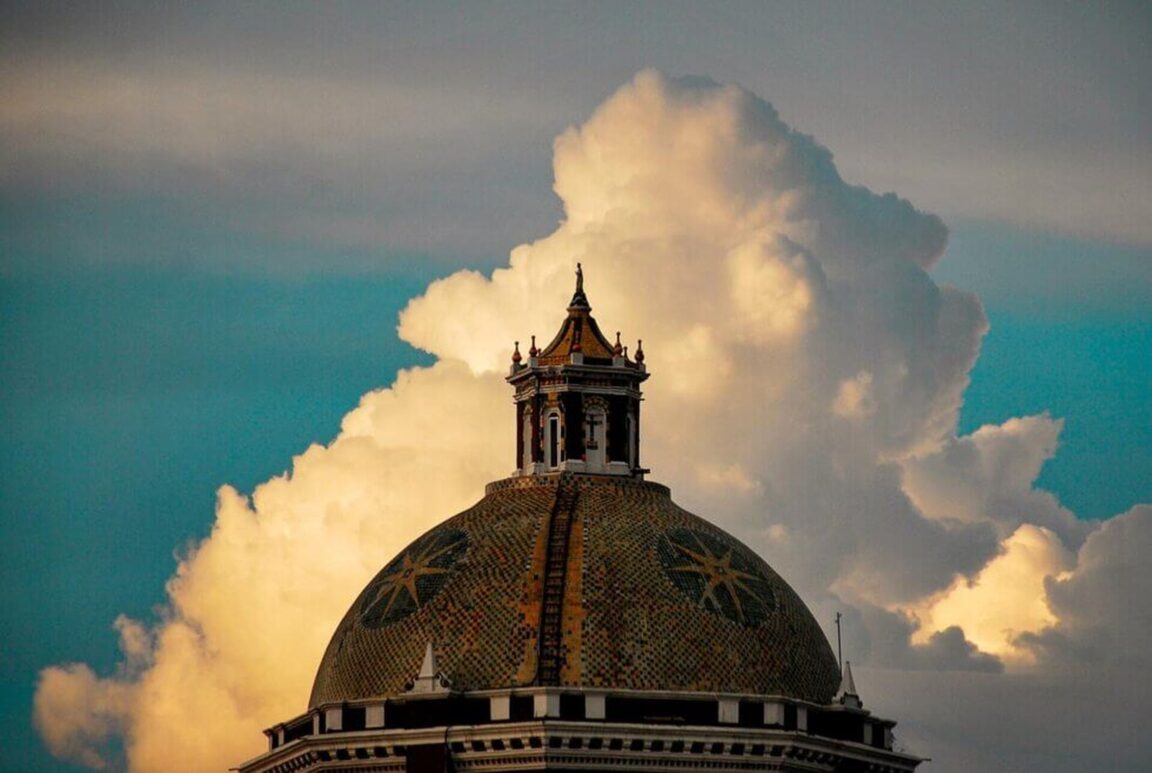
Featured image: A talavera tiled church dome in the Puebla and Cholula area under a dramatic sky. Photo by Aldo Gonzalez via Unsplash, Unsplash License.