 Omar Haddad
Fes is the Moroccan city that never modernised its medieval core, and it is all the better for it. Fes el Bali, the old medina founded in the late 8th and early 9th centuries, is a walled maze of more than 9,000 alleys, widely described as the world’s largest car-free urban area, where goods still move by donkey, handcart and shoulder, and where the working city of tanneries, brass beaters, weavers and bakers continues inside a UNESCO World Heritage site. This is not a medina kept for tourists. It is a living, sometimes overwhelming working city of hundreds of thousands of residents, home to the Chouara Tannery’s stone dye vats, the Bou Inania Madrasa’s carved cedar and tilework, and the University of al-Qarawiyyin, founded in 859 and recognised as the oldest continuously operating university in the world. Choose Fes over Marrakech if you want Morocco’s craft and scholarship capital, deeper, denser and less staged than its famous southern rival.
Quick Facts About Fes
- Where it is: Northern Morocco, inland between the Rif and the Middle Atlas, about 200 kilometres east of Rabat.
- The medina: Fes el Bali, a UNESCO World Heritage site since 1981, with more than 9,000 alleys and lanes, and no cars inside the walls.
- Founded: The city traces its founding to Idris I in 789 and Idris II in 809. Al-Qarawiyyin was founded in 859 by Fatima al-Fihri.
- The tannery: Chouara, the largest of the medina’s three tanneries, has operated in the same quarter for centuries and is viewed from surrounding leather-shop terraces.
- The madrasas: Bou Inania, built in the 1350s under the Marinid sultan Abu Inan, is the medina’s showpiece and one of the few religious buildings in Morocco open to non-Muslim visitors. Al-Attarine, from the 1320s, is smaller and equally fine.
- The three cities: Fes el Bali (the old medina), Fes el Jdid (the 13th century new city, holding the Royal Palace and the Mellah), and the French-built Ville Nouvelle, where the main railway station stands.
- Getting there: Fes-Saiss Airport serves domestic and European routes. Trains connect Fes with Rabat, Casablanca, Marrakech and Tangier. The medina itself is explored entirely on foot.
- How long: Two full days inside Fes el Bali is a minimum. Three lets you add Fes el Jdid, the pottery quarter and a viewpoint circuit without rushing.
Fes or Marrakech: how do you choose?
The two imperial cities reward different travellers. Marrakech is spectacle: a great square, palace hotels, and a medina long practised at receiving visitors. Fes is substance: older, more conservative, and organised around industries and institutions that predate tourism by a millennium. Its medina is larger, hillier and far easier to get lost in, its crafts are made in the medina rather than merely sold there, and its monuments, the madrasas above all, are finer. The trade-off is effort. Fes asks more of your legs, your sense of direction and your negotiating patience, and it gives less back in the way of poolside ease. Heritage travellers, photographers and anyone who has already done Marrakech and wants the deeper cut should choose Fes without hesitation. Travellers on the same Morocco route will find the counterpoint on the coast in our guide to Essaouira, Morocco’s slow Atlantic port, which makes a restorative final chapter after Fes’s intensity.
How does the car-free medina actually work?
Fes el Bali is a bowl. Two main arteries, Talaa Kebira and Talaa Seghira, the big and small climbs, run downhill from the western gate of Bab Bou Jeloud toward the river, the mosques and the tannery quarter, and almost everything a visitor wants hangs off them or off the lanes between them. Because the alleys are too narrow and too stepped for vehicles, the medina’s logistics are human and animal: porters with handcarts call out warnings, donkeys carry gas canisters and building materials, and deliveries arrive at the gates by truck and continue inward by muscle. That is why the car-free label matters. It is not a policy choice or a pedestrianisation scheme. It is a medieval street plan that never admitted the car, preserved entire.
Practically, this means three things. First, you will get lost, briefly and often, and that is normal; dead ends are part of the plan, and children will happily redirect you, sometimes for a coin. Second, hiring an official guide for the first half day is the single best investment in Fes: not for the commentary alone, but for the mental map it leaves behind, after which the medina becomes navigable. Third, stay inside the medina if you can. A riad within Fes el Bali puts you inside the rhythm of the place, with the call to prayer, the bakery runs and the morning deliveries as your soundtrack, although the walk from the nearest gate with luggage should be arranged through the riad, whose porters will meet you.
The tanneries: Chouara from the terraces
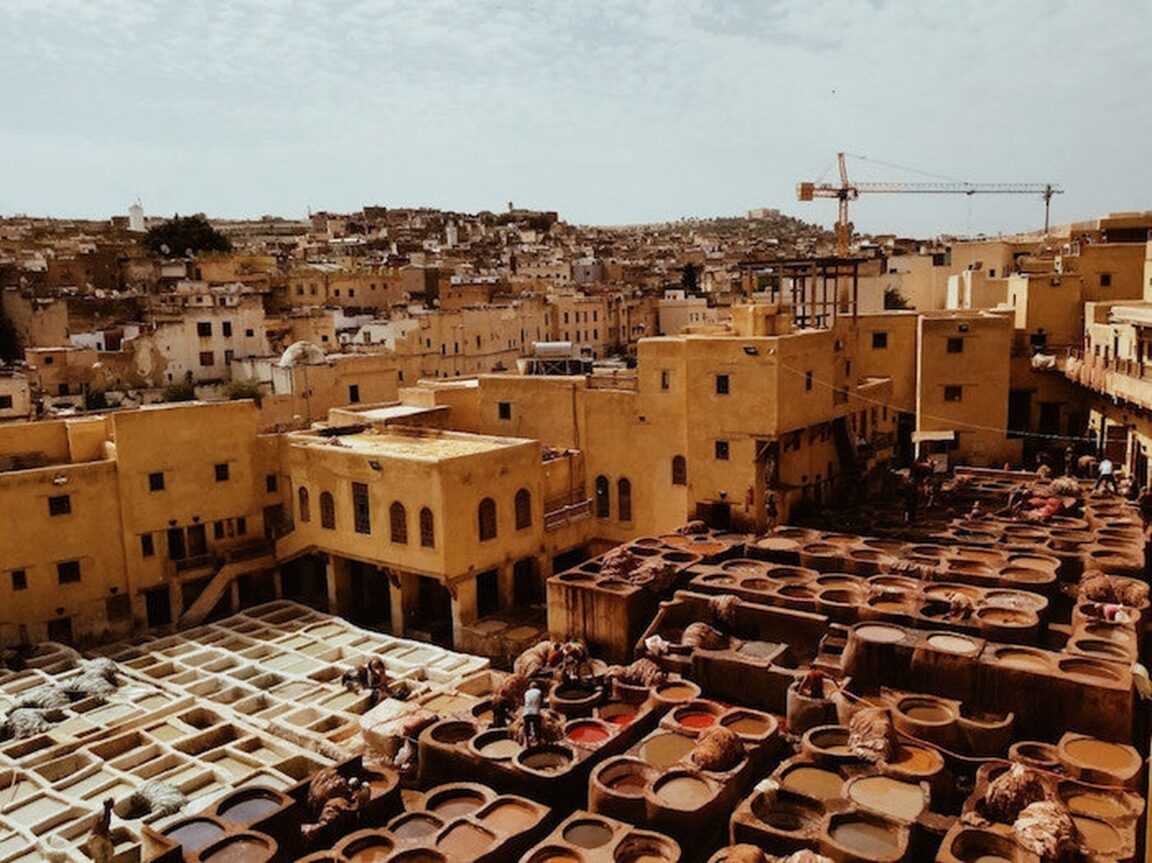
The Chouara Tannery is the medina’s signature sight, a honeycomb of stone vats in the northeastern quarter that has produced leather in this spot for centuries. The process runs in two acts. Hides are first softened in the white vats, in a pungent mixture that includes lime and, traditionally, pigeon droppings, whose ammonia does the work. They are then carried to the coloured vats, where natural dyes, poppy for red, indigo for blue, saffron for yellow, mint for green, colour the leather before it is hauled up to dry on the surrounding rooftops. Workers stand waist-deep in the vats and turn the hides by hand and foot, as their predecessors have done for generations.
Visitors do not enter the tannery floor. You view it from the terraces of the leather shops that ring it, reached through the shops themselves, and the ritual is well established: a sprig of mint is offered against the smell, the view is explained, and the shop’s bags, jackets and babouche slippers are then presented for your consideration. There is no obligation to buy, and a small tip for the terrace visit is the polite settlement if you do not. Go in the morning, when the dye vats are at their most colourful and the light is on the quarter. The smaller Sidi Moussa and Ain Azliten tanneries offer quieter versions of the same encounter. Morocco’s leather and mountain crafts connect naturally with the high country further south, covered in our guide to climbing Mount Toubkal, and many travellers pair a Fes stay with an Atlas trek on the same trip.
The madrasas and al-Qarawiyyin: the scholarly medina
Two buildings explain why Fes calls itself Morocco’s spiritual and intellectual capital. The Bou Inania Madrasa, completed in the 1350s, is a theological college, mosque and clock tower in one, wrapped in zellige tilework, carved plaster and cedar screens of extraordinary fineness, and it welcomes non-Muslim visitors outside prayer times. The smaller Al-Attarine Madrasa, built in the 1320s beside the al-Qarawiyyin mosque, compresses the same Marinid craft into a courtyard of almost jewel-like density. Al-Qarawiyyin itself, founded as a mosque in 859 by Fatima al-Fihri, a woman from a wealthy merchant family, grew into the university recognised by UNESCO and Guinness records as the oldest continuously operating educational institution in the world. Non-Muslims cannot enter its prayer hall, but its library, among the oldest in existence, and the glimpses through its doorways into the vast courtyard, convey the scale of what began here.
What else fills two or three days in Fes?
Beyond the headline sights, the medina rewards themed wandering: the Nejjarine square with its carved fountain and the woodwork museum in a restored fondouk, the Seffarine square where brass and copper workers hammer beside the river, the Henna Souk under its plane tree, and the pottery and zellige quarter outside the walls at Fes el Bali’s edge, where the famous blue-glazed ceramics are thrown, fired and hand-painted. In Fes el Jdid, the Royal Palace’s golden doors are photographed from the square outside, the Mellah preserves the former Jewish quarter’s distinct balconied streets, and the Borj Nord fortress and the Merenid Tombs on the northern hills give the two essential panoramas over the medina, best at sunset, when the whole bowl of rooftops turns gold and the tannery quarter is picked out by the last light.
Eat where the medina eats: grills and harira stalls along Talaa Kebira, pastilla, the sweet-savoury pigeon or chicken pie that Fes claims as its own, in a traditional restaurant, and breakfasts of msemen flatbreads and amlou in the cafes near Bab Bou Jeloud. Fes is the kitchen capital of Morocco in the eyes of most Moroccan cooks, and a cooking class built around a market run with the chef is the souvenir that survives longest.
Frequently Asked Questions About Fes
Is Fes el Bali really car-free?
Yes. The old medina’s alleys are too narrow and stepped for cars, so movement inside is on foot, with goods carried by porters, handcarts and donkeys. It is one of the largest car-free urban areas in the world. Taxis and vehicles operate outside the walls and at the main gates.
How do you visit the Chouara Tannery?
Through the leather shops that surround it. Staff will lead you to a terrace overlooking the vats, usually offering a sprig of mint against the smell. Viewing is free; expect a sales presentation afterwards, and leave a small tip if you do not buy. Morning light and colour are best.
Can non-Muslims visit the madrasas and al-Qarawiyyin?
The Bou Inania and Al-Attarine madrasas are open to all visitors outside prayer times, with a modest entry fee, and they are among the finest buildings in Morocco. The al-Qarawiyyin mosque and university prayer hall are not open to non-Muslims, although the complex can be appreciated from its doorways and the surrounding lanes.
Do you need a guide in Fes?
For the first half day, it is strongly recommended. An official guide builds the mental map that makes independent wandering enjoyable afterwards. Arrange guides through your riad or the official channels, agree the price and whether shopping stops are included before setting out.
How many days should you spend in Fes?
Two full days is the minimum for the medina, tanneries and madrasas. Three days adds Fes el Jdid, the pottery quarter and the hilltop viewpoints at an unhurried pace, and allows a day trip option such as Meknes and the Roman ruins of Volubilis.
Is Fes safe to explore on your own?
The medina is intensely commercial and getting lost is routine, but serious crime against visitors is uncommon. The main frictions are persistent unofficial guiding and hard selling. A polite, firm refusal, daylight wandering on the main arteries, and your riad’s advice on lanes after dark cover most situations.
Heritage details checked 13 November 2026 against UNESCO’s listing for the Medina of Fez. Madrasa opening arrangements and entry fees vary; confirm locally on arrival. Featured image: the Chouara Tannery in Fes, by Aleksandra Rupar on Unsplash, Unsplash License, via a verbatim hosted copy on CabinZero.