 Elena Vasquez
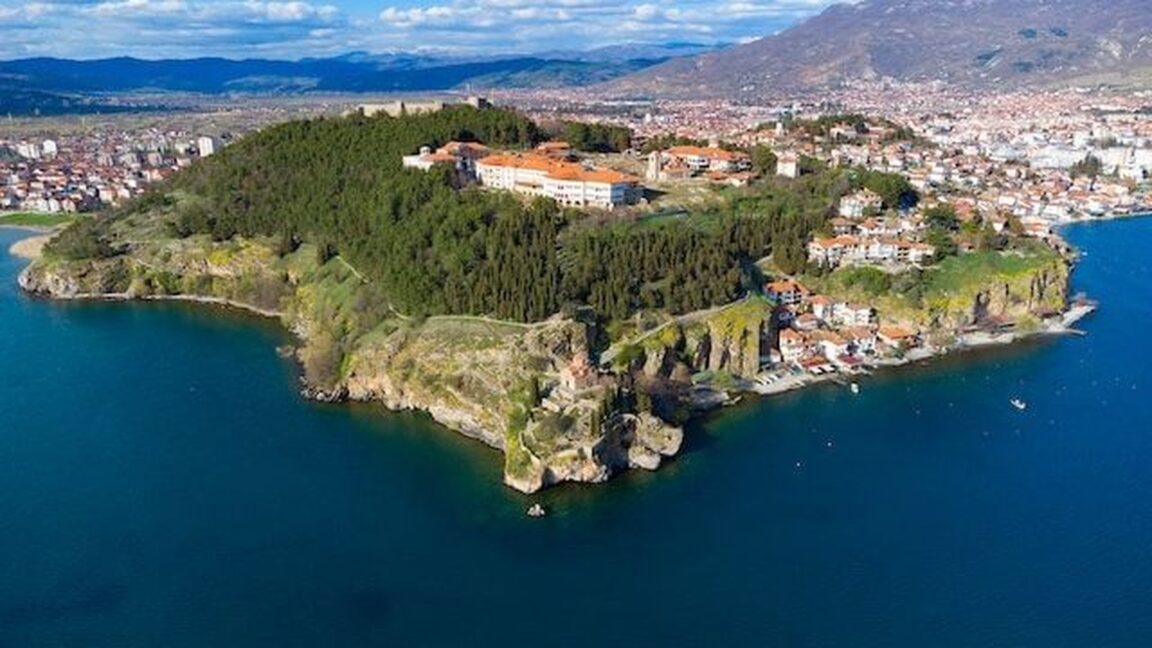
Ohrid rewards the traveller who slows down. This small town on the northeastern shore of Lake Ohrid, in the southwest of North Macedonia near the Albanian border, holds one of Europe’s oldest and deepest lakes on one side and a UNESCO-listed old town of cobbled lanes, Byzantine churches and a fortress skyline on the other. Local tradition counts 365 churches in and around Ohrid, one for every day of the year, and while the exact number belongs to legend, the density of medieval sacred architecture is real: the Church of St John at Kaneo on its cliff, the frescoed Church of St Sophia, and the monastery of St Naum down the shore. Ohrid is not undiscovered, and this guide will not pretend otherwise. It is, however, a lake town that still runs at a local pace, where swimming piers, church bells and evening promenades matter more than beach clubs, and where a three or four night stay feels too short rather than too long.
Quick Facts About Ohrid
- Where it is: Southwestern North Macedonia, on the northeastern shore of Lake Ohrid, close to the border with Albania.
- Heritage status: The Ohrid region is a UNESCO World Heritage site, inscribed for its natural values in 1979 and extended to the town’s cultural heritage in 1980.
- The lake: Lake Ohrid is one of Europe’s oldest and deepest lakes, with a maximum depth of around 288 metres and more than 200 endemic species.
- The churches: Tradition claims 365 churches, one for each day of the year. The landmarks include St John at Kaneo, St Sophia, and St Clement and Panteleimon at Plaosnik.
- Population: Roughly 40,000 residents in the town, swelling in July and August with regional holidaymakers.
- Nearest airport: Ohrid St Paul the Apostle Airport, about 9 kilometres from town, with seasonal European routes. Skopje’s airport is the year-round alternative, roughly three hours away by road.
- Currency: Macedonian denar (MKD). Cards are widely accepted in hotels and restaurants, cash is useful for boats, beaches and small churches.
- Best months: May, June and September for warm lake water, open sights and thinner crowds. July and August are the busiest and hottest.
Why does Ohrid feel different from other European lake towns?
Part of the answer is the lake itself. Lake Ohrid is ancient in a way few landscapes are: formed millions of years ago, fed largely by underground springs, and so clear that on a calm morning the bottom is visible metres below a wooden jetty. Its isolation made it a living museum of evolution, with snails, fish and crustaceans found nowhere else on earth, including the celebrated Ohrid trout. Swimming here is not a compromise made by people who could not reach the sea. It is the point of the place, done from town piers, from the pebbled coves at Kaneo and Labino, and from the livelier beach strips south toward Gradiste.
The other part is that Ohrid was never only a resort. It was a major centre of Slavic literacy and Orthodox Christianity, the seat of St Clement and St Naum, disciples of Saints Cyril and Methodius, and a town whose churches were built, painted and rebuilt across a thousand years. That history sits inside the modern town rather than behind museum glass. The old town climbs its hill in lived-in lanes, washing lines and all, and the evening volta, the slow promenade along the quay, belongs as much to Ohrid families as to visitors.
Travellers building a Balkan circuit will recognise the family resemblance to the walled Adriatic towns further west, and our first-timer guide to Kotor, Montenegro’s bay town makes a natural companion read. Ohrid is Kotor’s inland, freshwater counterpart: less polished, considerably cheaper, and anchored by churches rather than Venetian palazzi.
What should you see first in the old town?
Start at the water and walk up. The Church of St John at Kaneo is the image of Ohrid, a small cruciform church of brick and stone standing alone on a rocky headland above the lake, probably built in the 13th century. Come early in the morning, when the light is on the facade and the tour groups are still at breakfast, or at sunset, when the whole town seems to drift down to watch the sky change over the Albanian mountains. The path from the harbour passes the fishing quarter of Kaneo and a scatter of swimming decks, and it is an easy walk in either direction.
Higher in the old town, the Church of St Sophia anchors the lower lanes. An 11th century cathedral with celebrated Byzantine frescoes, it doubles as one of the region’s great concert venues during the Ohrid Summer Festival, when its acoustics do for chamber music what its walls once did for liturgy. Above it, the Plaosnik plateau holds the rebuilt Church of St Clement and Panteleimon above early Christian excavations and mosaic floors, and a short climb further up, Samuel’s Fortress restores the panorama: lake, rooftops, theatre and mountains in a single slow turn. The Ancient Theatre, a Hellenistic bowl from around 200 BC tucked between two hills, still hosts performances in summer, which tells you most of what you need to know about how Ohrid treats its ruins.
The monastery of St Naum, and the springs behind it
The essential excursion runs about 29 kilometres south along the shore to the Monastery of St Naum, founded by St Naum himself in the early 10th century and set where the lake’s spring-fed shallows run gin-clear over sand. Go by boat if the day is fine, because the approach across the water, with Galicica National Park rising behind the monastery, is half the pleasure. Behind the complex, wooden punts drift through the Black Drim springs, where the water arrives filtered through the mountain from Lake Prespa on the other side. Peacocks wander the monastery grounds, the church holds St Naum’s tomb, and the swimming beach beside it is among the best on the lake. It is popular, and deservedly so; arrive on the first boat or stay past the last one and the mood changes completely.
How do you spend time on the water?
Boatmen along the quay offer short harbour cruises and longer runs to St Naum and the Bay of Bones, the reconstructed prehistoric pile-dwelling settlement on stilts above the water near Gradiste, now a museum of how lakeside people lived thousands of years ago. Kayaks and stand-up paddleboards can be hired in season, the town beaches fill by late morning in summer, and the clearest swimming is from the rocks and decks around Kaneo and Labino, where locals favour the deep, cold water off the points. Galicica National Park, the mountain wall between Lake Ohrid and Lake Prespa, repays a half day with a car: the road over the pass stops at viewpoints from which both lakes are visible at once, a geography lesson you can see.
How do you get to Ohrid, and how long should you stay?
Ohrid’s own airport, St Paul the Apostle, handles seasonal flights from a number of European cities and is only about 9 kilometres from the old town. Outside the summer schedules, most travellers fly to Skopje and continue by bus or hire car, a journey of roughly three hours on improving roads, or arrive overland from Albania, whose shore of the same lake holds Pogradec. Buses connect Ohrid with Skopje and Bitola through the day. Give the town three nights at a minimum: one for the old town and its churches, one for St Naum and the springs, and one kept deliberately loose for swimming, boats and the evening promenade. Travellers combining Ohrid with the region’s other slow cities will find the same unhurried logic in our guide to Mostar, Bosnia’s bridge town, and the two pair well on a longer Balkan route that ends at the coast.
Base yourself in or just below the old town if you are on foot, where the lanes, restaurants and quay are all within a short walk, and accept the hills as the price of the views. The flat modern town toward the bus station suits drivers and longer stays. Either way, Ohrid is a walking town once you arrive, with taxis for the airport and St Naum the only rides most visitors need.
Frequently Asked Questions About Ohrid
Did Ohrid really have 365 churches?
That is the town’s famous claim, one church for every day of the year, and it is best understood as tradition rather than an audited count. What is certain is the extraordinary survival of medieval churches and frescoes, from St Sophia and St John at Kaneo to Plaosnik and St Naum, which earned Ohrid its nickname, the Jerusalem of the Balkans.
When is the best time to visit Ohrid?
May, June and September balance warm weather, swimmable lake water and manageable crowds. July and August bring the Ohrid Summer Festival and the liveliest atmosphere, along with the highest prices and busiest beaches. Winter is quiet and atmospheric but many seasonal services close.
Can you swim in Lake Ohrid?
Yes, and most visitors do. The water is exceptionally clear and warms up through the summer. Swim from town decks at Kaneo and Labino, the beaches south toward Gradiste, or beside the monastery at St Naum. The lake is deep and can be cold away from the shallows, so treat it with the respect due to deep water.
How many days do you need in Ohrid?
Three nights is the sweet spot for a first visit: the old town, a St Naum day, and time on the water. With four or five nights you can add Galicica National Park, the Bay of Bones and a cross-lake look at the Albanian shore without rushing any of them.
Is Ohrid a good base for the wider Balkans?
Yes, with realistic expectations about road times. Skopje is roughly three hours away, Bitola makes an easy day trip, and Albania is on the doorstep. Ohrid works best as a base for its own region rather than as a hub for daily long-distance excursions.
Heritage details checked 13 November 2026 against UNESCO’s listing for the Natural and Cultural Heritage of the Ohrid region. Opening arrangements for individual churches vary by season; confirm locally on arrival. Featured image: Lake Ohrid and the town of Ohrid, by Slavcho Malezanov on Unsplash, Unsplash License, via a verbatim hosted copy on Greca.