 Jonas Lindqvist
Kuldiga’s record needs putting in proportion before anything else: the Venta Rapid on the edge of its old town is the widest waterfall in Europe at about 249 metres across, and it is barely two metres high, a long, low, shining step of water that you hear before you understand. The town arranges itself around that paradox. An old brick bridge of 1874, among the longest of its kind in Europe, frames the rapid from 200 metres downstream; the UNESCO listed old town of wooden houses and cobbled lanes stands behind it; and each spring the calendar turns on the weeks when vimba fish hurl themselves up the falls, the flying fish that once made Kuldiga famous as the town where salmon were caught in the air. Come for a wide, gentle wonder rather than a tall, loud one, and Kuldiga delivers completely.
Quick Facts
- The rapid: Venta Rapid, Ventas rumba in Latvian, on the Venta River at Kuldiga. About 249 metres wide in normal conditions and up to about 275 metres in spring flood, with a drop of about 1.8 to 2.2 metres, per Latvia’s official tourism information.
- Status: A protected natural monument since 1977, formed where the river crosses a Devonian dolomite ledge.
- The bridge: The Kuldiga brick bridge, built in 1874, about 164 metres long with seven brick vault spans, roughly 200 metres downstream of the rapid and the classic viewpoint for it.
- The old town: Inscribed on the UNESCO World Heritage List in 2023, a preserved 17th and 18th century town of wooden houses on its medieval street plan.
- Flying fish: Migrating vimba leap the rapid in spring, with a second run in autumn. The Flying Fish Festival is held in late April, per the town’s event tradition.
- Getting there: Kuldiga has no passenger railway. Buses run from Riga in about two to three hours; most sights are within walking distance of each other in town.
Reading the rapid properly
Most waterfalls ask you to look up. The Venta Rapid asks you to look along. From the bank beside the town’s garden and museum quarter, the falls read as a bright, foaming seam across the whole width of the river, the water sliding over the dolomite ledge in a continuous sheet that changes character with the level of the Venta: modest and glassy in a dry summer, a quarter of a kilometre of white water after spring rain. Latvia’s official tourism site gives the working width at around 249 metres, rising towards 275 metres in flood, and the height at under two and a quarter metres at most, and both numbers matter to the experience: the spectacle is horizontal, a matter of scale and sound rather than drama.
The rapid is also why the town exists. It blocked navigation on the medieval Venta shipping route, so goods had to be unloaded and carried around it, and a settlement grew at the portage. The falls were designated a natural monument in 1977, and the riverside paths on both banks, the left bank walking trail running about 2.4 km one way, let you read the rapid at water level as well as from above. Keep to the established viewpoints and paths, and keep back from the slippery edges when the river is high.
The brick bridge: the frame for the view
Two hundred metres downstream stands the second half of the postcard: the old brick bridge, built in 1873 to 1874 to the standards of its century, about 164 metres long and built of seven spans of brick vaults on boulder piers, described by the town as the longest operating brick road bridge in Europe. It is still a working road bridge, which gives the view from it a pleasing lack of ceremony: you share the parapet with local traffic, lean where generations have leaned, and look upstream at the full width of the rapid with the old town’s roofs behind you, or downstream along the green valley of the Venta. Walk it in both directions, because the town side and the Pārventa side give different photographs, and the right bank has its own short walking trail of about 370 metres, looping to roughly 750 metres, built for exactly this view.
The flying fish of spring
The rapid’s strangest chapter is biological. Each spring, and again in autumn, vimba migrating up the Venta reach the ledge and attempt to leap it, fish clearing the water in arcs at the falls. About three hundred years ago, Jacob, Duke of Courland, had baskets set along the rapid to catch the jumping fish mid flight, and Kuldiga became known as the town where fish were caught in the air. The baskets are gone, but the leaping continues, and the town marks it with a Flying Fish Festival at the end of April. Timing a visit for the spring run means accepting the river on its own terms: the fish come with the water and the season, the best viewing is from the established bankside points and the bridge, and a quiet hour at dawn or evening, when the light is low and the crowds thin, is worth more than a midday scramble.
The old town behind the falls
Kuldiga’s old town, UNESCO listed in 2023, is the necessary second half of the visit: a compact grid of lanes between the Venta and its little tributary, the Alekšupīte, which runs directly along the walls of houses and under small bridges, earning the town its nickname as the Venice of the North. On the Alekšupīte stands the town’s second waterfall, a 4.2 metre drop built in the 17th century to power the first paper mill in Kurzeme, and, by height, the tallest waterfall in Latvia: the perfect comic counterweight to the rapid, since Kuldiga holds the national records for both widest and tallest falls, one of them barely taller than a person. The Kuldiga District Museum, in a merchant’s villa in the castle park beside the rapids, covers the town’s prosperous centuries, and the castle park itself holds the fragments of the first castle, built by German knights in 1242. The tourist information centre sits at Baznīcas iela 5 by the town hall square, and nearly everything in this guide is within a short walk of it. Travellers who like small European towns read at walking pace will find the same pleasure in our guide to St Gilgen and the Wolfgangsee, and those timing a trip by season rather than by sight should read our Akureyri in winter for the northern version of the same discipline.
Planning the visit
Kuldiga sits in western Latvia, in the Kurzeme region, and the practical route is the bus: several services a day run from Riga in two to three hours, with connections also from Ventspils and Talsi, and the town has no passenger trains, so check the current timetable on the national journey planner before travelling. A car makes the wider region easy, including the Riežupe sand caves a few kilometres north of town, but the town itself is a walking visit. One full day covers the rapid, the bridge, the museum and the old town; two days, with a spring morning reserved for the fish, is better. The rapid is free to view from the banks and bridge at any hour, and its character changes enough between morning mist, midday and evening light to justify returning to the same parapet twice in a day.
Frequently asked questions
How wide is the Venta Rapid really?
About 249 metres across in normal conditions, widening to roughly 275 metres during spring floods, per Latvia’s official tourism information. Its height is only about 1.8 to 2.2 metres. It is the widest waterfall in Europe and one of the lowest of any famous falls.
Where is the best view of the waterfall?
From the old brick bridge, about 200 metres downstream, for the full width in one frame, and from the riverside paths and garden on the town bank for the water level view. The right bank trail gives the view back towards the old town.
When can I see the flying fish?
Migrating vimba leap the rapid in spring, with the town’s Flying Fish Festival held in late April, and there is a second run in autumn. The fish follow the river’s condition, so sightings are likely in season but never guaranteed on a given day.
Why does Kuldiga have two waterfalls?
The Venta Rapid is natural, a dolomite ledge on the main river. The Alekšupīte waterfall, at 4.2 metres the highest in Latvia, was built in the 17th century on the small river through the town to power its first paper mill.
How do I get to Kuldiga from Riga?
By bus, in about two to three hours, with several services daily. There is no passenger railway to Kuldiga. Once in town, the rapid, bridge, museum and old town are all within walking distance.
Is Kuldiga a UNESCO site?
Yes. The old town of Kuldiga was inscribed on the UNESCO World Heritage List in 2023, recognised for its exceptionally preserved 17th and 18th century townscape on its earlier street plan.
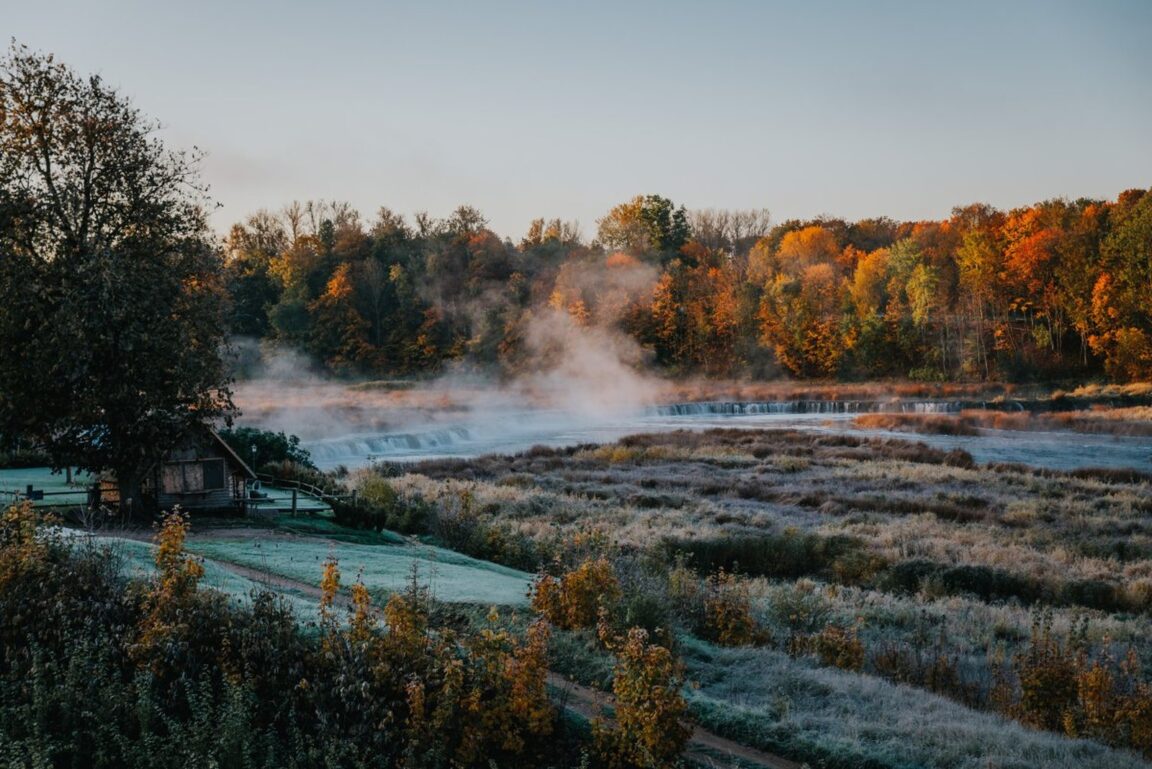
Featured image: The Venta Rapid at Kuldiga in autumn mist. Photo via Visit Kuldiga, the town’s official tourism website (visitkuldiga.com), used with credit.