 Maya Chen
Borobudur is climbed, not simply entered, and the visit turns on buying the right ticket in advance. A foreign visitor who wants to stand on the upper terraces needs the Temple Structure ticket sold by the official operator, InJourney Destination Management, at IDR 455,000 for an adult. It is sold for a timed session, places every climber in a guided group, and includes the upanat sandals that must be worn on the stone. Sunrise is a different product: a separate ticket, limited to 100 people a day, starting at 04:00 from the Borobudur Cultural Center at Manohara. Prambanan pairs with Borobudur in a single long day, but its ticket is separate, its foreign adult price is IDR 400,000, and no combined ticket should be assumed to include the climb. Book the climb first, then build the day around it.
Quick Facts
- The monument: Borobudur is a 9th century Mahayana Buddhist temple in Magelang Regency, Central Java, about 40 kilometres northwest of Yogyakarta, built as a stepped stone mandala with nine platforms, six square and three circular, crowned by a central stupa.
- The operator: Tickets are sold by InJourney Destination Management, part of PT Taman Wisata Candi, through its official ticket site, ticket.injourneydestination.id. That site, not a reseller, is the source to trust for prices, sessions and quotas.
- The climb ticket: The Temple Structure ticket costs IDR 455,000 for an international adult and IDR 150,000 for a domestic adult, per official InJourney package information checked for this guide. It includes structure access, a wristband, a guided group and upanat sandals to keep.
- Climb sessions: Climbing runs in timed sessions from 08:30 to 15:30 WIB, and visitors are asked to arrive for the session printed on the ticket. A courtyard ticket alone does not include the climb.
- The sunrise ticket: Borobudur Sunrise is a separate product limited to 100 people per day, starting at 04:00 WIB, with a guide, a flashlight, upanat sandals, breakfast at Manohara Restaurant and a souvenir in the full experience package.
- Sunrise pricing caution: Official package information lists sunrise prices from IDR 275,000 to IDR 800,000 depending on the package, while the official ticket product has been listed at IDR 1,000,000 for international visitors. The booking screen for a specific date and category is the final authority.
- Prambanan: The foreign adult ticket costs IDR 400,000 and the foreign child ticket IDR 250,000, on weekdays and weekends alike, according to official InJourney information. The ticket counter runs 06:30 to 17:00 WIB and the temple area 07:00 to 17:30 WIB.
- The pairing rule: InJourney lists a Borobudur and Prambanan through ticket valid for two days, with domestic adult prices of IDR 80,000 on weekdays and IDR 110,000 on weekends. No foreign through ticket price was published in the official information checked, and the climb remains a separate product, so price the two temples separately unless the booking screen shows otherwise.
Which Borobudur ticket actually gets a visitor onto the temple?
Borobudur sells access in layers, and the names matter. The courtyard, or temple ground, ticket admits visitors to the park and the area around the monument, with courtyard prices starting at IDR 50,000 for domestic tourists in official package information. It gives the classic ground level view of the stepped pyramid above the lawns. What it does not give is the climb: courtyard ticket holders look up at the terraces rather than walking them.
The Temple Structure ticket is the climb product. It is sold by timed session and by visitor category, and the booking flow asks that category question first. For an international adult the official listed price is IDR 455,000, roughly US$28 at recent exchange rates, although the operator charges in rupiah and the dollar figure moves with the rate. The price includes access to the structure itself, a wristband, a place in a guided group, and a pair of upanat, the woven sandals made for the monument, which visitors wear on the stone and take home afterwards.
That bundle is the result of a conservation decision. Unrestricted climbing wore the ancient volcanic stone, and the reopened climb is deliberately controlled: fixed sessions, guided movement, numbers managed through advance sale. The climb ticket is therefore the main booking of a Java temple trip, not an upgrade to decide at the gate. In busy periods sessions sell out, so buy online, on the official site, as soon as dates are fixed. The same book ahead, arrive early logic governs the dawn visit described in the guide to visiting Angkor Wat at sunrise, and it applies with even more force at Borobudur, where dawn is capped by number rather than merely crowded.
How the sunrise slots work, and why they are not part of a normal ticket
Sunrise at Borobudur is not an early opening of the regular visit. It is a standalone experience with its own ticket, meeting point and hard limit. The official ticket site describes it as an entrance ticket to see the sunrise at the temple, including breakfast and a souvenir, and states the limit plainly: 100 people per day. The tour begins before dawn at 04:00 WIB, a professional guide leads the group through the stories carved into the relief panels, and each participant receives a flashlight and upanat sandals. The full package then continues to breakfast at Manohara Restaurant.
The Manohara connection explains much of the confusion. Manohara is the hotel and cultural centre inside the temple area, and the sunrise programme is organised from the Borobudur Cultural Center there. Older advice about buying sunrise access through a hotel desk belongs to an earlier era. The current route is the official ticket site, in advance, because a cap of 100 places a day cannot absorb walk up demand in high season. A regular structure ticket does not convert into sunrise access, and a third party tour advertised with the word sunrise does not necessarily include the official on temple product. Before paying any intermediary, check whether confirmed entry to the official sunrise session is included by name.
Pricing deserves the same care. Official InJourney package information lists sunrise prices from IDR 275,000 to IDR 800,000 across its variants, while the official ticket product for the full international experience has been listed at IDR 1,000,000, roughly US$62. Those figures describe different packages, so the exact cost is the one shown for the chosen date and category in the official booking flow. What is not in doubt is the structure: one pre dawn session, 100 places, guide and sandals included, breakfast at Manohara in the full package.
The mandala climb, level by level
Borobudur was built to be walked as a diagram. Seen from above, its square base, stepped square terraces and circular upper platforms form a mandala, a geometric model of the Buddhist cosmos built at architectural scale. UNESCO descriptions count 2,672 relief panels and 504 Buddha statues across the nine platforms, and the traditional reading of the building divides the ascent into three zones of Buddhist cosmology, each looser and quieter than the one below.
Kamadhatu, the hidden foot and the world of desire
The lowest zone is the base, the Kamadhatu, representing the everyday world of desire and consequence. Its carved panels, the Karmawibhangga series illustrating cause and effect, were encased by a later outer foot and are largely hidden from the climbing route. Visitors begin the ascent having already, in the logic of the building, left the ordinary world behind. The courtyard walk before a session is the right place to take in the full silhouette, because once the climb starts the building is experienced one corridor at a time.
Rupadhatu, the square terraces and the world of forms
Above the base rise the square terraces of the Rupadhatu, the world of forms, where beings have begun to control desire but remain bound by shape and story. This is the long, instructive middle of the climb. Walled galleries run around the terraces, carved with narrative reliefs that a guided group can actually read: tales of the Buddha life and his previous lives, and the Gandavyuha sequence following the pilgrim Sudhana in search of enlightenment. The correct movement is clockwise, keeping the monument on the right, in the ritual circumambulation known as pradaksina. Buddha statues sit in niches along the balustrades, their hand gestures changing with the direction they face.
Arupadhatu, the circular terraces and the formless world
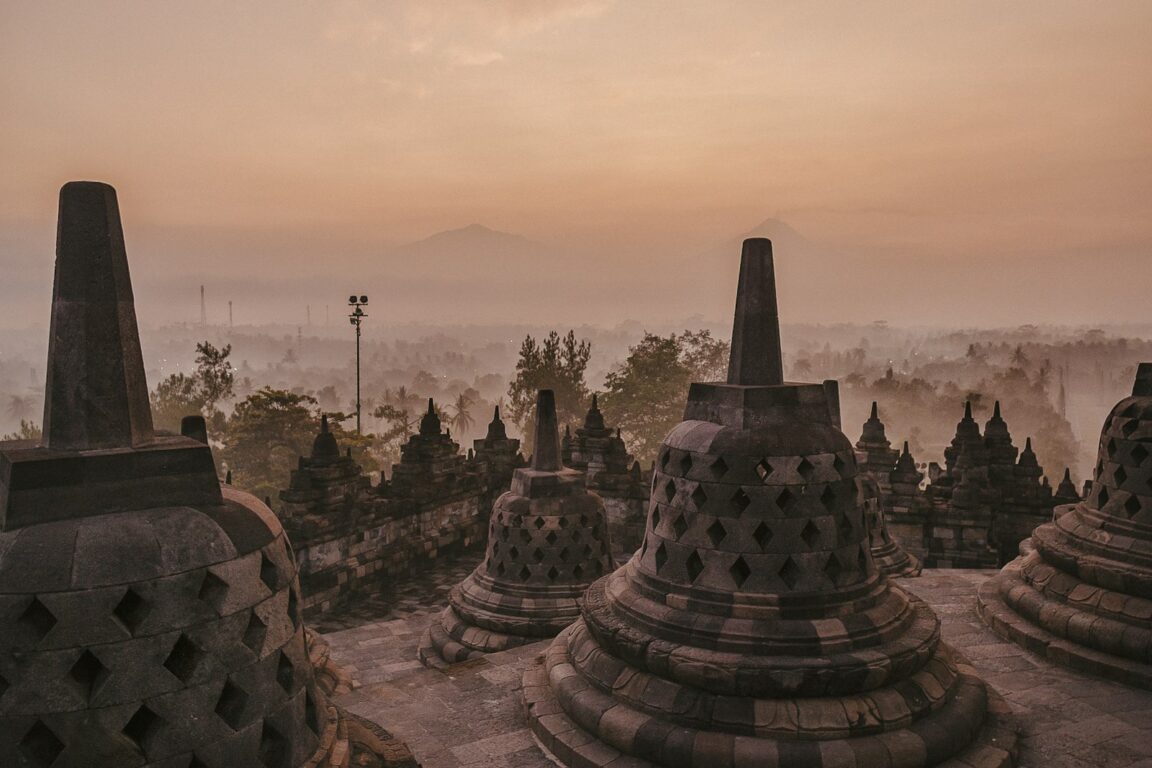
Above the square galleries the walls fall away. Three open circular terraces form the Arupadhatu, the formless world, and the architecture changes from corridor to sky. Seventy two perforated stone stupas stand across the three rings, thirty two on the lowest, twenty four on the middle and sixteen on the highest, each enclosing a seated Buddha visible through diamond shaped openings. At the centre rises the great central stupa. Views open across the Kedu Plain to the volcanoes around it, including Merapi and Merbabu on clear mornings. The contrast is the teaching made physical: dense carved narrative below, near empty openness above.
The rules of the climb itself
Every element of the modern climb follows from the fragility of the stone. Climbers change into the provided upanat sandals before stepping onto the structure, because ordinary footwear concentrates wear on steps that have carried more than a thousand years of feet. The sandals are included in the ticket and kept as a souvenir. Groups move with an official guide, sessions start at the time on the ticket, and late arrival can mean reduced access when the monument is busy. Touching reliefs and statues, climbing on carved stone outside the route, and leaving the guided path are out of bounds, and modest dress covering shoulders and knees is the respectful standard for a monument that remains a place of pilgrimage, not only a sightseeing stop.
Timing inside the day matters almost as much as the booking. The earliest sessions combine the coolest stone, the clearest views and the best light on the eastern reliefs. Midday sessions are workable but hot, with hard light flattening carving that morning reveals. Arrive with time to spare for ticket checks and the sandal change, and carry water and sun protection for the exposed upper terraces, where shade disappears entirely.
Pairing Prambanan on the same day
Prambanan is the natural second half of a Borobudur day, and the contrast is the point. Where Borobudur is a single Buddhist mandala mountain, Prambanan is a towering Hindu complex of the same broad era, dedicated to Shiva, Vishnu and Brahma, about 17 kilometres east of Yogyakarta. Borobudur sits about 40 kilometres northwest of the city, so the pairing is a triangle through or around Yogyakarta, and it needs a private car and driver. There is no useful direct public transport link between the two temples.
A workable order puts Borobudur first. Take the sunrise product or the earliest climb session, finish by mid morning, and drive to Prambanan for the early afternoon. The Prambanan ticket also covers the neighbouring temples inside the park, including Sewu, a substantial Buddhist complex a short walk north of the main group, plus Lumbung and Bubrah. Ninety minutes is a minimum rather than a target. Two cautions govern the pairing. The ticket counter closes at 17:00 and the temple area at 17:30, so a late start at Borobudur cannot be recovered. And on Mondays the main Prambanan temples are closed for maintenance, with only the surrounding zone, museum and outer temples accessible, so a Monday pairing is better rearranged.
On tickets, precision beats optimism. InJourney publishes a through ticket valid for two days, and its published table lists domestic prices. For foreign visitors, the official information checked does not publish a through ticket price, and the climb is in any case a distinct, session based product. Budget for the two confirmed foreign prices, IDR 455,000 and IDR 400,000, a combined IDR 855,000 before transport, and treat any through ticket offered in the booking screen as a bonus to verify. Spread across two days, the pairing becomes gentler, with Yogyakarta given the evenings. The same one major outing per day principle shapes the pacing of Kuching in Malaysian Borneo, where outings are likewise timed to the cool hours.
Waisak, the one date that changes everything
Borobudur is a living pilgrimage site, and its greatest festival is Waisak, known elsewhere as Vesak, marking the birth, enlightenment and passing of the Buddha. InJourney official information for the 2026 celebration placed the highlight on 31 May 2026, with a lantern release in ticketed evening sessions and a sunrise pradaksina and meditation the following morning. Normal sightseeing logic does not apply around Waisak: access patterns change, crowds reach their annual peak, lantern tickets are sold online in advance as a separate product, and the ceremonies belong first to the Buddhist community conducting them. Visitors whose trips coincide should check that year official announcements early and book further ahead than usual.
Frequently Asked Questions
How much does it cost a foreign visitor to climb Borobudur?
The Temple Structure ticket is listed by the official operator at IDR 455,000 for an international adult, roughly US$28 depending on the exchange rate. It includes structure access, a wristband, a guided group and the upanat sandals. A courtyard only ticket is cheaper but does not include the climb.
Is the Borobudur sunrise ticket the same as an early climb ticket?
No. Sunrise is a separate product, limited to 100 people per day, starting at 04:00 WIB from the Borobudur Cultural Center at Manohara, with a guide, flashlight, upanat sandals and, in the full package, breakfast at Manohara Restaurant and a souvenir. A regular structure ticket starts with the timed sessions from 08:30 and carries no sunrise access.
Is there a daily quota for the regular climb?
The climb is controlled by timed sessions and advance sale rather than by a single daily number published on the official ticket pages checked for this guide. The one daily cap the operator states openly is for the special products: 100 people per day for sunrise, and 100 per day for sunset. Because sessions sell out, booking online in advance is the practical answer to the quota question.
Can Borobudur and Prambanan really be done in one day?
Yes, with an early start and a private driver. Take sunrise or the first climb session at Borobudur, transfer across Yogyakarta, and give Prambanan at least ninety minutes in the afternoon, finishing before its 17:30 close. Avoid a Monday, when Prambanan main temples close for maintenance, and budget IDR 455,000 plus IDR 400,000 for the two foreign adult tickets.
What should a visitor wear and bring for the climb?
Modest clothing covering shoulders and knees, a hat and sunscreen for the shadeless upper terraces, and water. Footwear is settled by the monument: climbers change into the provided upanat sandals before stepping onto the stone.