 Lucas Meyer
The best two days on Hadrian’s Wall are spent slowly between Housesteads Roman Fort and Once Brewed. Walk west from Housesteads along the Whin Sill crags on day one, passing Crag Lough and Sycamore Gap before dropping down to Steel Rigg and The Sill at Once Brewed. Spend day two below the crags at Vindolanda, where an excavation site and a museum full of everyday Roman objects explain the lives behind the stones, then ride the 122 bus, still widely known as the AD122, back along the valley. The walking is short in miles and big in effort, so this plan keeps each day unhurried and puts the museums in the order that makes the frontier easiest to understand.
Quick Facts
- Core walk: Housesteads Roman Fort west to Steel Rigg and Once Brewed along Hadrian’s Wall Path, roughly 3.5 miles one way on the Wall, with steep climbs and descents throughout
- Full trail context: Hadrian’s Wall Path National Trail runs 84 miles (135 km) from Wallsend in the east to Bowness-on-Solway in the west
- Housesteads Roman Fort: Open daily, 10am to 4pm, with last entry at 3.30pm; entry is free for English Heritage and National Trust members, and booking online in advance can save up to 15 percent
- The bus: Go North East service 122, formerly branded AD122, links Hexham with Housesteads, The Sill, Vindolanda, Haltwhistle and Walltown, and runs daily all year except Christmas Day, Boxing Day and New Year’s Day
- Sycamore Gap today: The famous tree was illegally felled on 28 September 2023. No tree stands in the gap. A fenced stump remains, with new shoots growing from its base
- Vindolanda: Open daily, currently 9.30am to 4pm with last admission one hour before closing; allow at least two hours
- Roman Army Museum: Currently open Thursday to Sunday, 10am to 5pm, seven miles west of Vindolanda; allow about 1.5 hours
- Best base: Once Brewed and Twice Brewed, beside The Sill National Landscape Discovery Centre, put both days within walking distance or one short bus ride
Why This Section Earns Two Days
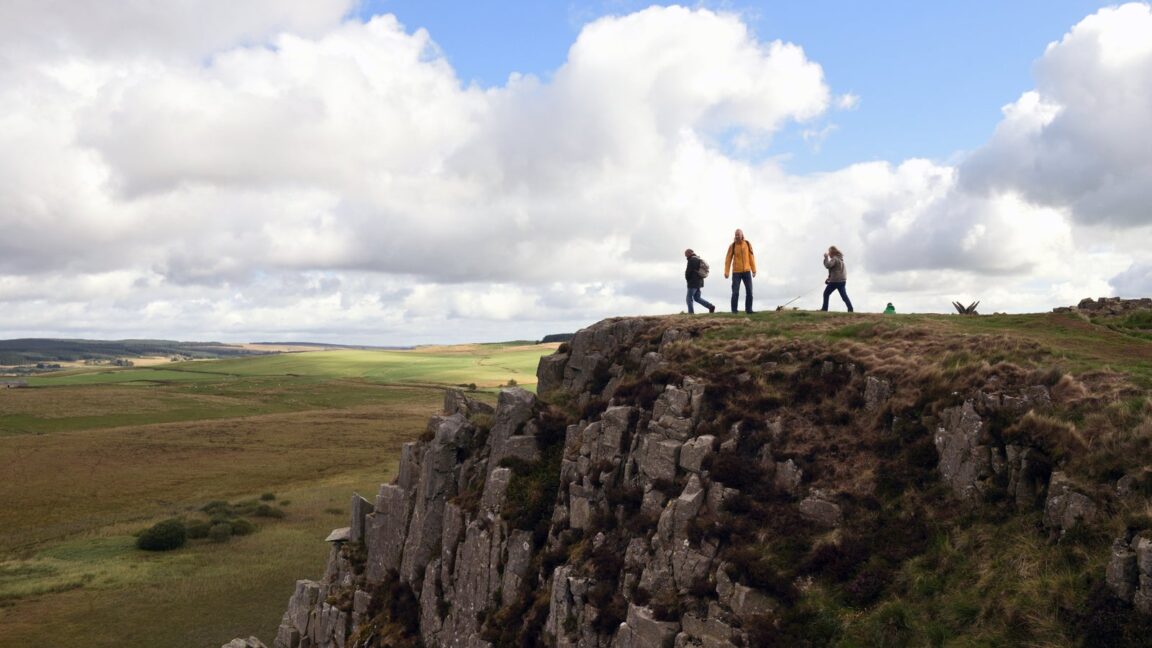
Most of the 84 mile National Trail is farmland and riverside walking where the Wall survives as a ditch or a line in a field. The central Northumberland section is different. Here the Wall was built along the top of the Whin Sill, a hard ridge of volcanic rock, and long stretches of the original stone curtain still stand on the crag edge, above a switchback of peaks and dips with views north over open country and south over the Tyne valley.
Housesteads anchors the eastern end of this stretch. English Heritage describes it as Britain’s most complete Roman fort, sitting directly on the Wall. It is owned by the National Trust and cared for by English Heritage. Its barracks, headquarters and communal latrines survive as readable stone plans, and the site museum displays objects that belonged to the soldiers stationed there, so every milecastle on the crags that follows connects back to a garrison whose routine has just been walked through.
Two days also solve a practical problem. The crags punish rushed itineraries. Splitting the area into a Wall day and a museum day keeps the walking to a half day at a time and leaves room for weather, which on an exposed ridge can change the character of the path within an hour.
Day One: Housesteads Fort and the Walk West to Once Brewed
Morning at Housesteads Roman Fort and Museum
Start at the Housesteads visitor centre in the valley, run by the National Trust, and take the main path up the hill to the fort. The fort opens at 10am, and arriving close to opening gives the site its quietest hour and leaves the whole afternoon for the walk.
Give the fort and museum at least two hours. The museum earns its place first, because its displays of soldiers’ belongings found on the site turn the ruins above into a workplace and a home rather than an outline, and a short film covers the building of the Wall. On the plateau, the highlights are the well preserved communal latrines, the headquarters, the rows of barrack blocks, and the north gate, where the Wall runs away in both directions. The fort commands the ridge, and the ridge does most of the defensive work.
Entry is charged for non members and free for English Heritage and National Trust members, with a discount for booking online up to midnight the day before a visit. Check current prices on the English Heritage website before travelling, as prices change seasonally. Parking at the valley car park is managed by Northumberland National Park and charged separately. English Heritage currently advises that all visitors use the lower car park, and that the toilets at the fort are closed while those at the car park remain open.
The Wall Walk: Housesteads to Steel Rigg
From the fort, join Hadrian’s Wall Path heading west, following the National Trail acorn waymarks. The route keeps to the crags all the way to Steel Rigg, roughly 3.5 miles that most walkers should allow two to three hours for once photo stops and climbs are counted. The terrain is repeated short, steep ascents and descents rather than one long climb.
The landmarks arrive in a satisfying order. The path crosses open crag top, passes the earthworks of Milecastle 38 near Hotbank, then drops and rises through the woods above Crag Lough, a dark lake directly below the crags and one of the finest views on the entire trail. The Wall runs along the very lip of the rock, and the path switches between its north and south sides as the official route directs. Stay on the waymarked path and off the Wall itself, which is a scheduled ancient monument as well as a World Heritage Site.
Sycamore Gap: What Is Actually There Now
West of Crag Lough, the path drops into a sharp dip between two crags. This is Sycamore Gap, and it needs an honest description, because older guidebooks and posters show a large lone sycamore standing in the dip, framed by the Wall climbing both sides. That tree is gone. It was illegally felled with a chainsaw in the early morning of 28 September 2023, in an act that damaged the Wall itself and led to criminal convictions. Anyone arriving expecting the famous photograph will not find it.
What remains is still worth the walk. The dip is as dramatic as ever, with the Wall running down one crag, across the floor of the gap beside Milecastle 39, known as Castle Nick, and up the other side. In the gap stands the tree’s stump, protected by a fence, and the stump is alive. Shoots were first recorded at its base in August 2024, and the National Trust reported in September 2026 that the growth had formed a thick ring of shoots around two to three feet tall, helped by fencing that keeps feet off the roots. Recovery to anything like the former tree would take well over a century, so the right way to see the gap now is as a place in slow recovery, not a restored landmark.
The story continues at The Sill, a short walk beyond Steel Rigg, where the largest section of the felled tree is on display in a permanent exhibition titled Sycamore Gap: Coming Home. Seeing the trunk indoors, at full scale, makes the size of what stood in the dip far clearer than any photograph. The National Trust has also grown 49 saplings from seed from the original tree, one for each foot of its height, as Trees of Hope.
Finishing Day One at Steel Rigg and Once Brewed
From Sycamore Gap the path climbs once more to Steel Rigg, a crag top viewpoint and car park above Once Brewed. A signed path drops south to Once Brewed itself, where The Sill provides a cafe, a shop, toilets and a rooftop walkway with views back along the crags just walked. Once Brewed and its neighbour Twice Brewed hold the area’s inns and bed and breakfasts, and staying here puts day two within easy reach. Anyone returning to Housesteads or Hexham instead can pick up the 122 bus at The Sill, subject to the timetable for the day of travel.
Day Two: Vindolanda, The Sill and the Roman Army Museum
Morning at Vindolanda Fort and Museum
Day two swaps the crag top for the valley floor, about a mile south of the Wall. Vindolanda was a working fort and town long before and after the Wall was built, and it is run by the independent Vindolanda Trust. The site combines extensive excavated remains with a museum built around objects recovered from its waterlogged layers, which preserve materials that rot almost everywhere else. Its most famous finds are the Vindolanda writing tablets, thin wooden postcards recording everyday military and family life on the frontier.
The Trust suggests at least two hours, and many visitors stay far longer. In excavation season, broadly April to September on weekdays, archaeologists can be seen working on site. Housesteads shows the finished frontier; Vindolanda shows it still being uncovered. The site is currently open daily from 9.30am to 4pm, with last admission one hour before closing. The 122 bus stops at Vindolanda on its route between Hexham and Walltown, a short ride from Once Brewed.
Afternoon Options: The Sill and the Roman Army Museum
Back at Once Brewed, The Sill works well as the afternoon pause. Its displays cover the landscapes of Northumberland National Park, and its rooftop walkway gives a level view of the crags for anyone whose legs have had enough of climbing them. It is also the most reliable wet weather stop on the route.
Walkers with energy and the right day can add the Roman Army Museum, seven miles west of Vindolanda near Walltown on the same bus route. Also run by the Vindolanda Trust, it is an entirely indoor museum about the life of a Roman soldier on the Wall, built around galleries and its Edge of Empire film. Allow about 1.5 hours. It is currently open Thursday to Sunday only, 10am to 5pm. A Saver Ticket covers one visit to both trust sites, the visits do not have to fall on the same day, and advance online tickets carry a saving. Go North East also lists admission discounts for passengers showing a 122 ticket. Check both websites for current offers.
Getting Around Without a Car: The 122 (AD122) Bus
This plan works without a car because of one bus. The Hadrian’s Wall Country Bus was branded AD122 for years, after the year building work on the Wall began. Go North East now displays the number 122 on the bus itself, and confirms the AD122 and 122 are the same service. It runs between Hexham and Walltown via Chesters, Housesteads, The Sill, Vindolanda and Haltwhistle, connecting with Tyne Valley line trains at Hexham and Haltwhistle.
The important change to older advice is seasonality. The service was once described everywhere as summer only. Go North East now states that the 122 runs daily, all year round, except Christmas Day, Boxing Day and New Year’s Day. Departures are roughly every two hours, so plan around the timetable for the actual date of travel. A missed bus on the crags is a long wait. Go North East lists an adult single at 2.50 pounds and a Northumberland Day Rover day ticket at 6 pounds at the time of checking, making the day ticket the sensible buy for a multi ride day. Fares change, so confirm them when planning.
Drivers announce stops on board, which helps where several stops are little more than a sign beside the road. The useful stops here are Housesteads, The Sill, Vindolanda and Haltwhistle railway station. Go North East also warns that the 23 mile trail section between Chollerford and Birdoswald, mostly served by this bus, is the most difficult part of the National Trail.
When to Go and What to Pack
The fort, the museums and the bus operate across the year, so the deciding factor is the walking. Late spring to early autumn brings the longest days and the Vindolanda excavation season. Winter offers empty crags, but the Roman Army Museum reduces to four days a week and the ridge can be severe in wind and ice. In any season, the crags demand footwear with real grip for wet rock and steep grass, plus waterproofs and a warm layer even on a fine morning. There is no shelter or water supply on the crag section, so carry everything needed between Housesteads and Steel Rigg. Signal is patchy on the ridge, so download the timetable and a map before setting out.
The same pattern works elsewhere: give a single famous site a full morning, then walk away from it, as at Stonehenge, where early access changes the visit entirely. This quiet ridge also makes a strong counterpoint to the crowds covered in our guide to Edinburgh in festival season.
Frequently Asked Questions
How far is it from Housesteads to Once Brewed on foot?
About 3.5 miles along Hadrian’s Wall Path via Steel Rigg. The route climbs and descends repeatedly over the crags, passing Crag Lough and Sycamore Gap, so allow two to three hours with stops. The National Trust’s circular version, returning through the fields, totals 8 miles.
Is the Sycamore Gap tree still there?
No. The tree was illegally felled on 28 September 2023. Its stump remains behind a protective fence and is regrowing, with a ring of shoots reported at two to three feet tall in September 2026. The largest section of the trunk is on display at The Sill.
Does the AD122 bus still run, and does it run in winter?
Yes, under a new number. Go North East brands the service as the 122 and states that the AD122 and 122 are the same bus. It runs daily all year round except Christmas Day, Boxing Day and New Year’s Day, between Hexham and Walltown via Housesteads, The Sill, Vindolanda and Haltwhistle. Departures are roughly every two hours, so check the timetable for the exact date.
Is entry to Housesteads free with National Trust membership?
Yes. Entry is free for members of both the National Trust, which owns the site, and English Heritage, which cares for it. Non members pay admission, with a discount for booking online in advance. Parking is charged separately.
Can Vindolanda and the Roman Army Museum be done on one ticket?
Yes. The Vindolanda Trust’s Saver Ticket covers one visit to each site, and the visits need not fall on the same day. Allow two hours for Vindolanda and 1.5 hours for the Roman Army Museum, open Thursday to Sunday only.
How long does the whole Hadrian’s Wall Path take to walk?
The National Trail runs 84 miles from Wallsend to Bowness-on-Solway, typically six to eight days end to end. This plan covers its most dramatic central stretch.