 Omar Haddad
Baalbek, in Lebanon’s Beqaa Valley about 85 km northeast of Beirut, holds the largest and among the best preserved Roman temples anywhere: the colossal Temple of Jupiter, where six columns still stand, and the Temple of Bacchus beside it, which survives almost complete. A day trip from Beirut works, but only as a long, early day. Allow around two hours of driving each way, two to three hours inside the site, and a separate stop at the ancient quarry to see the Stone of the Pregnant Woman. Do that, in that order, and Baalbek is the single most rewarding heritage day out in Lebanon. Skip the early start, and the same trip becomes a rushed look at ruins through a car window.
One honest condition applies to everything that follows. Travel conditions in Lebanon are sensitive and can change. Check current official travel advice from your own government and from Lebanese authorities before booking anything, confirm on the day that the site is open and the road is running normally, and be prepared to postpone if official advice says not to go. This guide makes no claim about conditions on any specific date, because only current official sources can give that.
Quick Facts
- Where: Baalbek, a town in the northern Beqaa Valley in eastern Lebanon, at about 1,150 metres above sea level, as recorded by UNESCO.
- Distance from Beirut: About 85 km by road, northeast of the capital.
- Typical drive time: Around two hours each way in normal conditions, longer with traffic, weather on the mountain pass, or delays at checkpoints.
- World Heritage status: Inscribed by UNESCO in 1984 as one of the most famous sanctuaries of the Roman world and a model of Imperial Roman architecture.
- The headline sights: The six surviving columns of the Temple of Jupiter, the near complete Temple of Bacchus, the small round Temple of Venus, and the trilithon blocks in the Jupiter podium.
- The quarry: The Stone of the Pregnant Woman, a finished but never moved monolith still lying in the ancient quarry south of the temples, estimated at roughly 1,000 tons or more depending on the source.
- Time needed on site: Two to three hours for the main complex, plus about 30 minutes for the quarry.
- Hours and entry fee: No current official figure could be verified for this guide, so confirm opening hours and the entry fee locally before you travel and carry cash.
- Best format: A private driver or an organised day tour for a first visit, leaving Beirut early and returning before dark.
Read This First: The Safety and Conditions Check
Before committing to the trip, read the current Lebanon travel advice published by your own government, check Lebanese official sources for any notices affecting the Beqaa or the Beirut to Damascus highway, and ask your driver, tour company or hotel about conditions on the day you intend to travel. If official advice advises against travel to the area at that time, do not go. The temples have stood for roughly two thousand years and will wait for a better week.
Build flexibility into the day itself. Conditions on the mountain road change with weather, especially in winter, and site opening can vary. A plan that leaves early, keeps the visit in the middle of the day and returns with daylight to spare absorbs most ordinary delays. Treat a Baalbek day as provisional until the morning it happens, and hold a Beirut based alternative in reserve.
How the Day Trip From Beirut Actually Runs
The route, step by step
From Beirut the route follows the Beirut to Damascus highway east, climbing through the Mount Lebanon foothills and over the Dahr el Baidar pass. On the far side it descends into the Beqaa Valley near Chtaura, the valley’s main junction town, then turns north up the flat valley floor, passing the turn for Zahlé before continuing to Baalbek at the northern end of the plain. Vineyards, farmland and the Anti-Lebanon range fill the windows for this final stretch.
The mountain section is slow and the valley section faster, so the honest planning figure is around two hours each way, ranging from about an hour and a half to two and a half hours depending on traffic, weather on the pass and time at checkpoints.
Checkpoints and paperwork
Road checkpoints are a normal feature of main routes in Lebanon, including the roads across the Beqaa, so plan on the assumption that the vehicle may be stopped. Carry your passport and entry documentation with you, keep it accessible rather than buried in luggage, and follow the instructions given at the stop. For most visitors in a hired car or on a tour, the driver handles the conversation and the stop is brief. What it costs is time rather than trouble, which is why the schedule below carries generous margins. A hired driver is the simpler choice for a first visit.
Transport choices
A private driver or a small organised tour suits Baalbek best. Both remove navigation, parking and checkpoint conversations from the visitor’s workload, and a driver who knows the valley can sequence Baalbek, the quarry and a Zahlé lunch without backtracking. Public minibuses run toward the Beqaa from Beirut, changing in Chtaura, and are cheap, but they add waiting time and make a same day return tight. Taxis can be negotiated for the full day, price agreed before departure. Either way, agree the return time and stops in advance, and plan to be back in Beirut before dark.
A Workable Timetable for the Day
Leave Beirut by about 07:30 and expect to reach Baalbek at roughly 09:30 to 10:00. Give the temple complex a full two to three hours, walking the sequence below. Add about 30 minutes for the quarry. Lunch then works naturally on the return leg in Zahlé, about 36 km southwest of Baalbek, known for its riverside restaurants along the Berdawni. Leave the valley by mid afternoon and expect to be back in Beirut around 17:00 to 18:00. That is nine to ten hours door to door, and any itinerary promising Baalbek in half a day is cutting the site itself short.
The Temple Sequence: How to Walk the Site
Baalbek was the Roman sanctuary city of Heliopolis, its temples built over more than two centuries on a raised plaza above the valley floor. UNESCO describes the complex as one of the most impressive testimonies to Roman architecture of the imperial period, honouring a triad of deities: Jupiter, Venus and Mercury. The site reads best in the order its builders intended, as a procession from the entrance courts up to Jupiter, then down to Bacchus.
1. The entrance courts
The visit begins with the monumental entrance, the Propylaea, then the unusual Hexagonal Forecourt, then the vast Great Court where worshippers once gathered before the main temple. These courts are not a warm up act. Their scale sets the terms for everything beyond them, and the Great Court’s altars, basins and porticoes show how much of the sanctuary was about ceremony, not just temple buildings. Cross them slowly and look back at least once: the view east over the Beqaa explains why this high, open site was chosen.
2. The Temple of Jupiter and its six columns
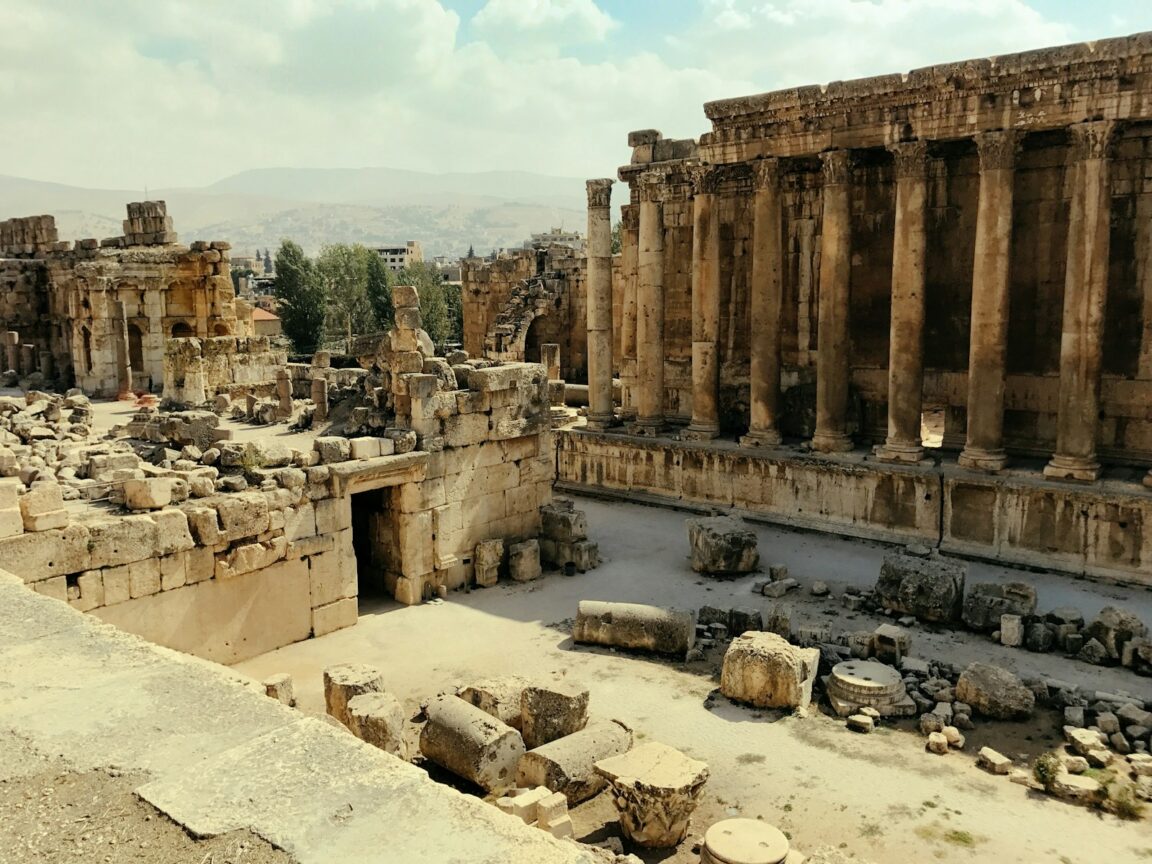
At the western end of the Great Court, up a broad staircase, stands what remains of the Temple of Jupiter, the principal temple of the Baalbek triad and one of the largest temples the Roman world ever built. UNESCO notes its columns stood about 20 metres high. Of the original 54 columns, six survive, still standing in a row on the south side and still carrying a section of their entablature. Photographs flatten them. In person they read as what they are: among the tallest surviving columns of the classical world, on a platform built to a scale that still looks excessive.
The podium deserves as much time as the columns. The raised plaza beneath the temple was formed from enormous monoliths, the largest weighing over 800 tons according to UNESCO. On the western side sits the famous trilithon, three gigantic limestone blocks set side by side in the terrace wall, each commonly estimated at about 800 tons. Seeing them in the wall, rather than in a diagram, is the moment the question of how Roman engineers moved such blocks stops being abstract.
3. The Temple of Bacchus, the survivor
A short walk south from Jupiter brings the visit to the Temple of Bacchus, and the change in condition is startling. Where Jupiter is a magnificent fragment, Bacchus is a building. UNESCO singles it out as exceptional, richly and abundantly decorated and of impressive dimensions, with a monumental gate sculpted with Bacchic figures. It is routinely described as one of the best preserved Roman temples in the world, and the description holds up: its colonnade stands, its walls stand, and its carved decoration, including vine and poppy motifs suited to its god, survives in detail.
Allow real time here, because Bacchus is where the imagination stops working overtime. Inside, the scale of a Roman temple interior, its raised sanctuary and carved ceilings can be read directly from the surviving fabric. As with visiting Petra in Jordan, the famous view is only the start, and the reward goes to whoever gives the second monument as much time as the first.
4. The Temple of Venus
The third temple is the smallest and most delicate. The Temple of Venus, which UNESCO calls the Round Temple, stands apart near the edge of the complex and differs, in UNESCO’s words, in the originality of its layout and in its refinement and harmonious forms, in a city otherwise marked by monumental structures. Its scalloped, circular design is unlike anything else at Baalbek, takes only a few minutes to see, and is the right closing note: proof that the builders of the largest temple in the Roman world could also work small and elegant.
The Quarry and the Stone of the Pregnant Woman
Do not leave Baalbek without the quarry. A short distance south of the temples lies the ancient limestone quarry that supplied the sanctuary, and in it lies the Stone of the Pregnant Woman, known in Arabic as Hajar el Hibla: a single finished monolith that was cut, shaped and then never moved. Estimates of its weight vary by source, commonly around 1,000 tons and in some accounts higher, heavier than any trilithon block that did reach the temple. A second, even larger block was identified in the same quarry by researchers in 2014, lying partly beneath it.
The quarry reframes the whole site. At the temples, the giant blocks are architecture. Here, the same kind of block is a logistics problem left sitting in its pit. It takes about half an hour including the short drive or walk from the main entrance. Local guides attach folklore to the stone’s name. Treat it as legend and enjoy it as such.
Zahlé and the Beqaa on the Way Back
Zahlé, the Beqaa’s main town, sits where the valley meets the mountains, about 55 km from Beirut and roughly 36 km from Baalbek. Its Berdawni riverside is lined with restaurants serving long Lebanese lunches, and a stop here breaks the return journey at exactly the right point. The wider Beqaa is also Lebanon’s best known wine country, and some tours pair Baalbek with a winery visit nearby. That pairing works only if the temples are not rushed to pay for it. Baalbek first, wine second, and only with a driver.
Travellers building a wider itinerary may also enjoy the very different logic of Salalah in Oman during khareef, where a monsoon turns a desert coast green. Baalbek makes the opposite demand: not the right season so much as the right day, checked carefully and taken early.
Practical Notes for the Visit
The site is large, open and exposed, at about 1,150 metres. Summer visits are hot with little shade, so carry water, a hat and sun protection. Spring and autumn give the most comfortable walking weather. Winter can be cold at this altitude, with a real chance of difficult weather on the pass. Wear shoes with grip: the walking is on ancient paving, worn steps and loose stone.
On money, plan for cash. Because no current official entry fee or opening hours could be verified for this guide, confirm both through your hotel, driver or a local official source before travelling, and carry enough cash to cover entry, parking and lunch without relying on a card machine. Hiring a local guide at the entrance is money well spent, because the site’s plan and building sequence are far clearer explained in place. Photography for personal use is the norm, but follow any restrictions posted on the day.
Frequently Asked Questions
How long does a day trip from Beirut to Baalbek take?
Plan on nine to ten hours door to door. The drive typically takes around two hours each way, the temple complex needs two to three hours, the quarry adds about 30 minutes, and a lunch stop in Zahlé fills the rest of the day.
What is the difference between the Temple of Jupiter and the Temple of Bacchus?
Jupiter was the larger temple and the centre of the sanctuary, but only six of its 54 columns survive, on a podium built from some of the largest blocks ever used in Roman construction. Bacchus was smaller but survives almost complete, with colonnade, walls and carved decoration intact, which is why it is described as one of the best preserved Roman temples in the world.
What is the Stone of the Pregnant Woman?
It is a huge finished monolith, estimated at roughly 1,000 tons or more depending on the source, still lying in the quarry south of the temples. It was cut for the complex but never transported, unlike the trilithon blocks in the Jupiter podium.
Can Baalbek be visited independently, or is a tour better?
Independent travel by hired car, taxi or minibus via Chtaura is possible, but a private driver or organised tour is better for a first visit. It removes navigation and checkpoint conversations, and makes the Baalbek, quarry and Zahlé sequence easy to run in one day.
Is it safe to visit Baalbek?
That question can only be answered with current information. Conditions in Lebanon are sensitive and change over time, so check the latest official advice from your own government and Lebanese authorities shortly before any trip, confirm conditions locally on the day, and postpone if official advice says not to travel. No guide can responsibly give a standing answer.
When is the best time of year to go?
Spring and autumn offer mild temperatures at Baalbek’s altitude, clear views across the Beqaa and manageable conditions on the pass. Summer is workable with an early start and plenty of water. Winter brings cold at the site and the greatest risk of disrupted driving over the pass.