 Wei Chen
Go to Huacachina for the strangest overnight stop on Perus southern coast: a palm ringed lagoon in a bowl of giant dunes, where the days one essential appointment is a late afternoon dune buggy run that ends with sandboarding and sunset. Huacachina itself needs only a night, but sequenced properly with a morning boat trip to the Ballestas Islands at Paracas, an hour north, it becomes the most efficient two day loop out of Lima on the whole coast.
Quick Facts
- Where: Just outside the city of Ica, about 5 kilometres from its centre and roughly 300 kilometres south of Lima.
- Best for: Adrenaline travellers, photographers, and anyone driving the Lima to Nazca to Arequipa route.
- Headline sights: The oasis lagoon, dunes rising more than 100 metres, buggy and sandboarding tours, Ica pisco bodegas, Paracas and the Ballestas Islands nearby.
- Time needed: One night in Huacachina plus a morning in Paracas. The pair also work as one very long day trip from Lima.
- Getting there: Bus from Lima to Ica takes about 4 to 5 hours, then a short taxi ride to the oasis. Paracas is about an hour away by road.
- Do not miss: The late afternoon buggy tour. Midday tours trade the sunset for the worst of the heat.
What actually is Huacachina, beyond the postcard?
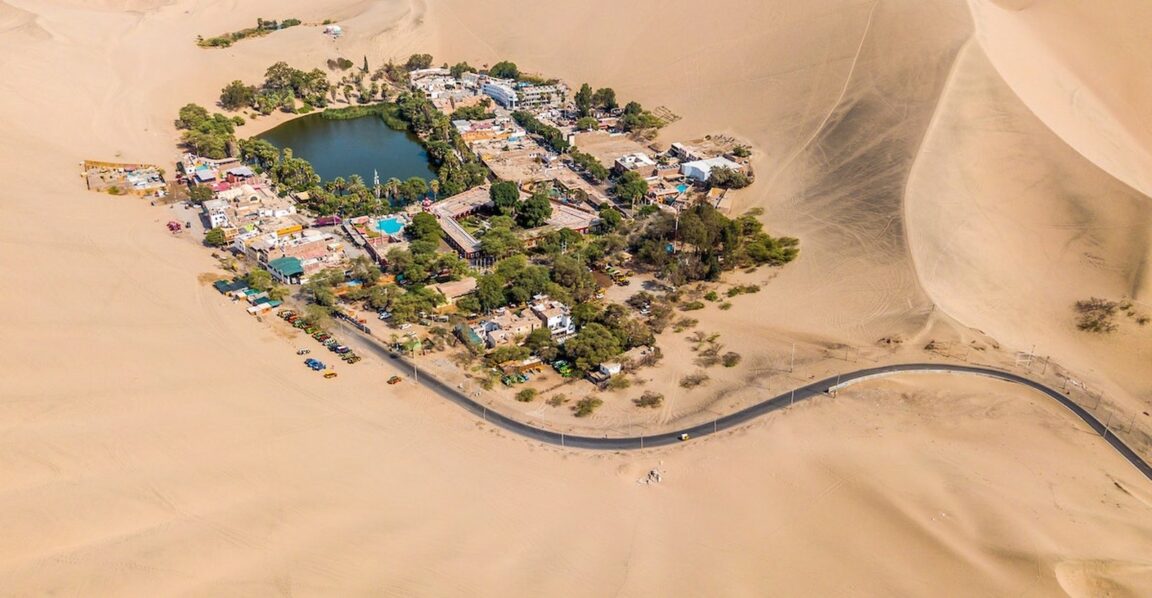
Huacachina is a small village built around a natural desert lagoon, ringed by palms, hotels and restaurants, and enclosed on every side by some of the tallest dunes in South America. You can walk around the lagoon in about 15 minutes, and that smallness is the point: everything here is the oasis, the dunes, and the hour when the light changes. Local legend credits the lagoon to the tears of a mourning princess, which is why the name is often translated as weeping woman in Quechua. The practical explanation is groundwater rising close enough to the surface to sustain the green in the middle of the Ica desert.
Set expectations correctly and Huacachina delights. Set them wrong and it disappoints. This is not a resort town with a week of activities, and the lagoon is for looking at and boating on rather than a swimming beach. It is a one night spectacle with a superb supporting act an hour away, which is exactly how the plan below treats it. Travellers continuing south will find the same honest sequencing useful in our Arequipa guide, the natural next base after Ica and Nazca.
How do the dune buggies and sandboarding actually work?
The buggies are open, roll caged vehicles carrying around 6 to 10 passengers with seatbelts, driven fast over the dune field in a style fairly described as a desert roller coaster: steep climbs, pauses on crests, and sudden drops down the faces. Between runs the driver stops at chosen slopes for sandboarding. Most visitors ride the board lying on their stomach, head first, which is faster, simpler and far more forgiving than standing. Tours last about 1.5 to 2 hours, and the ones leaving around 4pm finish on a high dune for sunset, the best seat in the region at that hour.
Two honest cautions belong in any guide. First, choose an operator properly: check the vehicle, the seatbelts and recent reviews, and use a company authorised to run tubular buggies, because accidents have happened on these dunes. Second, the ride is genuinely rough. Travellers who are pregnant or who have back or neck problems should skip the buggy and take the free alternative instead: climb the nearest dune on foot for the same sunset, hard work in soft sand but entirely at your own pace. A detailed run through of timings and operators is kept in the Huacachina travel guide from a local operator, useful for checking current practice before you book.
How should Huacachina be sequenced with Paracas?
The classic order exists for a reason: wildlife in the morning, desert in the afternoon. From Paracas, boats leave the El Chaco pier for the Ballestas Islands on a tour of about two hours. Nobody lands on the islands, which are protected, but the boats circle close enough for sea lions, Humboldt penguins, dense colonies of seabirds and a view of the Candelabra geoglyph cut into the coastal hillside. Morning is the right slot, when the sea is usually calmer and the light is on the islands.
From Paracas the road to Huacachina takes about an hour, which lands you at the oasis in time for lunch, a slow circuit of the lagoon, and the late afternoon buggy tour. Sleep in Huacachina, where the dunes at dawn are nearly empty, or in Paracas if an early bus matters more. Add the Paracas National Reserve, with its red beaches and desert headlands, if you have a second morning, and the pisco bodegas around Ica, where tours explain Perus signature spirit at source, if wine and spirits travel appeals. The pairing with the coast is what lifts the trip, in the same way the reed islands lift a stay in our Puno and Lake Titicaca guide at the other end of a Peru route.
When should you go, and who should skip it?
Huacachina is dry and sunny all year, sitting at only about 400 metres, so altitude is a non issue on this leg. December to March is very hot, which sharpens the case for the late tour and a dawn walk. The oasis gets busy at weekends and Peruvian holidays, when one night midweek is a noticeably calmer experience. Skip the overnight if your Peru time is brutally short and Machu Picchu logistics are still unresolved: Huacachina is a delight, not a duty. But if you are travelling the Pan American corridor in either direction, it is the easiest memorable night on the route, and the Nazca Lines, around two to two and a half hours further south, bolt on cleanly the next morning.
What should you pack and prepare for the dunes?
The desert here is practical, not decorative. Bring sunglasses that seal reasonably well, because buggy runs throw fine sand into every face, and keep phones and cameras in a zipped pocket or a sealed pouch between stops for the same reason. A light layer matters more than most travellers expect: the ride back after sunset crosses open dunes in cooling air, and the wind at speed does the rest. Closed shoes beat sandals for the walk up the boarding slopes, cash in small notes covers lagoon side extras and tips without a card machine hunt, and water belongs in the buggy with you, since the tour itself runs close to two hours with no shade at any stop. None of this needs a shopping trip. It just needs ten minutes of thought before the 4pm departure rather than after it.
Frequently Asked Questions
Can you do Huacachina and Paracas in one day?
Yes. Take the Ballestas Islands boat in the morning from Paracas, transfer about an hour to Huacachina, and ride the late afternoon buggy tour. One night in either place makes it far more comfortable.
How do you get to Huacachina from Lima?
By bus to Ica in about 4 to 5 hours, then a taxi of around 10 minutes to the oasis, which sits about 5 kilometres from the city centre.
Is sandboarding hard?
No, in the form most visitors do it. Riding lying down, head first, needs no experience, and the buggy tour builds in several slopes of increasing size.
Is the dune buggy ride safe?
It is rough and fast by design. Use a well reviewed, authorised operator, wear the seatbelt, and skip it entirely if you are pregnant or have back or neck problems.
Can you swim in the Huacachina lagoon?
Treat the lagoon as scenery and a boating lake rather than a swimming spot. Hotel pools handle the swimming; the lagoon handles the photographs.
How many nights do you need in Huacachina?
One. A second night only makes sense as a slow base for Paracas, the reserve and the Ica bodegas combined.