 Elena Vasquez
Piran is a Venetian port town preserved almost intact at the tip of a narrow peninsula on Slovenia’s short Adriatic coast, and it is the single best reason to visit that coast. Slovenia has only about 47 kilometres of shoreline, squeezed between Italy and Croatia at the head of the Adriatic, yet those kilometres hold three distinct towns, and Piran is the historic jewel among them. For roughly five centuries the town belonged to the Republic of Venice, and the evidence is everywhere: a marble main square named for a locally born violinist, a bell tower modelled on St Mark’s in Venice, pastel palaces, tight lanes, and a working salt trade in the pans just south of town that still produces salt by hand. This guide explains how Piran fits together, what to see in a day or two, and how to combine it with the rest of the tiny coastline without rushing.
Quick Facts
- Where: Tip of a peninsula on Slovenia’s Adriatic coast, between Italy and Croatia
- Coastline context: Slovenia’s entire coast runs about 47 km and holds Piran, Portoroz and Koper, with Izola between them
- Historic power: The Republic of Venice, for roughly five centuries until 1797
- Main square: Tartini Square, named for violinist and composer Giuseppe Tartini, born in Piran in 1692
- Languages: Slovene and Italian, which has official status in the town
- Traffic: The old town is effectively car free; visitors park in garages outside and walk or ride a shuttle in
- Salt: Still harvested by hand at the Secovlje Salina Nature Park south of town
- Time needed: One full day for the town, two to three days with the salt pans and the rest of the coast
Why does a 47 kilometre coastline hold three such different towns?
The Slovenian coast is short enough to drive in well under an hour, but each town on it answers a different purpose. Koper is the working port and the largest settlement, a historic town in its own right wrapped around a modern harbour and shopping edge. Izola is the fishing town, smaller and quieter, with a marina, a beach and a slower local rhythm. Portoroz is the resort, built around spa hotels, a sandy beach and a promenade. Piran, at the end of the road, is the preserved Venetian old town, the one that appears on the postcards.
That division of labour is what makes the coast work so well as a short trip. Stay in Piran for atmosphere, swim and take spa time in Portoroz, and use Koper as the transport and provisioning hub. Buses link all three, a coastal path connects long stretches on foot or by bike, and in summer boats run along the shore. Travellers building a wider Mediterranean old town itinerary often pair this coast with our guide to Valletta, Malta’s fortified harbour capital, because the two reward the same slow, walk everywhere approach.
What happened on Tartini Square?
Tartini Square is the natural start of any visit, an oval of pale marble paving ringed by Venetian style palaces. The shape gives away its past: this was once the town’s inner harbour, a sheltered basin where fishing boats moored in the middle of town. It was filled in during the 19th century, and the basin became the square. In the centre stands a bronze statue of Giuseppe Tartini, the Baroque violinist and composer born in Piran in 1692 and famous for the Devil’s Trill Sonata. His birthplace, Tartini House, stands on the square and hosts exhibitions and concerts.
Look for the Venetian House, a red Gothic palace on the square with a stone relief of a lion and an inscription tied to a local love story, and for the town hall and the court palace that frame the harbour side. The square is also the practical heart of town: cafes line it, the tourist information point sits nearby, and the shuttle from the parking garages arrives here. Come early in the morning for the marble at its emptiest, and again at dusk when the cafes fill.
Which viewpoints are worth the climb?
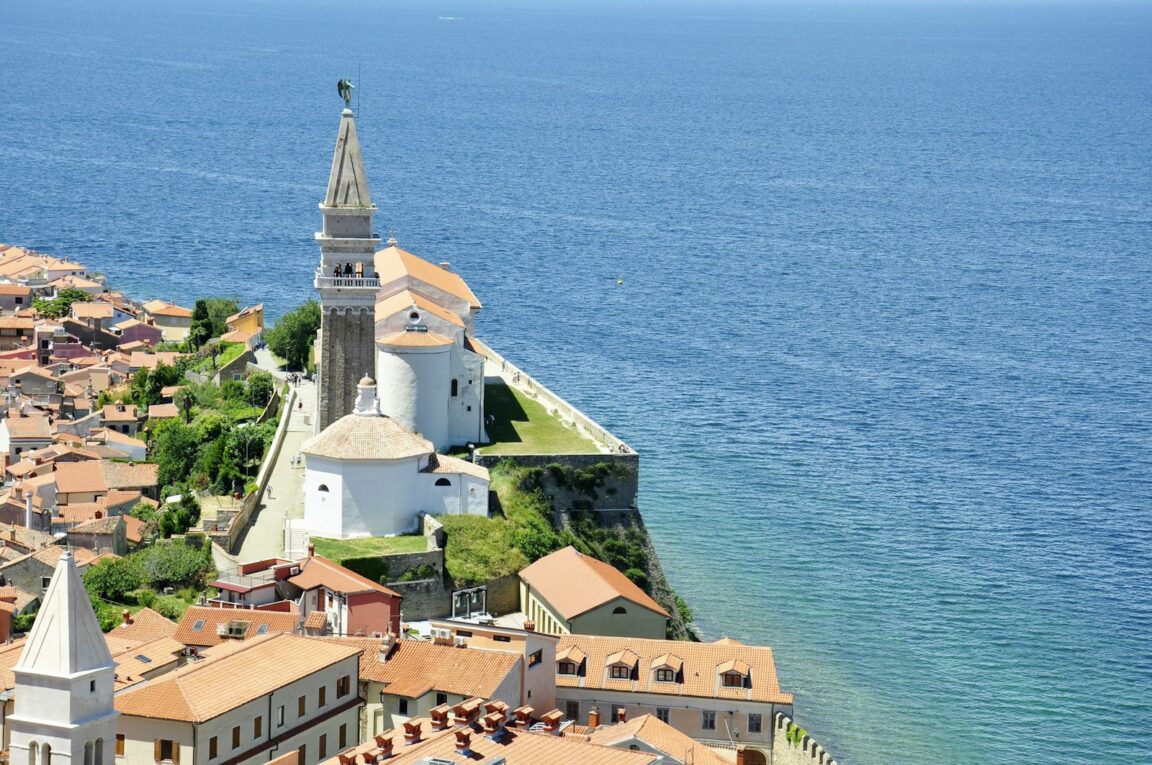
Two climbs define Piran. The first is short: from Tartini Square, lanes rise to the Church of St George on the hill above the harbour. The church holds a much loved crucifix and paintings, but the real draw is the separate bell tower, modelled on St Mark’s Campanile in Venice. From its gallery the whole peninsula reads like a map, red roofs running out to the point, the harbour below, and on clear days the coasts of Italy and Croatia both visible across the Gulf of Trieste.
The second climb is the town walls, which survive on the hillside behind the old town in sections dating from the medieval centuries when Piran fortified itself against rivals and pirates. Walking the walls gives the classic elevated view down the length of the peninsula, and it is the best sunset position in town. Between the two, most visitors also walk out to Punta, the very tip of the peninsula, where a small lighthouse church complex marks the point and locals swim from the rocks and concrete platforms. Piran has no sandy beach in the old town; swimming here means ladders into clear water, which suits the place perfectly.
How does the salt story work?
Piran grew rich on salt, and salt explains the town as much as Venice does. South of Portoroz, on the Croatian border, the Secovlje Salina Nature Park protects a working landscape of shallow pans where salt is still harvested by hand using a method documented for more than 700 years. A living layer of algae and minerals called petola is cultivated on the pan floors; it keeps impurities from rising and helps produce the white salt and the prized fleur de sel sold as Piran salt.
The park has two parts. Lera is the active production area, with the visitor entrance, the salt shop and demonstrations in season. Fontanigge, reached on foot or by bike, holds the ruins of salt workers’ houses and a salt making museum, and feels wilder and emptier. The whole park is also a major wetland for birds, so bring binoculars if you have them. Entry prices are modest and seasonal; check the park’s current rates before you go rather than relying on an old listing. A half day covers Lera comfortably; the full circuit with Fontanigge deserves longer.
What else fills a second day?
With the square, the church, the walls and the salt pans done, a second day in Piran can go deeper or wider. Deeper means the Sergej Masera Maritime Museum, which tells the coast’s seafaring story in a palace on the harbour, the small aquarium near Punta, and the galleries and studios tucked into the lanes. Wider means the rest of the coast: the Strunjan cliffs and nature reserve between Piran and Izola, where a protected stretch of flysch cliff drops to a quiet beach, or a bus to Koper for its own Venetian old town around Tito Square and its cathedral bell tower.
Eating in Piran follows the coast: grilled fish, seafood risotto, Istrian olive oil and local wines, with Piran salt on the table as a point of pride. Book dinner in high summer, because the old town’s restaurants are small and the day trip crowds leave by evening, which is exactly when staying overnight pays off. The town after dark, quiet lanes, lit marble and the harbour lights, is a different and better place than the midday version. Readers who like this pattern of a walled town that rewards an overnight stay will also enjoy our guide to Lucca, the Tuscan city inside its Renaissance walls.
How do you get to Piran and move around?
Piran sits about 120 km from Ljubljana, roughly two hours by road depending on traffic, and drivers need Slovenia’s electronic vignette for the motorways. The old town itself is closed to general traffic. Visitors park in the garages at the edge of town, principally Fornace and Arze, and either walk in or take the shuttle to Tartini Square; garage prices are posted and change, so check the current tariff on arrival. Buses connect Piran with Portoroz, Izola, Koper and Ljubljana, and Trieste in Italy is close enough to combine in one trip, with passport or ID sensible to carry for cross border movement.
Inside the town, everything is on foot. The lanes are steep and stepped in places, and the walk to the walls and the church involves climbs, so comfortable shoes matter more than any other packing decision. Cyclists can ride the coastal routes toward Portoroz and Koper, including stretches of the Parenzana trail, the old narrow gauge railway line converted into a cycling path along the Istrian coast.
Frequently Asked Questions
How many days do you need in Piran?
One full day covers Tartini Square, St George’s Church and bell tower, the town walls and Punta. Two to three days add the Secovlje salt pans, Strunjan, Portoroz and Koper at a relaxed pace, and make room for swimming and long dinners.
Can you drive into Piran old town?
No. The old town is effectively car free. Park in the Fornace or Arze garages outside the centre and walk in or take the shuttle to Tartini Square. Residents and deliveries operate under permit rules that do not apply to visitors.
Does Piran have a sandy beach?
Not in the old town. Swimming in Piran is from rocks and concrete platforms with ladders, notably around Punta and toward Fiesa. For sand, head to Portoroz, a short bus ride away, which has the coast’s main resort beach.
Why is Italian spoken in Piran?
Piran belonged to Venice for about five centuries and has a historic Italian community. The town is officially bilingual, with Italian holding official status alongside Slovene, and Italian appears on signage and in schools.
When is the best time to visit Piran?
Late spring and early autumn bring warm sea temperatures without peak crowds. July and August are busiest and hottest. Winter is quiet and atmospheric but some restaurants and the salt park facilities run reduced hours.
What is Piran salt?
It is sea salt harvested by hand at the Secovlje pans south of town using a centuries old method based on a petola layer in the pans. The fleur de sel skimmed from the surface is the premium product, sold in the park shop and used by chefs across Slovenia.