 Sofia Rossi
Book a timed entry, take the earliest slot you can face, and walk straight to the Botticelli rooms on the second floor before the tour groups fill them. That sequence, more than any ticket upgrade, decides whether a visit to the Uffizi feels like standing in front of the Primavera with room to breathe or shuffling past it in a river of people. The gallery is open Tuesday to Sunday from 08:15 to 18:30, closed on Mondays, and every ticket is now nominative, carrying the visitor’s name and checked against photo ID. This guide explains the timed entry system as it stands in 2026, the room order that puts Botticelli, Leonardo, Michelangelo and Raphael in the right sequence, what the cheaper afternoon ticket really allows, and how the Vasari Corridor fits, or does not fit, into the same morning.
Quick Facts
- Hours: Tuesday to Sunday, 08:15 to 18:30; closed Mondays, 1 January and 25 December; the ticket office closes at 17:30
- Standard ticket: 25 euros bought on the day; 29 euros booked ahead, the extra 4 euros being the reservation fee, via the official channel at tickets.uffizi.it
- Afternoon ticket: Entry from 16:00 at 16 euros on the day or 20 euros booked ahead, a tier introduced in January 2026
- Nominative rule: Since 13 October 2025 every ticket carries the visitor’s full name and is checked against photo ID at entry; tickets are not transferable
- Free and reduced: Under 18s of any nationality enter free; European Union citizens aged 18 to 24 pay 2 euros, with proof of age
- Free days: Entry is free on the first Sunday of each month, as in Italian state museums generally, with the crowds to match
- Time needed: Two hours for a disciplined highlights route; three to four hours for both floors properly
- Vasari Corridor: Visitable on a combined Uffizi and Corridor ticket, booked ahead at 47 euros in current listings, with corridor entry set two hours after the Uffizi slot
How does timed entry actually work at the Uffizi?
Every advance ticket is for a named person and a stated entry time. You book through the official seller, CoopCulture, at tickets.uffizi.it, or through the official call centre, and you pay the 4 euro reservation fee on top of the 25 euro ticket for the certainty of that slot. On the day, reserved ticket holders collect or validate their tickets at the designated ticket office doors in the Piazzale degli Uffizi, then enter at their time; staff generally work with a short grace window around the slot, but a booking is not an open ticket, and arriving an hour late in high season is a gamble rather than a right. Once inside, there is no time limit: the slot controls entry, not exit, and you may stay until closing at 18:30.
Two consequences follow. First, the morning slots, especially 08:15 to 11:00, sell out first from spring to autumn, so book as soon as Florence dates are fixed rather than in the week of travel. Second, the nominative rule, in force since 13 October 2025, ends the old informal market in spare tickets: the name booked must be the name on the photo ID the visitor carries, spelled as it appears in that document, for every member of a group. Third party sellers advertising priority or skip the line access at large markups are selling the same timed reservation the official channel sells for 4 euros, and the gallery’s own terms treat tickets bought outside authorised channels as invalid, so the official site is not just the cheapest route but the safe one.
What is the right room order for the Botticelli and Renaissance canon?
The collection is arranged chronologically, and the building helps you if you let it. Visits begin on the second floor. The early rooms carry the story from Giotto and the Sienese masters through Masaccio and the first Florentine Renaissance, and then the route reaches the rooms every visitor came for. The discipline is to move through the opening rooms at a steady pace, neither skipping them, because they explain what Botticelli changed, nor settling into them, because the day’s scarcest resource is quiet time further along.
The Botticelli rooms: go here first in spirit and nearly first in fact
The Botticelli rooms hold the Primavera and the Birth of Venus, the two most famous paintings in the building, alongside the Pallas and the Centaur and a wall of Madonnas that show the painter’s line developing. At the 08:15 entry these rooms can be genuinely calm for the first half hour. By late morning they are the most congested space in Florence. If you hold a later slot, the honest tactic reverses the instinct to linger early: move briskly through the first rooms, claim your time in front of the two great allegories, and backfill the early Renaissance on the way through the rest of the floor. Both paintings reward distance as much as closeness; step back to the room’s far wall for the full composition before joining the close viewing line.
Leonardo, Michelangelo and Raphael on the same floor
The sequence continues with Leonardo da Vinci’s early Annunciation and the unfinished Adoration of the Magi, painted while he was still in Verrocchio’s orbit and already unmistakable, then Michelangelo’s Doni Tondo, his only finished panel painting, round, sculptural and hung to be seen as the hinge between painting and the Sistine ceiling. Raphael follows, including the Madonna of the Goldfinch, and the floor closes with the Venetians and the great altarpieces of the High Renaissance. This run, Botticelli to Raphael, is the irreducible core of the Uffizi. A visitor with only 90 minutes should spend almost all of it here and treat everything else as surplus.
The first floor: Titian, Veronese and Caravaggio
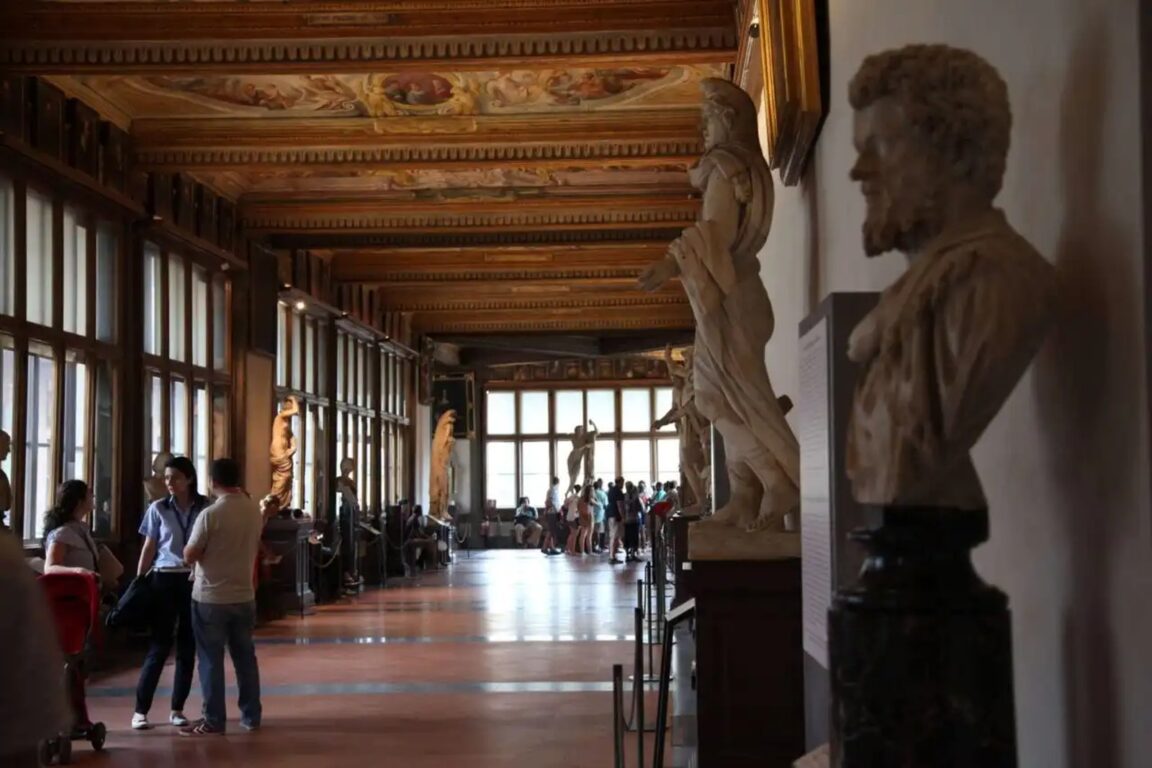
The first floor carries the 16th and 17th centuries: Titian’s Venus of Urbino, works by Veronese and Tintoretto, and the Caravaggio rooms, where the Medusa, painted on a wooden shield, and the Bacchus anchor the end of most visits. The corridors themselves are part of the collection, lined with ancient sculpture and portrait busts under painted ceilings, with window views across the Arno to the Oltrarno that pace the walk. The gallery’s own route suggestions reflect the same maths: a fast route of about one and a half to two hours covers the second floor highlights, a classic route over two hours adds the first floor’s main rooms, and a complete visit runs past three hours before any cafe stop on the terrace above the Loggia dei Lanzi.
Is the afternoon ticket good value, or a trap?
Since January 2026 the gallery has sold an afternoon ticket for entry from 16:00, at 16 euros on the day or 20 euros booked ahead, against 25 and 29 euros for the standard ticket. It is good value for a specific visitor: one who wants the highlights, has already accepted a two to two and a half hour ceiling, and values calmer rooms over complete coverage. From 16:00 the day groups thin out, the Botticelli rooms ease, and a disciplined Botticelli to Caravaggio route fits comfortably before the 18:30 close. It is a poor choice for a first time visitor who wants both floors unhurried, or for anyone whose Florence plan would make a missed 16:00 entry unrecoverable. Note also that the ticket office closes at 17:30, so an afternoon ticket bought on the day still requires reasonably prompt arrival.
Should you add the Vasari Corridor?
The Vasari Corridor, the enclosed elevated passage Giorgio Vasari built in 1565 to let the Medici walk from the Uffizi across the Ponte Vecchio to the Pitti Palace without touching the street, reopened to visitors in December 2024 after a long closure and restoration. It is visited on a combined ticket with the Uffizi, listed at 47 euros booked ahead, with the corridor entrance timed two hours after the Uffizi entry slot, in small accompanied groups, walking one way and exiting by the Boboli Gardens side. The experience is architectural rather than painterly: the long windowed run above the goldsmiths’ shops, the view down the Arno, and the sheer strangeness of a private ducal motorway in the air.
Decide on opportunity cost. The corridor consumes the middle of a visit day, fixes your Uffizi slot around its own timetable, and sells out well ahead in season. For a first Uffizi visit, the paintings should win; book the corridor on a second Florence trip, or on a longer stay where a separate afternoon can absorb it. Travellers comparing systems will recognise the same trade off in our Louvre timed entry and Denon wing guide, where the headline wing first rule mirrors the Botticelli first rule here, and our Bordeaux three day guide covers the other great wine and art pairing for a longer European route.
What are the practical rules on the day?
Carry the photo ID each ticket is named for. Expect airport style security and a cloakroom for large bags, which are not allowed in the galleries. Photography for personal use is permitted without flash, tripods, selfie sticks or professional equipment, though individual loans and exhibitions can restrict it, so watch room signage. The official audio guide is rented at the entrance against an ID document and returned by early evening. Finally, build the Piazza della Signoria and the Palazzo Vecchio, two minutes away, into the same half day rather than treating the Uffizi as an isolated errand: the square was the gallery’s audience chamber in Medici Florence, and it reads differently after the rooms.
Frequently Asked Questions
How much are Uffizi tickets in 2026?
The standard ticket is 25 euros at the ticket office on the day or 29 euros booked ahead, including the 4 euro reservation fee. Entry from 16:00 costs 16 euros on the day or 20 euros booked. The combined Uffizi and Vasari Corridor ticket is listed at 47 euros booked ahead. Under 18s are free and EU citizens aged 18 to 24 pay 2 euros.
What are the Uffizi opening hours, and when is it closed?
Tuesday to Sunday, 08:15 to 18:30, with the ticket office closing at 17:30. The gallery is closed every Monday and on 1 January and 25 December. An apparently empty booking calendar often simply means a Monday.
Do you have to show ID at the Uffizi?
Yes. Since 13 October 2025 all tickets are nominative. Book under the full name shown on the photo ID each visitor will carry, and bring that ID to entry. Tickets cannot be transferred to another person.
How long do you need inside the Uffizi?
Two hours covers the second floor highlights with intent. Three to four hours covers both floors properly, including the Caravaggio rooms and the corridors. The afternoon ticket’s roughly two and a half hours suits a highlights visit only.
When is the Uffizi least crowded?
At the 08:15 opening, and again from about 16:00 when day groups leave. The first Sunday of the month is free and therefore among the busiest days, despite the saving. Tuesdays to Thursdays outside school holidays are the calmest full price days.
Can you buy Uffizi tickets on the day?
Yes, same day tickets are sold at the ticket office at 25 euros, subject to availability and a queue that can be long in season. From spring to autumn, and for any morning slot, booking ahead through the official channel is the prudent default.
Prices, hours and the nominative rule checked 14 November 2026 against Uffizi Galleries official information as reported through its official sales channel. Room hangings and individual works on loan change; check the gallery’s current notices in the week of your visit.