 Jordan Ellis
Choose Uxmal as your second Maya site, or even as your first. About 80 kilometres south of Merida in the low Puuc hills, Uxmal is the fullest surviving expression of the Puuc architectural style, all precisely cut limestone, plain lower walls and upper facades exploding into stone mosaics of lattice, serpents and stacked masks of the rain god Chaac. It receives a fraction of the visitors who pour into Chichen Itza, it can be read properly in two to three hours, and it anchors the Ruta Puuc, the short chain of smaller sites at Kabah, Sayil, Xlapak and Labna that turns a morning into one of the best archaeological days in Mexico. This guide gives the site order that works, explains what Puuc actually means when you are standing in front of it, and sets out the two ticket system, hours and pairing maths honestly.
Quick Facts
- What it is: A Classic period Maya city in the Puuc region of Yucatan, Mexico, and a UNESCO World Heritage Site since 1996, listed together with Kabah, Sayil and Labna
- Base: Merida, about 80 kilometres north by road, roughly one to one and a quarter hours by car
- Hours: Daily from 08:00; INAH listings give closing between 16:00 and 17:00 with last entry an hour earlier, so treat the morning as the visit and confirm on the day
- Ticket: Two payments at two windows, a federal INAH charge and a state Cultur charge; INAH based listings put the combined foreign visitor total at 566 pesos and the Mexican visitor total at 262 pesos, checked November 2026
- Free entry note: The federal charge is waived for Mexican citizens and residents on Sundays; the state charge still applies
- Headline buildings: Pyramid of the Magician, Nunnery Quadrangle, Governor’s Palace, Ball Court, House of the Turtles, Great Pyramid
- Time needed: Two to three hours for Uxmal alone; a full day for Uxmal plus Kabah and Sayil
- Climbing: Do not plan on climbing the Magician Pyramid or other major structures; access is restricted and roped
What does Puuc mean, and how do you see it?
Puuc is the Maya word for the low hill country south of Merida, and the name was borrowed for the architecture built there in the Terminal Classic period, roughly the 8th to 10th centuries. The Puuc formula is easy to learn because Uxmal repeats it at every scale. A building’s lower wall is plain, smooth stone. Above a dividing moulding, the upper facade becomes a mosaic: thousands of individually cut stones assembled into lattice screens, frets, columns, serpents and masks, over a concrete like core faced with thin veneer stone.
The mask that matters is Chaac, the rain god, recognisable by his long hooked nose. In a limestone land with no rivers, where water came from rain and from hand dug cisterns called chultunes, rain was not decoration but survival, and Chaac’s face is stacked corner over corner on building after building. Once that is understood, the facades stop being ornament and start being argument: a dry city announcing, in stone, the power it depended on. The site museum, included with admission, is good on exactly this point and on the water system that made the city possible.
Which order should you walk the site in?
Start with the pyramid that breaks the rules
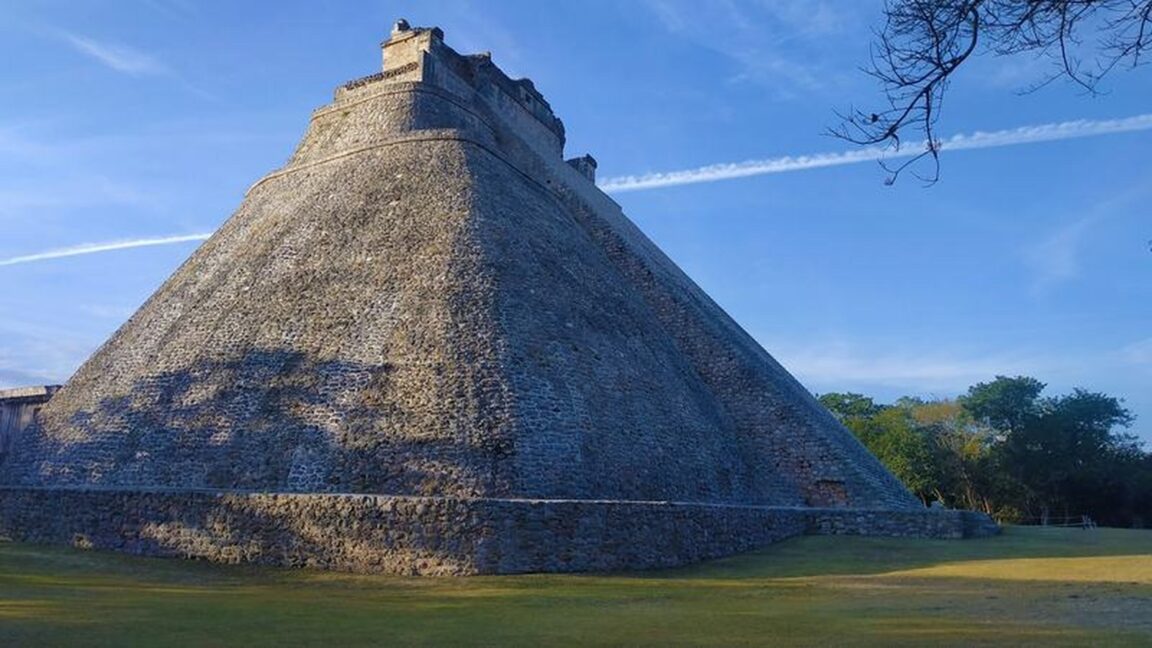
The entrance delivers you almost immediately to the Pyramid of the Magician, and there is no reason to fight the sequence. At about 35 metres high it is the tallest structure at Uxmal, and it is unlike any other Maya pyramid: its sides are rounded, its plan is oval rather than square, and it was built in five successive temples layered one over another. Legend, recorded after the conquest, says a dwarf magician hatched from an egg built it in a single night to win the city’s rulership, which is why Spanish speakers also call it the Pyramid of the Dwarf. The western staircase is precipitously steep and rises to a temple whose doorway is a giant monster mouth in the Chenes style. You view it from the ground; that restriction is also what keeps its silhouette clean for the photographs everyone takes from the Nunnery courtyard.
Then give the Nunnery its full circuit
West of the pyramid, the Nunnery Quadrangle is four long buildings arranged around a courtyard on a raised platform, entered through a corbelled arch in the south building. The Spanish name, the House of the Nuns, is a guess based on the many small rooms; the buildings were more likely a royal palace and administrative complex. Walk the full circuit slowly. The north building, the highest, carries the richest facade, with Chaac masks, lattice and a feathered serpent running its length; the east and west buildings trade masks for lattice and serpent motifs at a smaller scale. Standing in the courtyard also gives the best framed view back to the Magician Pyramid, which was aligned to be seen from here.
Cross the ball court to the Governor’s Palace
South of the Nunnery lies the Ball Court, smaller and later than Chichen Itza’s giant version, and beyond it the great artificial platform that carries the Governor’s Palace and the House of the Turtles. The Governor’s Palace is the Puuc masterpiece and the building to budget the most time for. Its upper facade is a single mosaic field roughly 100 metres long, centred on a ruler’s figure above the main doorway and woven through with hundreds of Chaac masks and lattice. The House of the Turtles next to it is plainer and takes its name from the carved turtles along its cornice, animals linked to rain and to the Chaac cult. From the platform edge the whole southern city opens up, including the partly restored Great Pyramid and the Dovecote, whose tall pierced roof comb is the other Uxmal silhouette worth seeking out.
How do the two tickets and hours actually work?
Uxmal charges through two agencies, and first time visitors regularly stall at the windows because of it. The federal INAH ticket and the Yucatan state Cultur ticket are sold side by side, both are required, and you should keep both for checks at the gate. Recent INAH based listings put the federal charge at 105 pesos and the state charge at 461 pesos for foreign visitors and 157 pesos for Mexican visitors, giving combined totals of 566 and 262 pesos before exemptions; children under 13 enter free under INAH rules, and Mexican citizens and residents get the federal charge waived on Sundays. Fees in Mexico were revised for 2026 and can change again, so treat those totals as the checked November 2026 position and confirm at the window. Bring pesos in cash for at least the federal ticket, as card acceptance has historically been unreliable at the federal window.
On hours, plan conservatively. The site opens at 08:00 daily and INAH sources variously list closing at 16:00 or 17:00, with last entry an hour before closing. The practical translation is simple: Uxmal is a morning site. An 08:00 entry gives cooler air, raking light on the east facades, the full circuit in two to three hours, and the option of the Puuc route afterwards. Our base guide to Merida, its haciendas and cenotes covers where to stay and eat at the other end of the drive.
How does the Ruta Puuc pairing work in one day?
The Ruta Puuc runs southeast from Uxmal for about 40 kilometres, linking the smaller sites that share its UNESCO listing and style. With a rental car or a hired driver, the realistic version is Uxmal first, then Kabah, then Sayil, adding Xlapak or Labna only if the group is still fresh. Each smaller site needs its own INAH ticket, each takes 30 to 60 minutes, and each adds one clear idea. Kabah contributes the Palace of the Masks, whose facade is a solid field of hundreds of Chaac faces, and the great standalone arch that once carried a raised causeway, a sacbe, toward Uxmal. Sayil contributes the Great Palace, three storeys of columned facades that show Puuc design turning almost palatial and domestic. Labna, if reached, contributes its famous decorated archway between palace groups.
Public transport is the weak point. A special Sunday tourist bus from Merida has historically looped the route sites, and ordinary buses serve the main road towns, but neither gives the flexible, site by site day a car gives. Travellers without a car usually do better with a small group tour from Merida or a private driver for the day than with improvised buses between sites in serious midday heat. For the sanctuary in order method applied to another great classical site, see our Delphi sanctuary and museum order guide, and for the wider timed entry pattern at blockbuster museums, our Louvre timed entry guide makes a useful comparison.
What should you bring for a Puuc day?
Bring more water than feels reasonable, a hat and sunscreen, and cash in pesos for the sequence of site tickets, parking and roadside stops. The Puuc sites have almost no shade away from the tree lines, the limestone reflects heat, and there is no meaningful food or drink offer inside the fences; the services cluster at the Uxmal entrance. Wear closed shoes with grip for worn stone steps and platform edges. Photography is for personal use; professional equipment and drones sit under INAH permit rules, so leave both assumptions and kit behind unless a permit has been arranged.
Frequently Asked Questions
How much does it cost to enter Uxmal in 2026?
Two tickets are required, federal INAH and state Cultur. INAH based listings checked in November 2026 total 566 pesos for foreign visitors and 262 pesos for Mexican visitors, before exemptions. Children under 13 are free under INAH rules, and the federal part is waived for Mexican citizens and residents on Sundays. Confirm the current split at the windows, as fees are revised periodically.
What are Uxmal’s opening hours?
The site opens daily at 08:00. INAH listings give closing at 16:00 in some places and 17:00 in others, with last entry an hour before closing. Plan an arrival at or near opening and you are unaffected by the difference; plan a late arrival and you risk a closed gate.
Can you climb the Pyramid of the Magician?
No. Climbing the Magician Pyramid and the other major structures is restricted, with staircases roped off. Uxmal is a viewing and walking site at ground and platform level, which is also how its facades were designed to be read.
Is Uxmal better than Chichen Itza?
They reward different things. Chichen Itza is grander in single monuments and far busier. Uxmal is finer in carved detail, more coherent as a Puuc showcase and far calmer. With two site days from Merida, do both; with one, travellers who care most about architecture usually choose Uxmal.
How long does the full Ruta Puuc take?
Uxmal plus Kabah and Sayil fills about six to seven hours door to door from Merida, including drives of roughly an hour out and shorter hops between sites. Adding Xlapak and Labna makes a long full day. Start at the 08:00 opening or the heat will make the decision for you.
Do you need a guide at Uxmal?
Not formally, but licensed guides at the entrance add real value on the facades, the Chaac symbolism and the water system, and their fee split across a small group is modest. Independent visitors should at least start in the site museum, which is included in admission.
Fees and hours checked 14 November 2026 against INAH and INAH museum listings and UNESCO’s listing for the Pre Hispanic Town of Uxmal. Recheck fees before travel, as Mexican federal and Yucatan state charges are revised separately.