 Elena Vasquez
Every visitor to Madagascar needs a tourist visa, and the system is built around one idea: apply online before you fly, receive a landing authorisation, and have the visa itself issued when you land at Ivato International Airport in Antananarivo. The official portal is evisamada.gov.mg. Online tourist visas are single entry and run up to 60 days, the portal fee list checked in October 2026 prices 15 days at 30 euros, 30 days at 35 euros and 60 days at 40 euros, and the same visa can also be bought at the airport counter on arrival at the same listed prices. This explainer walks through the filing sequence in order, flags the February 2026 fee change that still catches people out, and separates the airport arrival route from the land border and yacht cases where the rules are different.
Quick Facts
- Official portal: evisamada.gov.mg, the Madagascar eVisa portal, which forwards to the application site
- What you get online: A landing authorisation for a single entry tourist visa, with the visa issued on arrival
- Fees on the official portal list: 30 euros for up to 15 days, 35 euros for 16 to 30 days, 40 euros for 31 to 60 days, checked October 2026
- Fee change: The 15 day fee rose from 10 euros to 30 euros on 16 February 2026, so older guides quoting 10 euros are out of date
- Processing: Allow about 72 hours for the landing authorisation; applications open from six months before arrival and should be filed at least a week ahead
- Main gateway: Ivato International Airport (TNR), Antananarivo; the eVisa is accepted at eight international airports in total
- Extensions: A tourist stay can be extended in Antananarivo up to 90 days in total
- Passport: Valid for at least six months after arrival, with blank pages for the visa and stamps
Who needs a Madagascar visa?
The short answer is almost everyone. Madagascar runs a visa required system for tourists of all nationalities, and the choice is not whether to get a visa but where: online in advance through the eVisa portal, or at the visa counter when you land. There is no broad visa free list for ordinary passport holders planning a holiday, so build the visa step into every itinerary, whether the trip is a lemur circuit out of the capital, a beach week on Nosy Be or a sailing charter down the west coast.
The eVisa covers tourism only. It does not authorise business activity, paid work or long term residence, and those purposes follow separate consular routes. It is also single entry. If your route leaves Madagascar, for example a side trip to Mauritius or Reunion, and then returns, the first visa ends when you exit and a new application is needed for the second entry. Travellers combining Madagascar with other Indian Ocean or African stops should sequence the Madagascar leg as one unbroken stay wherever possible. For a regional comparison, our guide to Kenya’s eTA system shows how a neighbouring destination handles the same pre travel authorisation idea with different rules.
How does the eVisa landing authorisation work?
The Madagascar eVisa is best understood as a two stage process. Stage one happens at home: you apply on the official portal, enter your passport and travel details exactly as they appear on your documents, choose your stay length and your port of entry, and submit. The system issues a landing authorisation, the document that confirms you are cleared to board and to be issued a visa on arrival. Print it and keep a copy on your phone, because airlines may ask to see it at check in and the arrival officers will ask for it at Ivato.
Stage two happens at the airport. On landing at Ivato you go to the eVisa counters before or alongside the main immigration lines, present the landing authorisation and your passport, pay the visa fee that matches your stay length, and receive the visa in your passport. The visa runs from your arrival date, so count your permitted days from the day you land to the day you fly out, not from the start of the trip at home. Processing of the online stage is normally quoted at about 72 hours, and the application window runs from six months before arrival down to about a week before, so there is no reason to leave it to the last days, when a rejected photo upload or a mistyped passport number has no time to be fixed.
What does the Madagascar visa cost in 2026?
Fees are where older information does the most damage. The official portal fee list, checked in October 2026, prices the tourist visa at 30 euros for a stay of up to 15 days, 35 euros for 16 to 30 days and 40 euros for 31 to 60 days, with dollar equivalents listed alongside at 35, 41 and 47 dollars. The same list shows a 50 euro line for longer stays, but the online visa itself only runs to 60 days, and a 90 day stay is arranged by extension inside Madagascar or through an embassy before travel, not by buying a longer visa at the border.
The change to memorise is the shortest stay. Until February 2026 the up to 15 day visa carried only a small administration charge, widely quoted at 10 euros, and many government advice pages and guidebooks still describe short stays that way. On 16 February 2026 the fee for the 15 day visa rose to 30 euros, which puts it only 5 euros below the 30 day visa. The practical effect is that a short trip no longer costs meaningfully less than a month long one, and travellers budgeting from an old guide will under budget the arrival counter. Pay by card where the terminal is offered and carry a cash backup in euros, dollars or ariary, because airport payment systems are the one part of the process that can fail on the day.
Which airports accept the eVisa, and what about land borders and yachts?
The eVisa is valid at a closed list of eight international airports: Antananarivo Ivato (TNR), Nosy Be Fascene (NOS), Antsiranana (DIE), Mahajanga (MJN), Sainte Marie (SMS), Toamasina (TMM), Toliara (TLE) and Fort Dauphin (FTU). Ivato handles the great majority of arrivals and has dedicated eVisa counters. If your itinerary enters Madagascar any other way, the online authorisation is not the right document. Land borders and seaports sit outside the eVisa list, so an overland entry or a yacht arrival needs a consular visa arranged before travel, or specific clearance through the port authorities, rather than an assumption that the airport rules will be applied at the dock.
This distinction matters for two common trip shapes. The first is the Mozambique Channel crossing, where travellers arrive by boat from Mozambique or the Comoros; that is a seaport arrival and should be cleared in advance. The second is the fly in, sail away itinerary, which is fine on an eVisa because entry is by air, provided the exit is recorded properly. When in doubt, the test is simple: if your first footprint in Madagascar is not one of the eight listed airports, do not rely on the eVisa. Southern Africa trips often pair Madagascar with a mainland leg, and our explainer on Namibia’s visa on arrival change is a useful reminder of how quickly entry rules in the region are being rewritten.
Can you extend a Madagascar tourist visa?
Yes, up to a ceiling. A tourist visa can be extended in person at the immigration office in Antananarivo, taking the total stay to a maximum of 90 days in the country. The eVisa site’s February 2026 notice lists the extension fee at 210,000 ariary. Extensions are not automatic and are not handled online, so build in a working day in the capital, take your passport and copies of your visa and entry stamp, and apply before the original visa expires rather than after. Overstaying first and explaining later converts an administrative task into a negotiation, and it can complicate the exit stamp you need for onward travel.
Travellers who know from the start that they need more than 60 days have two cleaner options: arrange the longer visa through a Madagascar embassy before departure, or plan the trip as 60 days plus an Antananarivo extension day in the middle. What does not work is buying a second eVisa from inside the country; the system is an entry document, not a residence tool.
What are the common mistakes with the Madagascar eVisa?
The first is using a lookalike website. The official portal is evisamada.gov.mg; commercial sites with similar names charge service fees on top of the government price and are not the government. The second is a date error: the dates entered on the application cannot be changed after submission, so check the arrival date against the flight booking before paying or confirming. The third is assuming the 15 day visa is still nearly free, which the February 2026 change ended. The fourth is arriving at a seaport or land border with an airport authorisation. The fifth is a passport problem: less than six months of validity after arrival, or no blank pages, can end the trip at check in. Each of these is cheap to prevent at home and expensive to fix at the counter.
Frequently Asked Questions
Do I need a visa for Madagascar if I am only staying two weeks?
Yes. Every tourist needs a visa, and since 16 February 2026 the up to 15 day visa costs 30 euros on the official portal list, only 5 euros less than the 30 day visa. Apply online for the landing authorisation or buy the same visa at the airport counter on arrival.
Is the Madagascar eVisa a visa or just an authorisation?
It works in two stages. The online application produces a landing authorisation that lets you board and be issued the visa; the visa itself is placed in your passport at the arrival airport, and your permitted stay runs from the arrival date.
How long does the Madagascar eVisa take to process?
Allow about 72 hours for the landing authorisation. Applications can be filed from six months before arrival and should be submitted at least a week ahead, so a document error can still be corrected before departure.
Can I enter Madagascar by boat or overland on an eVisa?
No. The eVisa is valid only at eight listed international airports, including Ivato in Antananarivo and Fascene on Nosy Be. Seaport and land border arrivals need a consular visa or specific advance clearance.
Can I extend my Madagascar tourist visa beyond 60 days?
Yes. Extensions are handled in person at the immigration office in Antananarivo and can take your total stay to 90 days. The February 2026 notice on the eVisa site lists the extension fee at 210,000 ariary. Apply before the original visa expires.
What happens if I leave Madagascar and come back during the same trip?
The tourist visa is single entry, so leaving ends it. A return to Madagascar, even a few days later, needs a new visa, which is why multi country itineraries should keep the Madagascar stay in one unbroken block.
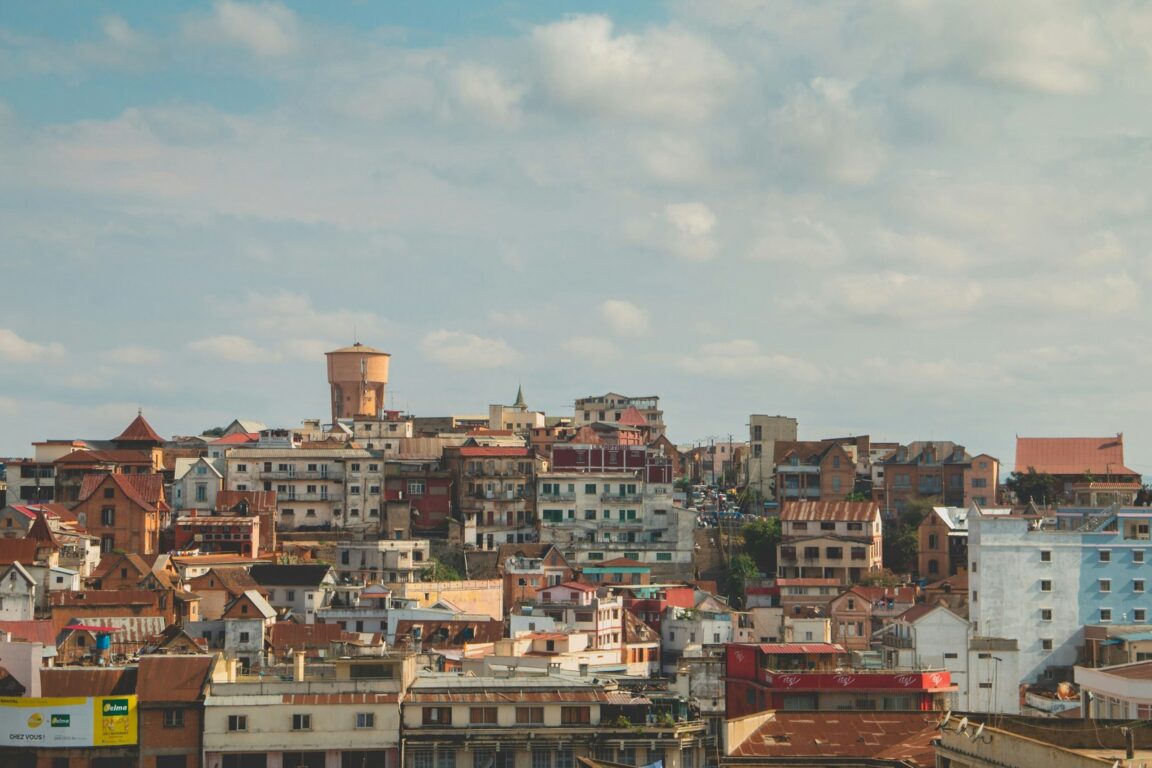
Photo: Antananarivo hillside rooftops, Madagascar. Photo by Brent Ninaber on Unsplash, Unsplash License. Facts checked 16 November 2026 against the official eVisa portal fee list and current government advice summaries; confirm fees on evisamada.gov.mg before paying, as schedules change.