 Aiko Tanaka
Ban Gioc Falls is one waterfall system with two names, two countries and one river: Vietnam calls it Ban Gioc, China calls it Detian, and the Quay Son River between them is the border. From the Vietnamese bank you get the full picture for 45,000 VND entry, plus about 50,000 VND if you take the bamboo raft to the foot of the cascades. You cannot cross to the Chinese side from here: the Detian viewpoints are something you look at across the water, not a same day add on, and reaching them means a separate Chinese visa and border crossing. Plan the visit as a Vietnamese side day, sequenced bank first, raft second, pagoda panorama last.
Quick Facts
- Where: Dam Thuy commune, Trung Khanh district, Cao Bang province, about 90 km from Cao Bang city and about 360 to 400 km from Hanoi
- Size: About 30 metres high and up to about 300 metres wide in full flow, in three tiers
- Entry: 45,000 VND per person, cash; no ATMs nearby
- Raft: About 50,000 VND per person for roughly 10 minutes to the foot of the falls
- Hours: Commonly listed as 7:30 am to 5:00 pm daily
- Landscape: Inside the Non Nuoc Cao Bang UNESCO Global Geopark
- Best flow: Rainy season into early autumn, roughly June to October; the clearest water and golden rice are often September to October
- Border rule: No crossing at the falls; the cross border pilot arrangements apply only to Vietnamese and Chinese citizens
One falls, two names: Ban Gioc and Detian
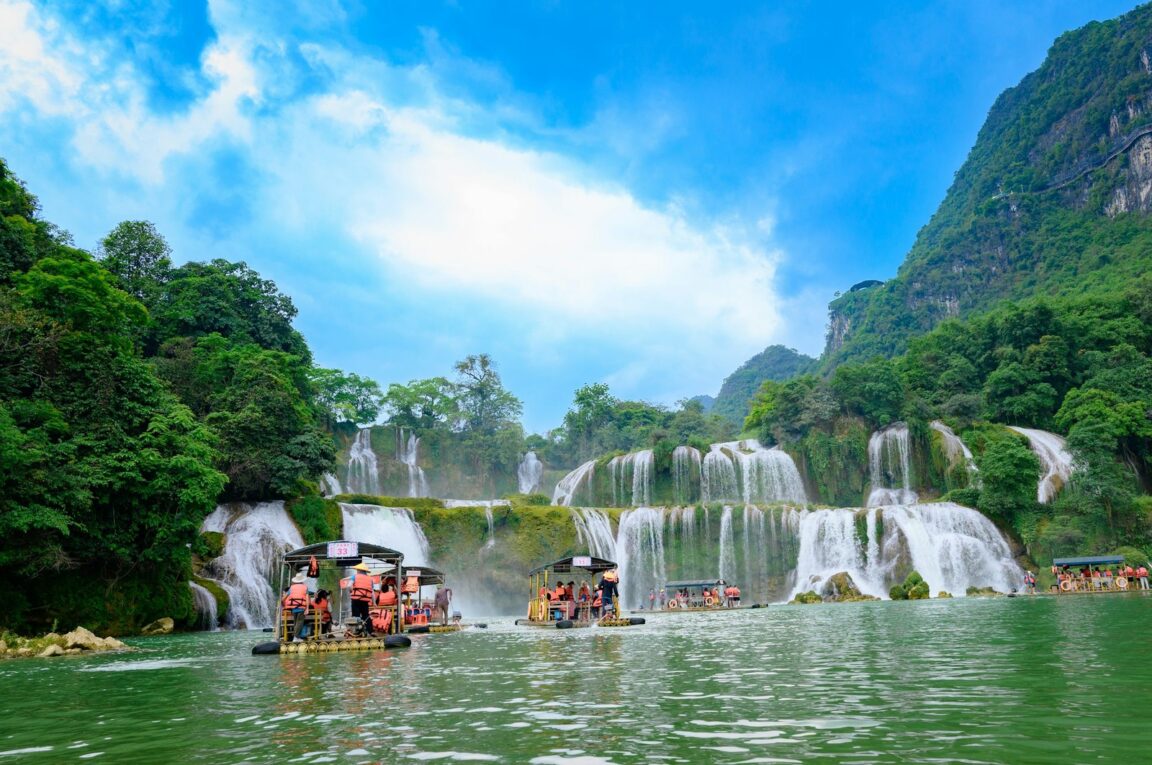
The falls drop over limestone tiers in the middle of the Quay Son River, and the border runs along the water. In the rainy season the separate streams merge into a single wide sheet, often measured at around 300 metres across, which is why Ban Gioc is regularly described as one of the largest transnational waterfalls in the world and the widest waterfall in Vietnam. In the dry season the flow splits into two falls, the wider Vietnamese fall on the left and the Chinese fall on the right as you face them from the Vietnamese bank. Neither version is the lesser sight: the wet season gives power and spray, the dry season gives structure, separate threads of water over dark rock, and the emerald colour the river is known for.
Allow the visit its own pace. Most travellers arrive on a day trip rhythm, but the falls reward anyone who waits out a cloud cycle, walks the bank twice as the light changes, and takes the pagoda climb slowly rather than treating Ban Gioc as a single viewpoint with a car park attached.
The setting does half the work. The falls sit in a pastoral bowl of rice fields, bamboo groves and karst hills inside the Non Nuoc Cao Bang geopark, with no cable car and no viewing tower on the Vietnamese side. Across the pool you can see the Chinese side viewing platforms of Detian, which is the honest framing for the cross border view in the headline of every guide to this place: it is a view of another country tourism complex from your own riverbank, close enough to read its scale, and legally a world away.
The viewpoints, in the order to use them
The riverbank and the path right from the car park
Start at ground level. The bank paths give the closest look at the cascades, the full width of the falls in one frame, and the rice fields in the foreground that make Ban Gioc photographs recognisable. The path to the right of the car park is the classic first viewpoint. Work the bank slowly, because the light on the water changes as clouds move over the karst, and the falls read completely differently in flat light and in sun.
The bamboo raft, and its rules
The raft is the second viewpoint and the only one that moves. For about 50,000 VND per person, a bamboo raft carries you out onto the Quay Son and toward the foot of the cascades for roughly ten minutes, close enough to be wet from the spray. The rules are simple and worth stating plainly. Stay on the Vietnamese side operation: the rafts work the river in front of the falls and do not land in China. Expect to get wet, so bag phones and cameras before you board, not when the spray arrives. Raft operation depends on water conditions, and prices are quoted slightly differently by different sources, with some listing a per raft figure shared between passengers, so confirm the price at the jetty before boarding. Life jackets and boarding order are managed at the jetty; follow the crew, and do not treat the border line on the water as a photo prop to cross.
Truc Lam Phat Tich Pagoda, the panorama
Finish above. The Truc Lam Phat Tich Pagoda, also rendered as Truc Lam Ban Gioc, sits on the hillside above the falls, built in 2013 in current accounts, and its terrace gives the panorama the bank cannot: the whole falls system, the Quay Son bending away, and the valley and rice fields laid out below. It is a working pagoda, so dress respectfully, with shoulders and knees covered, and keep voices down. Photographers rate the temple hill as the favourite vantage at Ban Gioc, and late afternoon, when the light drops across the valley, is its hour.
Tickets, cash and the border permit question
Entry is 45,000 VND, payable in cash, and the day stays cheap even with the raft and parking: current guides total the falls themselves at around 4 dollars per person all in. Bring more cash than the ticket math suggests, because there are no ATMs nearby and the nearest services are back toward Trung Khanh or Cao Bang city. One caution circulates in recent guides: Ban Gioc sits in a designated border area, and some Cao Bang guidance describes a border area permit process for foreign travellers. Rules and enforcement in border districts change, so check the current position with your Cao Bang accommodation or local authorities before travelling, and carry your passport for the journey regardless. What is not in doubt is the crossing rule: the 2023 passport only pilot for the falls scenic area is open only to Vietnamese and Chinese citizens, and other visitors cannot use it.
Getting there and what pairs with the falls
Ban Gioc is a long way from everywhere, which is the price of its quiet. The standard approach is Hanoi to Cao Bang city by bus, then about 90 km of mountain road to the falls; riders also come by motorbike on Highway DT206, with rentals in Cao Bang quoted around 10 to 15 dollars a day in recent guides. Almost every visit pairs the falls with Nguom Ngao Cave, a few kilometres away, where a lit route of about 1 km runs through stalactite chambers for a separate entry of about 45,000 VND, and with the stone village of Khuoi Ky on the same circuit. Drones are prohibited near the border, a rule photographers at the falls run into immediately, so plan on ground level and pagoda compositions instead. If you are building a wider Vietnam trip around the falls, sort the paperwork first with our guide to Vietnam 90 day e-visa, and eat well in the capital on the way through with our Hanoi food guide.
Frequently Asked Questions
How much does Ban Gioc Falls cost?
Entry is 45,000 VND per person. The optional bamboo raft to the foot of the falls costs about 50,000 VND per person, and parking adds a small fee, so the falls themselves total roughly 4 dollars per person. Pay in cash.
Can I cross to the Chinese side at the falls?
No. The border runs along the Quay Son River. You can see the Detian side viewpoints from the Vietnamese bank and from the raft, but crossing requires a Chinese visa and a formal border crossing elsewhere; the falls pilot scheme is limited to Vietnamese and Chinese citizens.
When is Ban Gioc at its best?
The falls are fullest in and just after the rainy season, roughly June to October. September and October often combine strong flow with clear water and golden rice fields in front of the cascades.
How long do I need at Ban Gioc?
Half a day covers the bank viewpoints, the raft and the pagoda, and pairs naturally with Nguom Ngao Cave. The travel time to reach Cao Bang is the real commitment, not the visit itself.
Can I fly a drone at Ban Gioc?
No. Drone use is prohibited in this border area. Use the riverbank, the raft and the pagoda terrace for photographs instead.
Is the raft safe for children?
The rafts are short, crewed trips of about ten minutes on the river in front of the falls, operating subject to water conditions. Expect spray at the base of the cascades, keep children seated, and follow the jetty crew instructions.
Prices and hours checked 16 November 2026 against current Ban Gioc guides published in autumn 2026. Confirm raft operation and any border area requirements locally before travel, as both change with conditions.