 Camille Baptiste
Start with the honest answer, because it decides your whole packing list: there is nowhere to eat at Ross Lake. No restaurant, cafe or store serves the lake itself, and Ross Lake Resort, the only lodging on its shore, is a boat-in or hike-in property reached by ferry, truck and shuttle boat, not a lunch stop. Eating at Ross Lake means eating what you carried in, cooked or assembled at a boat-in camp or at Colonial Creek Campground on Diablo Lake, with every ingredient bought before you leave the last towns on State Route 20. So the real food question for this trip is an order of stops: buy supplies in Marblemount, base at Colonial Creek for $24 a night, walk its trailheads in the morning, take the Diablo Lake Overlook on the highway as your scenic pause, and only then commit to the ferry, portage and water taxi chain that puts you on Ross Lake itself. Entry to the North Cascades complex is free, the resort season runs from mid June to the end of October, and everything about this lake rewards travellers who treat the logistics as the itinerary.
Quick Facts
- Destination: Ross Lake, Ross Lake National Recreation Area, inside the North Cascades National Park Service Complex, Washington
- Entrance fee: None. There is no fee to enter the North Cascades National Park Service Complex, per the National Park Service
- Food reality: No dining or store at Ross Lake. All food is carried in; the last supply towns are on State Route 20, including Marblemount
- Base camp: Colonial Creek Campground on Diablo Lake, $24 per night, reservations through Recreation.gov in season
- Access chain: Diablo Lake ferry twice daily in season, then the resort’s passenger truck over the portage road, then a shuttle boat to Ross Lake Resort
- Boat-in camps: 19 camps along Ross Lake, every one requiring a backcountry permit, per the National Park Service
- Checked: Fees, ferry times and access details verified against nps.gov and Ross Lake Resort on November 17, 2026
Where do you actually eat on a Ross Lake trip?
You eat at camp, from your own supplies, and planning for that fact is the difference between a good Ross Lake trip and a hungry one. The National Park Service is blunt about the geography: there is no direct road access to Ross Lake from the south, and the resort that anchors the lake is open from June to October as the only lodging facility on Ross Lake, reached by hiking or boating in. A property you reach by ferry, flatbed truck and shuttle boat does not run a walk-in restaurant trade, and the 19 boat-in camps along the shore are wilderness sites with fire rings, picnic tables, vault toilets and bear resistant food storage boxes, not serviced pitches. Dinner at Ross Lake is whatever you cooked over your own stove, eaten at a picnic table above water that seldom rises above 50 degrees Fahrenheit even in summer.
That shapes the stops before the lake. Marblemount, the last real supply town on the western approach to State Route 20, is where the food plan is executed: groceries, ice, stove fuel and a final restaurant meal before the highway climbs into the park complex. Newhalem, the company town further east, has limited services and should be treated as a bonus rather than a plan. From Colonial Creek Campground onward, assume nothing is for sale. Travellers who have read our guide to three days on Congaree’s Boardwalk Loop will recognise the pattern: the parks that feel most remote are the ones where the supply stop has to happen before the entrance, not after it.
Why is Colonial Creek the right base, and which trailheads start there?
Colonial Creek Campground sits on the shore of Diablo Lake at milepost 130 of State Route 20, split into north and south sections with 130 sites between them, and it is the hinge of the whole trip. It is the drive-in base for the trailheads, the launch point for the paddle to the portage dock, and the place where most Ross Lake journeys effectively begin. In the main season, from mid May to early September, sites cost $24 per night and reservations through Recreation.gov are required; a handful of walk-in tent sites in the south section stay open free through winter with no water or services. Book the summer sites early, because this campground serves the entire Diablo and Ross Lake corridor.
Two trailheads make Colonial Creek more than a car park. The Thunder Knob Trail starts at the campground entrance and climbs gently for 3.6 miles round trip, with about 425 feet of elevation gain on the park’s figures, to a knob above Diablo Lake with benches and views of Colonial Peak, Pyramid Peak, Davis Peak and Jack Mountain. It is the right first morning walk: two hours, big payoff, and a clear look at the turquoise water, coloured by glacial rock flour, that you will paddle later. The second trailhead, Thunder Creek, leaves from the south section and follows the creek into old growth forest for as many miles as you care to walk. Do Thunder Knob first, because its viewpoint reads the whole corridor for you, then Thunder Creek on the second morning if the legs want distance over views.
Where does the Diablo Lake Overlook fit in the order?
After the trails, before the lake. The Diablo Lake Overlook is the signed roadside viewpoint on State Route 20 east of Colonial Creek, a short drive from the campground, and it delivers the corridor’s postcard in one stop: Diablo Lake’s improbable blue green water held between forested ridges, with the dam and the peaks beyond. It takes minutes, not hours, and that is exactly its role in the order. Hikers coming down from Thunder Knob have just seen the lake from above at trail level; the overlook gives the same water from the highway’s engineered vantage, the version every traveller on the North Cascades Highway stops for. Do it on the drive, not as a destination, and do it before you commit to the ferry timetable, because once the Ross Lake access chain starts, the day runs on the resort’s clock, not yours.
How does the boat-in access to Ross Lake actually work?
In three legs, and the order matters. Leg one is the Diablo Lake ferry, run by Seattle City Light, which departs twice daily in season at 10:30 a.m. and 2:00 p.m. for the 20 minute crossing to the portage dock, at $10 per person each way, payable on board. Ferry reservations are mandatory and require a confirmed booking with Ross Lake Resort for a cabin, equipment rental or water taxi. Leg two is the resort’s passenger truck, which carries you and your gear over the gravel portage road around Ross Dam for $30 per person round trip, added to your resort bill. Leg three is a short shuttle boat ride from the Ross Lake dock to the resort itself. The resort’s 2026 season runs June 11 to October 31, and its own advice is firm: day visitors and hikers should skip the ferry and walk the roughly one mile Ross Dam Trail from the trailhead near milepost 134 instead, saving the ferry seats for guests with gear.
Bringing your own canoe or kayak follows the older route. Launch at Colonial Creek Campground, paddle five miles up Diablo Lake to the portage dock, and either carry around Ross Dam yourself on the mile long gravel portage road, with about 520 feet of gain, or pay the resort’s truck portage, which runs daily in season on a first come, first served basis. On Ross Lake, the resort rents motorboats, canoes and kayaks and runs a water taxi to the trailheads and camps along the shore. Every overnight at the 19 boat-in camps requires a backcountry permit, which the park prices at $10 per person plus a $6 reservation fee, with campers 15 and under free. Larger boats cannot be portaged at all; the only vehicle route to the lake is the long gravel road from Hope, British Columbia, to the ramps at Hozomeen at the lake’s north end. For how reservation systems like this shape a park trip, see our explainer on national park reservations for 2026.
What order should the whole trip follow?
Day one: drive State Route 20, shop in Marblemount, settle at Colonial Creek and walk Thunder Knob in the late afternoon light. Day two: Thunder Creek in the morning, the Diablo Lake Overlook on a short drive east, and an early night, because the Ross Lake chain starts with a morning ferry. Day three: ferry at 10:30 a.m., truck, shuttle boat, and Ross Lake by early afternoon, with camp food you planned two days earlier. Build the return with the same slack, because wind on Ross Lake is a real scheduling force; the park warns that strong gusty winds and whitecaps arrive without warning, that mornings are usually calmest, and that a comfortable paddling distance for most groups is five to seven miles per day. November travellers should note that the resort and ferry are out of season now and the high highway closes with winter snow, so this is a trip to book for the June to October window, not a late autumn improvisation.
Frequently asked questions
Is there a restaurant at Ross Lake? No. There is no dining or store at Ross Lake, and Ross Lake Resort is a hike-in or boat-in lodging property, not a public restaurant stop. Carry all food in, and buy supplies in Marblemount or another State Route 20 town before basing at Colonial Creek.
How much does Colonial Creek Campground cost? $24 per night in season, with reservations required through Recreation.gov from mid May to early September. A small set of walk-in tent sites stays open free in winter with no water or services.
How do you reach Ross Lake Resort without a boat? Take the Diablo Lake ferry at 10:30 a.m. or 2:00 p.m. in season ($10 per person each way, reservation required with a resort booking), then the resort’s passenger truck over the portage road ($30 per person round trip), then the shuttle boat to the resort. Day hikers can instead walk the Ross Dam Trail from milepost 134.
Do you need a permit to camp on Ross Lake? Yes. All 19 boat-in camps require a backcountry permit, priced by the park at $10 per person plus a $6 reservation fee, with ages 15 and under free. Entry to the park complex itself is free.
When is Ross Lake in season? Ross Lake Resort operated June 11 to October 31 in 2026, and the park notes the lake is generally at full pool from July to September. Outside that window the ferry, portage and resort services do not run.
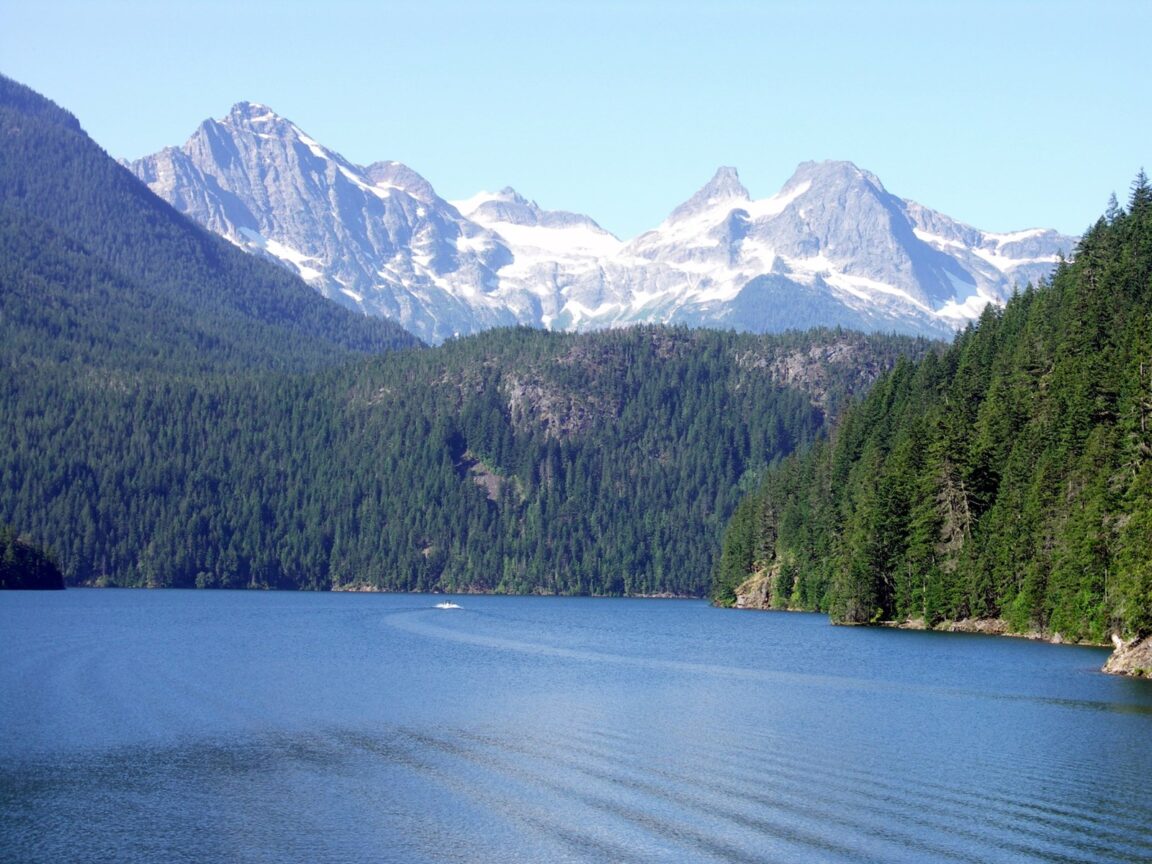
Photo: A boat on Ross Lake beneath the North Cascades peaks. Photo by R. Seifried, National Park Service, via nps.gov.