 Lucas Meyer
Three days is the right amount of time for Congaree National Park if the Boardwalk Loop is your anchor: one day for the boardwalk itself and the Harry Hampton Visitor Center, one day for the longer floodplain trails and Weston Lake, and one flexible day that absorbs the thing Congaree does most often, which is flood. Entry is free, no day-use reservation is required, and the park sits about 30 minutes southeast of Columbia, South Carolina. What decides whether this itinerary works is not fitness or budget. It is water level, checked on the National Park Service conditions page on the morning of each day, because the same flooding that feeds this old-growth forest regularly covers low trails and parts of the boardwalk.
Quick Facts
- Park: Congaree National Park, South Carolina, protecting the largest intact expanse of old-growth bottomland hardwood forest in the southeastern United States
- Entrance fee: None. Entry is free and no timed reservation is needed for a normal day visit
- Anchor walk: Boardwalk Loop, 2.4 miles of boardwalk from the Harry Hampton Visitor Center, per the National Park Service
- Visitor center: Harry Hampton Visitor Center, open 9:00 a.m. to 5:00 p.m. daily, closed on major federal holidays
- Firefly event: Synchronous fireflies for roughly two weeks between mid-May and mid-June; viewing passes are awarded by lottery on Recreation.gov
- Base: Columbia, South Carolina, about a 30-minute drive from the park entrance
- Checked: Fees, firefly lottery details and trail facts verified against nps.gov on November 17, 2026
Why does Congaree need three days rather than one?
Most visitors give Congaree half a day, walk the boardwalk, and leave thinking they have seen the park. The boardwalk deserves that first day on its own. It leaves the visitor center on an elevated section raised above the floodplain, descends into bald cypress and water tupelo forest, and reaches Weston Lake, an oxbow lake left behind when the Congaree River changed course. The National Park Service counts 2.4 miles of boardwalk and more than 25 miles of hiking trails in the park, and the contrast between the two systems is the point of a longer stay. The boardwalk is flat, accessible and reliable. The dirt trails beyond it are where the champion trees, the quiet and the wildlife are, and they are also the first thing flooding takes away.
Building the trip across three days lets the plan bend instead of break. If the low boardwalk or the Weston Lake Loop is under water on day one, the elevated boardwalk and the upland Bluff Trail usually remain walkable, and the flooded section can be retried on day three. Congaree floods roughly ten times a year as the Congaree and Wateree rivers push water across the floodplain, and the park is explicit that this is a feature, not a malfunction: floodwater delivers the nutrients that built one of the tallest temperate deciduous forests on earth. A one-day visitor gambles the whole trip on one water reading. A three-day visitor almost always gets one dry, complete circuit.
What should day one on the Boardwalk Loop look like?
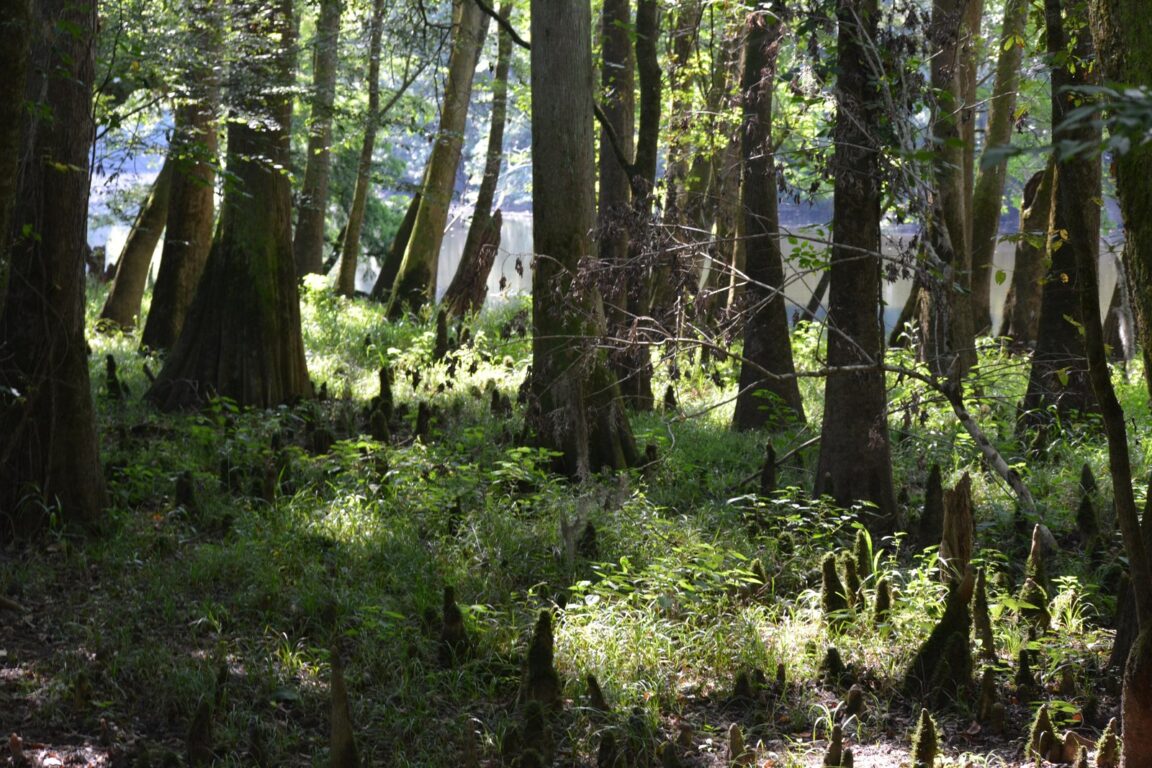
Start at the Harry Hampton Visitor Center when it opens at 9:00 a.m. Pick up the self-guided boardwalk brochure, check the posted trail conditions with a ranger, and look at the exhibits on the floodplain ecosystem before walking, because the numbered stops on the loop make far more sense with that context. Then walk the full loop slowly. The elevated section comes first, carrying you above the forest floor through loblolly pine and hardwood, before the route drops to the low boardwalk, which runs at ground level through the cypress and tupelo swamp where knees rise out of dark water on both sides.
Allow one to two hours for the loop itself, longer with a camera. Benches are spaced along the route, the surface is step-free, and the walk is suitable for wheelchairs and strollers in normal conditions. At the far side of the loop, take the short spur to the Weston Lake overlook before turning back. Weston Lake is the visual payoff of the walk, a still, tree-fringed oxbow where wading birds, turtles and, in warm months, alligators are regularly reported by the park. Finish day one with the Bluff Trail, an easy upland loop of about 1.7 to 1.8 miles near the visitor center that shows the park’s second landscape, drier pine and hardwood on higher ground, and that stays usable when the floodplain is wet.
How do flood closures change the plan on day two?
Day two is for distance, and it begins with a conditions check, not a trailhead. The park’s current conditions page and the visitor center board list which trails are flooded or closed, and rangers close sections with little warning when water rises. The standard day-two route links the boardwalk to the Weston Lake Loop Trail, about 4.4 miles, which leaves the boards for packed earth and roots, circles Weston Lake, and passes some of the largest trees close to the frontcountry. The longer Oakridge Trail, about 7.2 miles, is the upgrade for strong walkers on a dry day.
If the water is up, do not treat it as a lost day. The elevated boardwalk remains the park’s wet-weather backbone, and a second, slower boardwalk circuit in different light is a genuinely different walk, with bird activity concentrated along the water’s edge. The other wet-day option is Cedar Creek by canoe or kayak. The park marks a canoe trail on Cedar Creek, a blackwater stream that winds through the old-growth forest, and paddling is possible in conditions that close foot trails, provided water levels are within the range the park and local outfitters in Columbia consider safe. Never wade flooded trails to reach a route: floodwater here hides drop-offs, carries debris, and is exactly what the closures exist for.
What is the firefly lottery, and how does it reshape a spring trip?
For roughly two weeks between mid-May and mid-June, male synchronous fireflies flash in unison in the forest around the boardwalk, one of only a handful of places in North America where the display can be watched reliably. Because the viewing area is small, the park runs the Synchronous Fireflies Viewing Event with passes awarded by lottery through Recreation.gov. For the 2026 event, held May 13 to 20, the lottery opened at 10:00 a.m. EST on April 7 and closed at 10:00 a.m. EST on April 14. Entering cost a 1 dollar non-refundable fee, applicants drawn in the lottery paid a further 24 dollars for the pass, and 145 passes were available for each event night, with results announced on April 17. Dates and numbers are set fresh each year, so treat those figures as the pattern, not a promise, and confirm the new season on the park’s fireflies page each spring.
The event changes daytime logistics too. During the 2026 event, all day-use visitors had to be off the trails and out of the parking lots by 4:30 p.m., and the visitor center, boardwalk and frontcountry trails closed at that hour on event days so staff could prepare and the firefly habitat stayed dark and undisturbed. A spring itinerary therefore works best in one of two shapes. Either build the trip around a lottery pass, walk the boardwalk in the morning, rest in Columbia in the afternoon, and return for the evening viewing. Or visit just outside the event window, when the full trail system keeps normal hours and the forest is at its greenest, and accept missing the synchrony. What does not work is arriving on an event night without a pass and hoping to stay late. There is no walk-up route in.
Where should you sleep, and what does the trip cost?
Congaree has no lodge and no developed drive-up campground with hookups. Its two frontcountry campgrounds, Longleaf and Bluff, are primitive, and sites are reserved in advance through Recreation.gov; backcountry camping is also available under park rules. Most three-day visitors base in Columbia, which puts hotels, restaurants and outfitters about 30 minutes from the trailhead and makes the flood-flex day easy to fill with the South Carolina State Museum or the Riverbanks Zoo if the park is fully under water. Costs stay low either way. Park entry is free, the boardwalk is free, and ranger programs are generally free, so the real budget lines are lodging, food in Columbia, a possible canoe rental, and, in firefly season, the 25 dollar event pass. Travelers planning a wider parks trip can compare how unusual Congaree’s free, reservation-light model is in our guide to US national park reservations in 2026, and anyone combining Congaree with a mountain trip will find the layering logic in our Banff in winter guide a useful contrast in trip pacing.
What should you pack and watch out for?
Congaree is a warm, wet, insect-rich floodplain for much of the year. Mosquito repellent is not optional in late spring and summer, and the park itself warns visitors to expect biting insects. Bring more water than a 2.4-mile walk seems to need, because humidity does the damage, and wear shoes that can get muddy on the dirt trails even when the boardwalk stays clean. Summer afternoons bring heat and thunderstorms; winter and late autumn are the most comfortable walking seasons, with thinner insects, lower water on many weekends and clearer views through the canopy. Snakes, including venomous species, live in the floodplain and are most often seen near water and downed logs, which is one more reason the boardwalk, with its raised, railed view into the swamp, is such a good first encounter with this ecosystem. Pets are allowed on trails and in campgrounds under park rules but are not permitted during the synchronous firefly viewing event, so spring visitors traveling with a dog should plan around event nights.
Frequently asked questions
Is Congaree National Park really free to enter?
Yes. The National Park Service charges no entrance fee at Congaree and requires no reservation for an ordinary day visit. The exceptions are paid Recreation.gov transactions for campground reservations and for a synchronous firefly event pass in spring.
How long does the Boardwalk Loop take?
The loop is 2.4 miles of boardwalk and most visitors take one to two hours, including stops. It is flat and step-free in normal conditions, although flooding can close the low section and shorten the usable route.
When is the firefly lottery, and how much does it cost?
The lottery runs on Recreation.gov in April for the mid-May to mid-June viewing event. In 2026 it opened April 7 to 14, cost 1 dollar to enter and 24 dollars more if drawn, for a 25 dollar pass, with 145 passes per night. Check nps.gov each spring for the new dates.
What happens if the trails are flooded when I arrive?
Use the elevated boardwalk and upland Bluff Trail, consider a Cedar Creek paddle if conditions allow, and retry the low trails on a later day of the trip. Flood closures are posted on the park conditions page and at the visitor center, and flooded sections must not be waded.
Can I camp inside the park?
Yes, at the primitive Longleaf and Bluff campgrounds, reserved ahead through Recreation.gov, and in the backcountry under park rules. There is no lodge and no RV campground inside the park; Columbia, about 30 minutes away, is the hotel base.
Sources checked November 17, 2026: National Park Service pages for Congaree synchronous fireflies, park fees, conditions and trail descriptions at nps.gov/cong. Featured image: old-growth floodplain forest with cypress knees at Congaree National Park, National Park Service, via nps.gov.