 Sofia Rossi
The one sight worth building a Villa de Leyva trip around is the Plaza Mayor, a cobbled square of about 14,000 square metres that is the largest in Colombia and one of the largest entirely cobbled plazas in South America. There is no ticket, no gate and no closing hour. The way to do it properly is to give it a full day in layers: cross it empty at dawn, read its edges building by building through the morning, leave for the fossil country and the blue pools in the heat of the day, and come back when the cafes light up and the whole town walks across it again. This guide treats the plaza the way the town does, as the main event rather than the photo stop between other sights.
Quick Facts
- Sight: Plaza Mayor, Villa de Leyva, Boyaca, Colombia
- Size: About 14,000 square metres of cobblestones, roughly 120 metres a side, the largest plaza in Colombia
- Entry: Free and open at all hours; vehicles are restricted from the square
- Town: Founded June 12, 1572; declared a National Monument on December 17, 1954; elevation 2,149 metres
- Anchor building: Iglesia Parroquial Nuestra Senora del Rosario, the parish church on the plaza
- Getting there: About 37 kilometres west of Tunja and roughly three to four hours by road from Bogota, depending on traffic
- Checked: Town history and plaza facts verified against the Villa de Leyva municipal site and Colombia heritage sources on November 17, 2026
Why is this plaza so much bigger than it needs to be?
Spanish colonial towns were laid out on a grid around a main square, and the standard square was modest. Villa de Leyva’s is not. At about 14,000 square metres, the Plaza Mayor was built for a town that expected to matter: Villa de Leyva was founded in 1572 in the fertile Zaquencipa valley as a retreat and supply town for Spanish officials and clergy from Tunja and Bogota, and its plaza was sized for markets, processions, military musters and a population that never quite arrived in the numbers imagined. Trade routes shifted, no mines were found nearby, and the town settled into a long, quiet agricultural life that accidentally preserved it. When Colombia declared Villa de Leyva a National Monument in 1954, the plaza and the whitewashed streets around it were protected largely as they had stood for centuries.
That history explains the plaza’s strange emotional effect, which every account of the town mentions and no photograph prepares you for. The space is too large for the number of people in it on a weekday, so it reads as calm rather than empty. The cobbles are river stones, uneven and unforgiving, sloping gently, with a simple stone fountain near the centre and no gardens, no benches in the middle and no traffic. Around the edges sit the town in cross-section: the parish church, the town hall in the Casa Juan de Castellanos, the house museum of the painter Luis Alberto Acuna, and arcaded cafes and shops in two-storey whitewashed buildings with tiled roofs and wooden balconies. The hills of the dry Boyaca highlands close the view in every direction.
What is the best way to read the plaza, hour by hour?
Go first at dawn, ideally before 7:00 a.m. The square belongs to deliveries, dog walkers and bakers, the light rakes across the cobbles, and the scale of the place is easiest to grasp when it is nearly empty. Walk the diagonal slowly. The fountain at the centre, known as the Fuente del Peregrino, is modest up close, which is the point: nothing in the middle competes with the space itself. From the centre, turn full circle and pick out the church, the alcaldia, the museum houses and the gaps where cobbled streets run off toward the other small plazas of the old town.
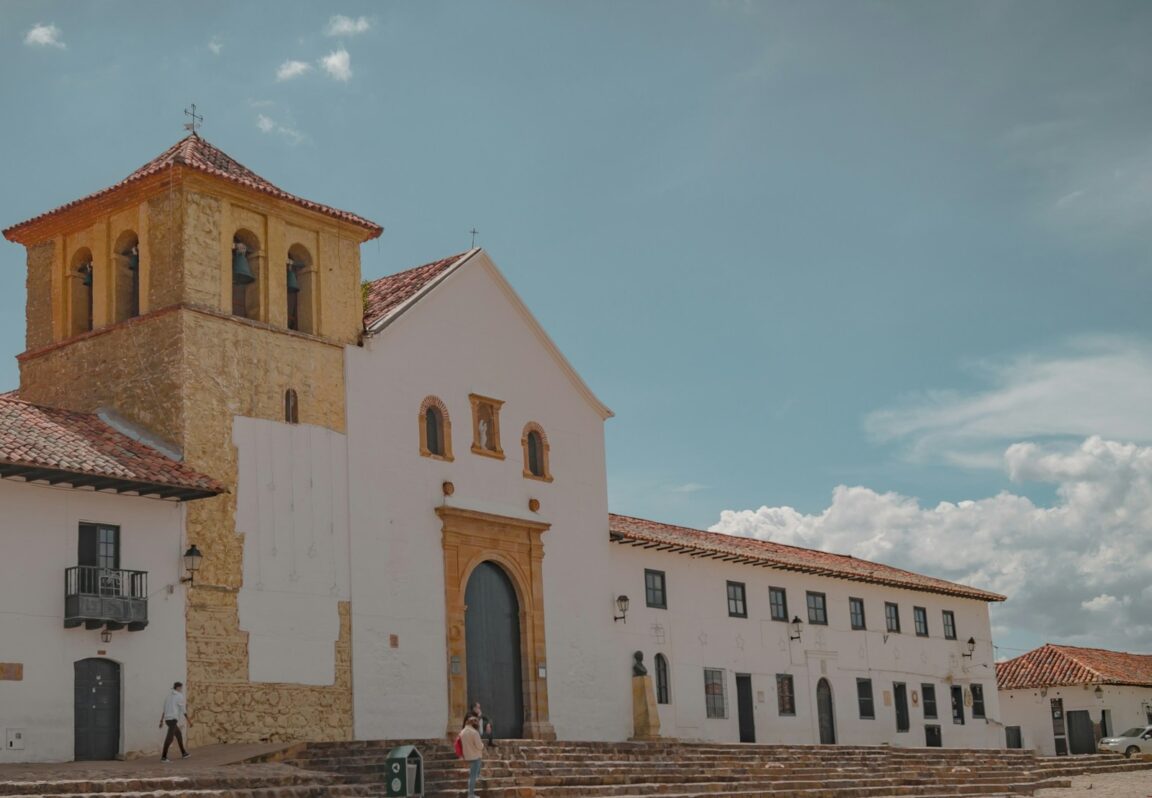
Mid-morning is for the edges. The parish church of Nuestra Senora del Rosario, begun in the early 1600s on the plaza’s north side, is the building in our featured image, white and plain outside with a single stone tower, and worth stepping into for its cool, dark interior and colonial religious art when it is open. The Casa Museo Luis Alberto Acuna, across the square, fills a large colonial house with the work of one of Colombia’s best known muralists and gives a sense of how grand these plaza houses were inside. The Casa del Primer Congreso recalls the town’s second moment in national history, when the First Congress of the United Provinces of New Granada met here in 1812. None of these visits is long. Their value is cumulative: an hour spent on the edges turns the open space in the middle from a backdrop into a document.
What should you do when the plaza gets hot at midday?
At 2,149 metres the sun is strong even when the air is cool, and the cobbles offer no shade. Local rhythm answers the problem: eat lunch under an arcade, then leave the square for the afternoon circuit that the town’s own geography suggests. West of town, the El Fosil museum is built around the fossilised skeleton of a kronosaurus, a giant marine reptile found by local farmers in the 1970s and left in place where it was discovered, a reminder that this dry valley was once a Cretaceous sea. The nearby paleontology research centre and the Paleontological Museum in town fill in that story. In the other direction, the Pozos Azules are a set of vivid blue-green mineral pools in the semi-desert scrub, reached by a short walk or a taxi ride, best in afternoon light. The Casa Terracota, a house sculpted entirely from fired clay, divides opinion and delights most visitors who make the short trip out.
All of these are half-day pieces, and all of them return you to the same place. That is the structure of a Villa de Leyva day and the reason this guide is built around one sight: everything else in town is a satellite. Visitors combining Villa de Leyva with Colombia’s Caribbean coast can plan the connection with our 2 days in Cartagena itinerary, and those heading into coffee country next will find the same slow-town rhythm in our Salento and Cocora Valley guide.
How does the plaza change in the evening and on weekends?
Return before sunset. Late afternoon, roughly 4:00 to 6:00 p.m., brings the best light of the day and the town’s social hour, when families cross the square, kite sellers and snack carts appear, and the cafes under the arcades fill. After dark the plaza is lit warmly, restaurants around it serve long dinners, and on clear nights the high, dry air makes it a fine place simply to stand and look up. Weekends transform the scale of everything: Villa de Leyva is a favourite escape from Bogota, a Saturday market operates a few blocks from the plaza, hotels fill, and the square carries crowds, festivals and, on event weekends, everything from kite flying in August to December light celebrations. Neither version is better. The weekday plaza is the monument; the weekend plaza is the living town it was built for. If your dates are flexible, arrive on a Thursday or Friday, take the quiet version first, and let the weekend build around you.
What does a plaza-focused trip cost, and where should you stay?
The plaza itself costs nothing, and the town’s main museums and satellite sights charge small entry fees that are best confirmed on the day, as prices in pesos change and are not consistently published online. The real costs are the bus or car journey from Bogota or Tunja, and lodging. Stay within a few blocks of the Plaza Mayor if you can: the dawn and evening hours, when the square is at its best, are exactly the hours day-trippers miss, and a hotel on a cobbled side street puts both within a short walk. Rates rise sharply on Colombian holiday weekends, of which there are many, so book ahead for any long weekend. Altitude is the other practical factor. At 2,149 metres, days are warm in the sun and nights are cold, and first-time visitors arriving from sea level should take the first afternoon gently, drink water, and save the Pozos Azules walk for day two. The cobbles themselves are a final honest warning: they are beautiful, historic and genuinely hard on ankles and wheels. Flat, sturdy shoes are not a suggestion in Villa de Leyva. They are the admission price the plaza still charges.
Frequently asked questions
How big is the Plaza Mayor in Villa de Leyva?
About 14,000 square metres, roughly 120 metres on each side. It is the largest plaza in Colombia and is believed to be the largest entirely cobbled square in South America.
Does it cost anything to visit the plaza?
No. The plaza is a public square, free and open at all hours. Small fees apply at the house museums on its edges and at satellite sights such as El Fosil and the Pozos Azules, and those are best confirmed locally on the day.
When is the best time of day to see it?
Early morning, between about 6:00 and 8:00 a.m., for the empty square and the best photography light, and again in the late afternoon and evening, when the town gathers there. Midday is best spent at the fossil sites and pools outside the centre.
How many nights does Villa de Leyva need?
Two nights is the sweet spot. It allows one full plaza day with the afternoon satellite circuit, a market morning if you stay over a weekend, and unhurried evenings on the square, without the trip feeling rushed from Bogota.
Is Villa de Leyva suitable for visitors with limited mobility?
Partly. The plaza is flat and step-free, but its historic cobblestones are large and uneven, and many side streets share the same surface. Wheelchair users can cross the plaza with care and assistance; sturdy footwear and a cautious pace are essential for everyone.
Sources checked November 17, 2026: Villa de Leyva municipal site (villadeleyva-boyaca.gov.co) for founding and National Monument dates, and Colombia heritage and town sources for plaza dimensions and sights. Featured image: the parish church on the Plaza Mayor, Villa de Leyva, via Unsplash.