 Lucas Meyer
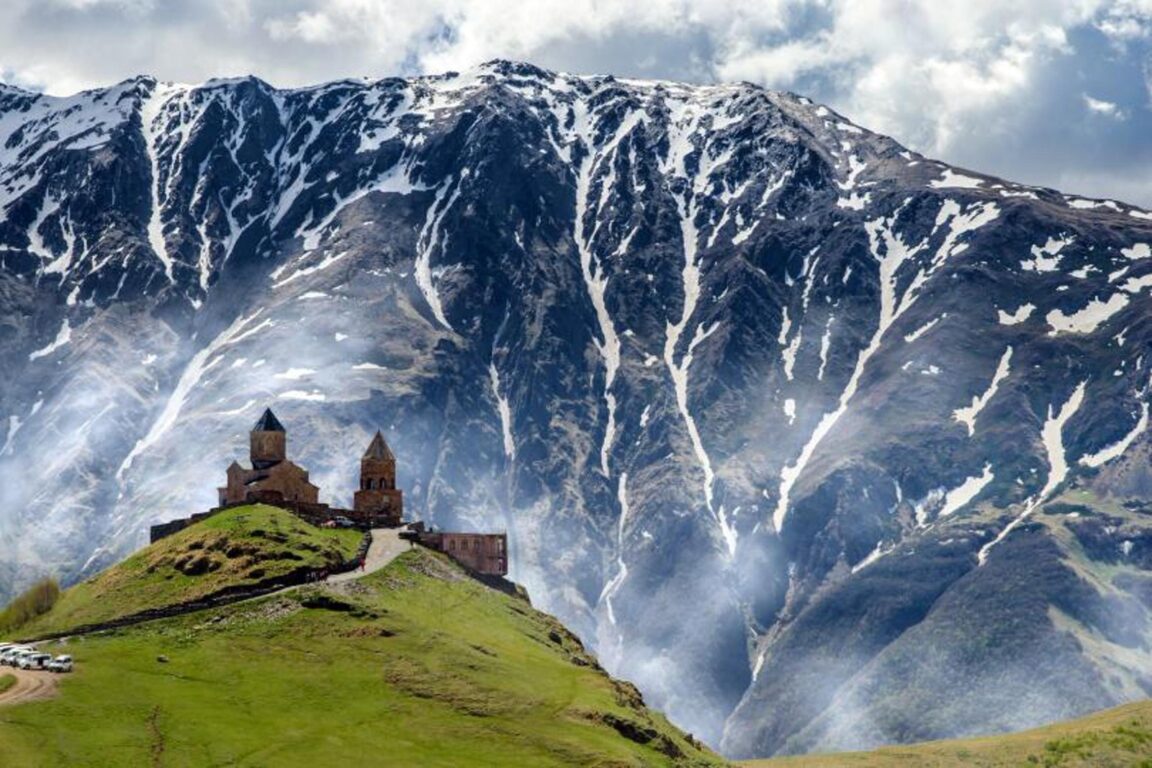
Stepantsminda in winter is a single road decision followed by a single climb. The road is the Georgian Military Highway from Tbilisi, about 152 kilometres and roughly three to three and a half hours, whose Gudauri to Kobi section crosses the Jvari Pass at 2,379 metres and closes from time to time between December and April after heavy snow or when avalanche risk is high. The climb is the walk, or the shared 4×4 ride, from the village at about 1,740 metres up to Gergeti Trinity Church at 2,170 metres, a 14th century stone church standing alone under Mount Kazbek at 5,054 metres. Go for at least two nights, check the Roads Department announcements on the morning of travel, carry boots with grip and ice grips for the church path, and accept the trade the season offers: the higher summer trails are closed, the terraces and viewpoints are quiet, and on a clear morning the church under snow, with Kazbek behind it, is the finest winter view in Georgia. Entry to the church is free. The costs that matter are transport, and they are set out below.
Quick Facts
- Where: Stepantsminda, also called Kazbegi, Mtskheta-Mtianeti region, northern Georgia, about 10 kilometres from the Russian border
- The road: Georgian Military Highway, Tbilisi to Stepantsminda about 152 kilometres, roughly 3 to 3.5 hours in normal conditions
- The closure risk: The Gudauri to Kobi section over the Jvari Pass, 2,379 metres, closes at times from December to April for snow and avalanche risk; closures are announced on the day by the Roads Department of Georgia
- Winter tyre law: From 1 December to 1 March, winter tyres are legally required on named mountain sections, including the Kazbegi road from Mleta to Kobi
- The church: Gergeti Trinity Church, 14th century, at 2,170 metres, about 400 metres above the village; entry is free and it remains a working church
- The mountain: Mount Kazbek, 5,054 metres, a dormant stratovolcano directly west of the town
- Getting up: Walk of about 3 kilometres uphill, roughly 1 to 1.5 hours, on snow and ice in winter, or a shared 4×4 from the main square, reported at about 25 GEL per person or 70 to 100 GEL per vehicle in 2026 guides
- From Tbilisi: Marshrutka minibuses from Didube station roughly hourly in the day, reported at about 15 to 20 GEL, subject to road conditions
- Winter temperatures: Long term averages for Stepantsminda put winter days near freezing and nights well below, around minus 8 degrees Celsius in the coldest weeks
- Prices checked: 16 November 2026. Fares in Kazbegi are negotiated locally and change with conditions, so confirm every figure in the village on the day
When is Stepantsminda worth visiting in winter?
Winter, December to February with snow often lasting into March and April on the pass, is the season of the photograph and the empty terrace. Summer brings the crowds, the day trip buses from Tbilisi and the full trail network. Winter removes the trails above the village, closes Juta and Truso as practical excursions in most conditions, and leaves the essentials standing: the village under snow, the Military Highway stops at Ananuri and Gudauri on the way up, and Gergeti Trinity Church above it all. Visitor numbers fall sharply, guesthouse terraces that queue in August stand empty, and a clear dawn, when Kazbek is most often visible before cloud builds, can be watched in near silence.
The honest limits matter as much. Serious trekking above the village is not a winter activity without winter mountaineering skills and equipment. The church path ices over. The pass can close on the morning of a planned departure and strand a tight itinerary, which is why this guide builds the trip around two nights minimum and a flexible final day. Travellers who need guaranteed hiking should come from June to September. Travellers who want the Caucasus in snow, and can absorb one weather day, get the better bargain in winter.
How does the Georgian Military Highway work in winter?
The highway is officially the Mtskheta to Stepantsminda to Larsi road, and it is kept open all year because it is Georgia’s only open land route to Russia at Upper Lars. Ploughs work it, trucks use it, and most winter days it runs. The exception is the high section between Gudauri and Kobi over the Jvari Pass. Georgia winter reporting records closures of that section on roughly 10 to 17 days a winter in recent seasons, announced on the day, sometimes for hours and sometimes longer, with the section below Gudauri staying open when the pass is shut. In the closure of 13 January 2026, for example, traffic was suspended between kilometres 93 and 107 on avalanche grounds.
The practical routine is simple. Check the Roads Department of Georgia announcements at georoad.ge on the morning of travel, in both directions, and again before leaving Stepantsminda for the return. Travel in daylight. If self driving, winter tyres are the law on the Mleta to Kobi section from 1 December to 1 March, and chains may be needed in serious conditions. A new Kvesheti to Kobi road with long tunnels will one day bypass the pass, but no opening date had been confirmed by autumn 2026, so winter planning still runs on the old alignment. The stops that make the drive a sightseeing day still work in winter: Ananuri fortress on the Zhinvali reservoir, the Gudauri ski area, and the Friendship Monument above the pass, weather permitting at each.
For wider Georgia planning, the Always Packed guide to Tbilisi, Georgia covers the capital base this trip starts from, and the winter packing logic in what to pack for Iceland in winter transfers well to Kazbegi: layers, waterproof shell, and footwear chosen for ice rather than distance.
How do you get up to Gergeti Trinity Church in the snow?
There are two ways up, and winter changes the balance between them. On foot, the path leaves through Gergeti village, climbs through pine and then open slope for about 3 kilometres and 400 metres of ascent, and takes roughly one to one and a half hours in summer conditions. In winter the same path is a snow and ice walk: boots with real grip are the minimum, ice grips or microspikes turn it from a slide into a walk, and poles help on the descent. Start in the morning, when the surface is firmest and Kazbek is most likely to be clear.
By vehicle, shared 4x4s wait on the main square and run the switchback road, sealed in 2018 but a genuine 4×4 proposition on snow, in about 10 to 15 minutes. Recent guides report about 25 GEL per person or 70 to 100 GEL for the whole vehicle. In deep conditions the track is sometimes impassable even to them, and the walk becomes the only route. A common winter pattern is to ride up and walk down in daylight, which halves the exposure if the weather turns. At the top, remember that Gergeti is a working 14th century church, not a viewpoint with a roof: dress modestly, cover shoulders and knees, women may need a head covering, keep voices down, and do not photograph services or the interior.
What does a winter day in Stepantsminda look like?
Breakfast in the village, then the church climb in the clear morning window, aiming to be on the ridge while Kazbek is still visible. Lunch back in the village, where the cafes and guesthouse dining rooms around the main square and the Kazbegi terraces serve khinkali and hot soups through the season. The afternoon belongs to the valley floor: the walk toward the Tergi river, the village lanes, and the small Stepantsminda Historical Museum in the writer Aleksandre Kazbegi’s house for a short indoor hour. If the pass forecast threatens the departure day, use the afternoon to decide, with the guesthouse, whether to leave a day early or sit out a closure in the village rather than at the roadside. Evenings are early and quiet, which is the point: dinner, a wood stove where the guesthouse has one, and a check of the sky for the next morning.
How long should you stay, and what does it cost?
Two nights is the working minimum and three is better. One night gambles the entire trip on a single morning of weather and a single day of pass conditions. Two nights gives two dawn chances at the Kazbek view and a buffer day if the road closes. The cost structure is modest by mountain Europe standards: the church is free, the walk is free, and the paid items are the marshrutka or transfer from Tbilisi at roughly 15 to 20 GEL by minibus in recent reporting, the optional 4×4 at about 25 GEL per person, and guesthouse accommodation and meals, which vary too much by property to price honestly here. Carry cash in lari from Tbilisi: the village has ATMs, but they can be empty, and card payment is not universal in winter.
One more cost is time. Budget the Tbilisi drive at three to three and a half hours in good conditions and treat anything faster as a bonus. In snow, with pass checks and slow truck traffic, allow substantially more, and never schedule a flight out of Tbilisi on the same day as the drive down from Stepantsminda in winter.
Frequently Asked Questions
Is the road to Stepantsminda open in winter?
Most winter days, yes. The Georgian Military Highway is maintained all year, but its Gudauri to Kobi section over the Jvari Pass, at 2,379 metres, closes from time to time between December and April after heavy snow or when avalanche risk is high. Closures are announced on the day by the Roads Department of Georgia, so check georoad.ge on the morning of travel.
Can you hike to Gergeti Trinity Church in winter?
Yes, with the right footwear. The path from the village is about 3 kilometres uphill and roughly 400 metres of ascent, and in winter it is snow and ice underfoot. Boots with grip are essential and ice grips are strongly recommended. Shared 4x4s from the main square are the alternative, at about 25 GEL per person in recent guides, though the track itself can become impassable in deep snow.
How much does Gergeti Trinity Church cost to enter?
Entry is free. It is a working 14th century church at 2,170 metres. The costs of the visit are getting there: your transport from Tbilisi and, if you choose it, the shared 4×4 up from Stepantsminda.
How cold is Stepantsminda in winter?
Cold. The village sits at about 1,740 metres and long term winter averages put daytime temperatures near freezing and nights around minus 8 degrees Celsius in the coldest weeks, with wind on the church ridge making it feel colder. The church itself is 400 metres higher. Dress for a mountain winter, not a city one.
How many nights does a winter trip need?
Two at minimum, three ideally. Winter adds two uncertainties, pass closures and cloud over Mount Kazbek, and a single night leaves no second chance at either. Extra nights also move the visit from a day trip rhythm to the quiet mornings and evenings that justify coming in this season.
Are winter tyres required for the drive?
Yes, in law. From 1 December to 1 March, named mountain road sections in Georgia, including the Kazbegi road from Mleta to Kobi over the Jvari Pass, may only be driven on winter tyres. Rental agreements and police checks enforce it in season.
Last updated and prices checked: 16 November 2026. Sources consulted the same day: Roads Department of Georgia closure reporting and Georgia winter road guides checked in November 2026 (Jvari Pass closure pattern, 1 December to 1 March winter tyre rule), Stepantsminda and Kazbegi guides updated in 2026 for church altitude, 4×4 and marshrutka fares, and Mount Kazbek elevation references.