 Lucas Meyer
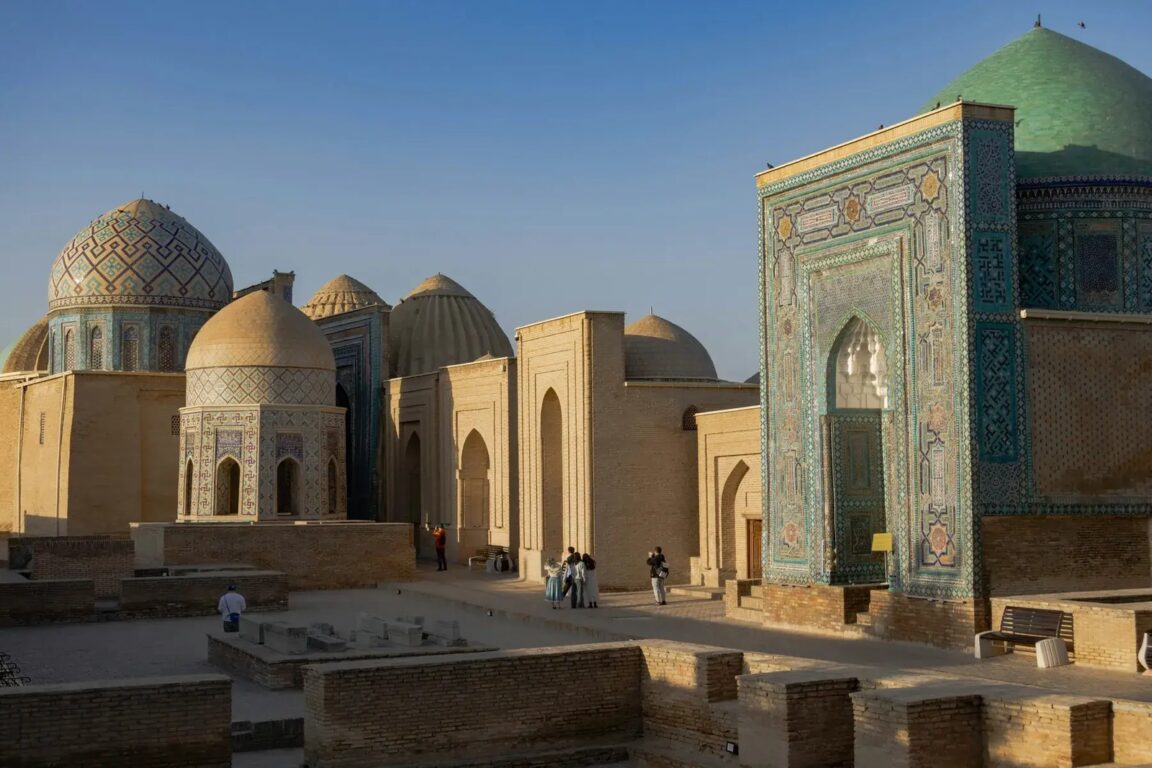
Shakhi Zinda is done properly in the first hour of the day, on foot, from the bottom of the stairs to the shrine at the top, before the tour groups reach the lane around 10 a.m. The necropolis in the north east of Samarkand is a narrow, climbing avenue of more than twenty buildings formed over eight centuries, from the 11th to the 19th, with its great age of building in the Timurid 14th and 15th centuries. Foreign visitors paid about 80,000 Uzbek som in 2026 reporting, the complex opens from about 7 a.m. in several current guides with ticketed hours commonly given as 9 a.m. to 7 p.m., and the visit takes one to one and a half hours done slowly. Read the tilework in sequence as you climb, lower group to middle group to upper group, give the shrine of Qusam ibn Abbas the quiet it asks for at the top, then walk five minutes to the Siab, or Siyob, Bazaar by the Bibi Khanym mosque for bread and tea. That pairing, necropolis first and bazaar second, is the whole plan, and this guide explains the timing, the tickets and the tilework order that make it work.
Quick Facts
- Where: Shakhi Zinda necropolis, north eastern Samarkand, Uzbekistan, on the slope below the ancient Afrasiab settlement, near the Bibi Khanym mosque
- The name: Shah-i-Zinda means the Living King, from the legend of Qusam ibn Abbas, a cousin of the Prophet Muhammad, said to be buried here
- The ensemble: More than twenty buildings in three groups, lower, middle and upper, linked by domed passages called chartak, formed from the 11th to the 19th century
- The great period: Most surviving mausoleums date to the 14th and 15th centuries, built for Timur’s family, nobles and clergy
- The entrance: The southern portal, or darvazakhana, built in 1434 to 1435 under Ulugh Beg
- Ticket: About 80,000 Uzbek som for foreign adults in 2026 reporting, bought at the entrance; there is no combined Samarkand ticket, each monument charges separately
- Hours: Guides checked in 2026 give opening from about 7 a.m. with typical ticketed hours of 9 a.m. to 7 p.m. and longer summer evenings; confirm closing at the gate on the day
- Time needed: One to one and a half hours for the lane, the shrine and the view back over the cemetery
- Best time: At opening, for morning light on the tiles and an empty lane; groups arrive from about 10 a.m.
- Dress: This is an active pilgrimage site. Modest clothing is required, shoulders and knees covered, and women should carry a head covering for the shrine area
- Prices checked: 16 November 2026. Samarkand fees rose sharply through 2025 and 2026 and no official online tariff is published for this site, so confirm at the ticket office
What is Shakhi Zinda, and why does the sequence matter?
The complex grew around a grave. Tradition holds that Qusam ibn Abbas, a cousin of the Prophet Muhammad who came to Samarkand in the 7th century, is buried at the top of the hill, and the legend that he did not die but lives on gave the place its name: the Living King. A sanctuary stood here under the Karakhanids by the 11th century, and after Timur made Samarkand his capital, his family and court built their mausoleums as close to the shrine as ground allowed. The result is not a planned monument but an accumulation: tomb added to tomb along one climbing lane across the 14th and 15th centuries, each patron and each workshop trying to outdo the last in glazed tile.
That is why the order of the visit matters. Walked bottom to top, the lane reads as a development chart of Timurid tilework in a single hour: carved terracotta and simpler glazed brick in the earlier work, then the full polychrome mosaic, majolica and calligraphic bands of the mature Timurid style, in turquoise, cobalt, white and touches of yellow and green. ICOMOS assessors have described the ensemble as holding fine examples of polychrome glazed tiles and tile mosaic representing centuries of continuous development, with no equivalent elsewhere in the region. Visitors who start at the top, or who treat the lane as a photo corridor and rush it, miss the one thing Shakhi Zinda teaches better than any museum: how a decorative art changed, decade by decade, on facing walls.
How do tickets and timing actually work?
There is no Samarkand pass. Each major monument sells its own ticket, and Shakhi Zinda’s is bought at the entrance at the foot of the complex, in som, with cash the reliable option. Foreign adult prices reported through 2026 cluster at about 80,000 som, up steeply from 15,000 som in spring 2025 and about 50,000 som later that year, which is exactly why no figure in any guide, including this one, should be treated as fixed. Budget for the reported figure, carry small notes, and expect the total for Samarkand’s big five sights, Registan, Gur-e-Amir, Shakhi Zinda, Bibi Khanym and the observatory, to come to roughly 400,000 som per person at 2026 prices.
Timing is the real ticket. Current Samarkand guides agree on the shape of the day: the complex is accessible from early morning, with several sources giving a 7 a.m. start and ticketed hours commonly listed as 9 a.m. to 7 p.m., longer in summer. Tour groups reach the lane from about 10 a.m., and the lane is narrow enough that a single group fills it. The visit that works is therefore the first one of the day: enter at opening, climb slowly while the lane is empty and the low sun is raking across the tilework, and be at the shrine before the first groups arrive. The second best window is the last hour before closing, when groups have gone and the light turns warm, though the tiles photograph best in the morning. A midday visit in peak season is the one to avoid: harsh light, a crowded lane, and no room to stand back from the portals.
The tilework sequence, group by group
Enter through Ulugh Beg’s portal of 1434 to 1435 and climb the entrance stairs, the steps local tradition asks visitors to count on the way up and again on the way down. The lower group, at the foot of the lane, sets the baseline: smaller mausoleums and the chartak passages that link the levels. The middle group holds the heart of the Timurid building campaign, including the mausoleums of Timur’s female relatives, among them the Shadi Mulk Aka mausoleum of 1372, built for Timur’s niece and often cited as a peak of 14th century tile mosaic, and the Shirin Bika Aka mausoleum for his sister, facing it across the lane. Read these two against each other: the portals, the dome drums, the inscription bands in Kufic and Thuluth script, and the muqarnas, the honeycomb vaulting inside the arches, are a matched lesson in what Samarkand workshops could do at their best.
The upper group closes the lane with three mausoleums facing one another, including the Khodja Akhmad mausoleum of the 1340s, among the earliest Timurid work here, and then the shrine complex of Qusam ibn Abbas itself: a group of rooms of the 14th and 15th centuries around the tomb, with a carved wooden door dated 1404 to 1405, tile revetment, painted ceilings and a multi tiered tiled cenotaph of the 1370s. This is a place of active pilgrimage. Pilgrims pray here, and visitors should move quietly, dress modestly, keep photography discreet and follow any instruction from attendants. From the top, look back down the lane and across the cemetery toward the city: the view explains the site’s geography, a holy hill on the edge of ancient Afrasiab, better than any plan.
How does the Siab Bazaar pairing work?
Shakhi Zinda sits a short walk from the Bibi Khanym mosque, and beside the mosque stands the Siab, or Siyob, Bazaar, Samarkand’s main market. The pairing works because the two visits ask for opposite energies and reward opposite hours. The necropolis wants the first, quietest hour. The bazaar wants the morning in full swing: bread stalls selling the round, stamped Samarkand non, dried apricots and raisins, almonds, halva and, in autumn, pomegranates, with tastings offered as a matter of course. Do the necropolis at opening, walk down past Bibi Khanym, whose ticket is separate, and be in the bazaar by mid morning with the monument crowds still behind you. A pot of green tea at a bazaar tea house is the natural full stop. Travellers continuing a Samarkand day from here usually go on to the Registan in the afternoon or return to it after dark for the floodlit facades.
For more Silk Road monument planning, the Always Packed guide to visiting Angkor Wat makes the same case for an opening time arrival at a great religious complex, and visiting the Alhambra in Granada covers another tiled palace city where tickets, timing and sequence decide the quality of the visit.
What should you know about restoration and authenticity?
Honest guides note the argument. A government restoration campaign in 2004 to 2005, under a 2004 cabinet decree, cleared accumulated soil, exposed earlier foundations and renewed a good deal of tilework across the ensemble. ICOMOS monitoring at the time recorded both the necessity of the work, after long neglect, and the change it made to the site’s appearance. The practical consequence for a visitor is simple: some of the brightest mosaic you see is careful modern renewal on genuinely old structures, and some portals retain largely original Timurid fabric. The ensemble’s value, as part of the UNESCO listed Samarkand, Crossroad of Cultures site inscribed in 2001, rests on the whole: the lane, the sequence and the shrine, not on any single tile. Knowing that in advance makes the visit better, not worse.
Frequently Asked Questions
How much does Shakhi Zinda cost to enter?
About 80,000 Uzbek som for foreign adults in 2026 reporting, bought at the entrance in cash. Prices rose steeply through 2025, from about 15,000 som in spring to about 50,000 som by summer and about 80,000 som in 2026 guides, and no official tariff is published online, so confirm at the ticket office on the day.
What are the opening hours?
Guides checked in 2026 give access from about 7 a.m., with typical ticketed hours of 9 a.m. to 7 p.m. and longer evenings in summer. Sources differ because the complex is both a ticketed monument and an active pilgrimage site. Arrive for the earliest entry you can and confirm the closing time at the gate.
When is the best time of day to visit?
At opening. Morning light rakes across the tilework, the lane is empty, and the shrine is quiet. Tour groups arrive from about 10 a.m. and the narrow lane fills quickly. The last hour before closing is the second best window.
How long does a visit take?
One to one and a half hours, climbed slowly from the entrance portal through the lower, middle and upper groups to the shrine of Qusam ibn Abbas, with time to look back over the cemetery from the top. Rushed group visits take half that and miss the tilework sequence that is the point of the place.
What should you wear?
Modest clothing: shoulders and knees covered, and women should carry a head covering for the shrine area. Shakhi Zinda is an active pilgrimage site as well as a monument, and attendants enforce respectful dress at the shrine.
What pairs well with Shakhi Zinda on the same morning?
The Bibi Khanym mosque next door, on a separate ticket, and the Siab Bazaar beside it, which is free. The classic order is necropolis at opening, mosque, then the bazaar by mid morning for Samarkand non bread, dried fruit and tea, before the Registan later in the day.
Last updated and prices checked: 16 November 2026. Sources consulted the same day: Samarkand guides and ticket reporting checked in September to November 2026 for the 80,000 som foreign adult price and hours pattern, UNESCO and ICOMOS material on the Samarkand listing and the Shakhi Zinda ensemble, and architectural histories of the complex for the 1434 to 1435 portal, the 1372 Shadi Mulk Aka mausoleum and the Qusam ibn Abbas shrine.